

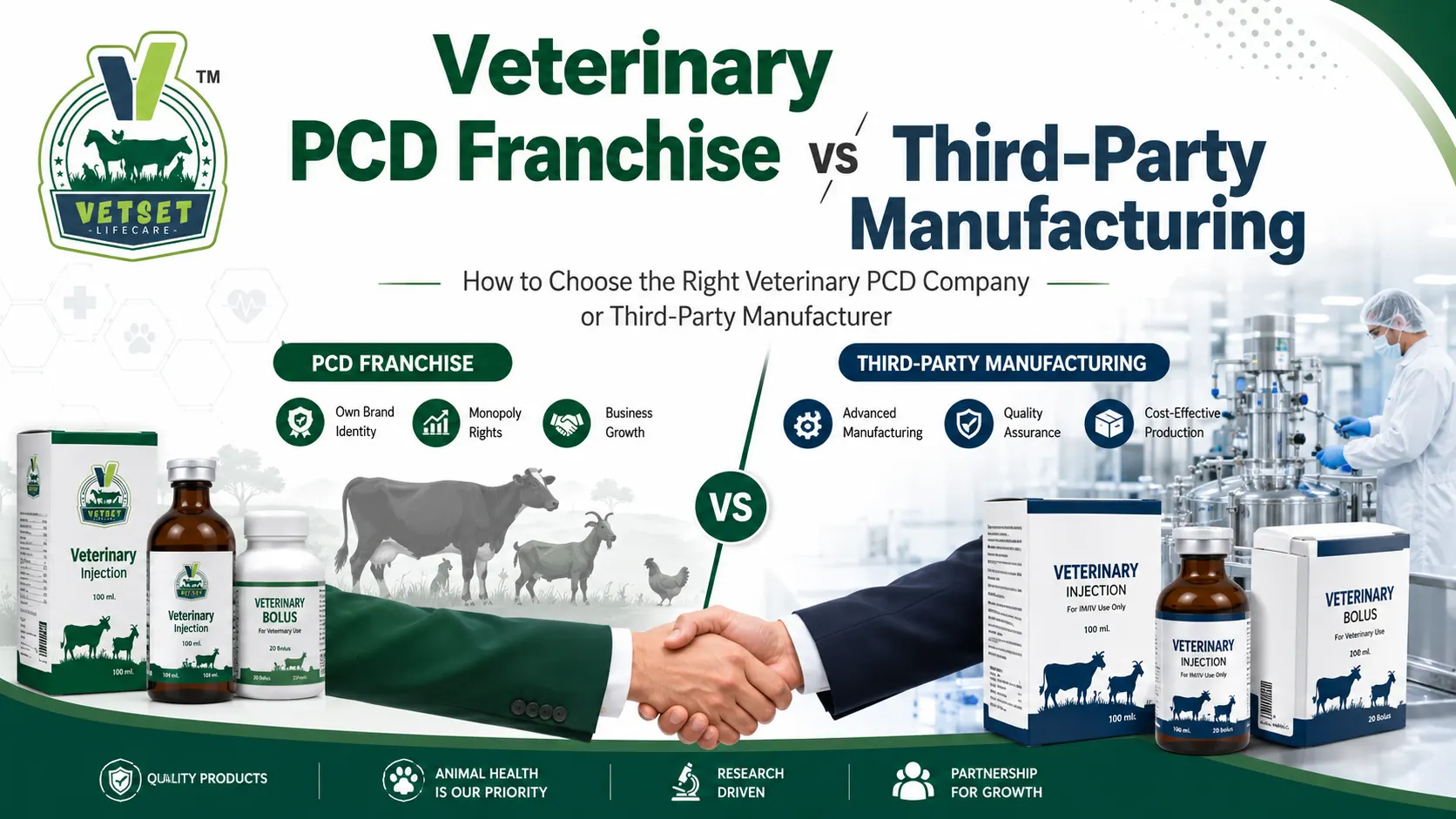
A veterinary PCD franchise gives you distribution and marketing rights to sell an established brand’s products in your territory — low investment, no manufacturing responsibility. Third-party veterinary medicine manufacturing means a certified manufacturer produces products under your own private label — more control over branding, suited for businesses that want to build an independent identity. Choose a PCD franchise if you want a low-risk entry with brand backing; choose third-party manufacturing if you want to own your brand and scale it independently. VetSet Lifecare, a WHO-GMP certified veterinary PCD company, offers both models under one roof.
Introduction
If you’re planning to enter India’s veterinary pharmaceutical business, you’ll quickly run into two common paths: a veterinary PCD pharma franchise or third-party veterinary medicine manufacturing. Both are proven, low-infrastructure ways to enter the animal healthcare market — but they work very differently, and picking the wrong one for your goals can cost you time and money.
This guide breaks down Veterinary PCD Franchise vs Third Party Manufacturing in detail — what each model means, how to choose the right veterinary PCD company or third-party manufacturer, whether a PCD pharma franchise is actually profitable, and how veterinary PCD franchises compare to other pharma franchises. We’ll also show current market stats and a clear comparison table using VetSet Lifecare, a WHO-GMP certified veterinary medicine company offering both models, as a reference point.
What Is a Veterinary PCD Pharma Franchise?
PCD stands for Propaganda Cum Distribution. In this model, a pharmaceutical company grants distribution and marketing rights to a franchise partner, who promotes and sells its veterinary products within a specific region under the company’s existing brand name.
Key characteristics:
- You sell an already-established brand’s products
- The manufacturer handles production, quality control, and R&D
- You focus purely on local marketing, sales, and distribution
- Often comes with monopoly/exclusive territory rights
- Low entry investment, minimal business risk
What Is Third-Party Veterinary Medicine Manufacturing?
Third-party manufacturing (also called contract manufacturing or private-label manufacturing) is when a certified manufacturer produces veterinary medicines under your own brand name and packaging, based on your specifications and formulation needs.
Key characteristics:
- You own the brand identity, not the manufacturer
- The manufacturer handles formulation, production, and compliance (WHO-GMP/ISO)
- You control pricing, packaging, and market positioning independently
- Typically requires a slightly higher investment and stronger marketing effort than PCD
- Ideal for businesses that already have a customer base or distribution network and want to build a long-term, independent brand
Key Differences Between Third-Party Manufacturing & PCD Pharma Franchise
| Factor | Veterinary PCD Franchise | Third-Party Manufacturing |
|---|---|---|
| Brand Ownership | Sell under the parent company’s brand | You own and build your own brand |
| Investment Level | Low (₹25,000–₹1,00,000 typical) | Moderate to high, depending on order volume |
| Territory Rights | Often exclusive/monopoly | Not applicable — you define your own market |
| Manufacturing Responsibility | None — fully handled by the company | None — handled by the manufacturer, but to your specifications |
| Marketing Support | Provided by the parent company | Managed independently by you |
| Business Control | Limited to sales & distribution | Full control over branding, pricing & positioning |
| Best Suited For | First-time entrepreneurs, distributors wanting a low-risk start | Established distributors/businesses wanting an independent brand |
| Scalability | Grows within assigned territory | Scales as wide as your marketing and distribution allow |
Is a PCD Pharma Franchise Profitable?
Yes — the veterinary PCD pharma franchise model is widely considered one of the most profitable low-investment business models in India’s pharmaceutical sector, for several reasons:
- No manufacturing cost or risk — you only pay for stock and earn trade margins (typically 20–40%)
- No royalty fees in genuine PCD models
- Exclusive/monopoly territory rights mean no internal brand competition
- Recurring demand — veterinary medicines are a repeat-purchase category tied to livestock health, poultry farming, and pet ownership
- Low break-even period — most partners recover initial investment within a few stock cycles
Profitability, however, depends heavily on which veterinary PCD company you partner with — certification, product range, and support quality directly affect how well your territory performs.
Market Stats: Why This Business Model Is Growing
| Metric | Data Point | Source |
|---|---|---|
| India veterinary medicine market size (2024) | USD 1.73 billion | Grand View Research |
| Projected market size by 2033 | USD 4.17 billion (10.2% CAGR) | Grand View Research |
| India veterinary pharmaceuticals market (2024) | USD 1,155.8 million, growing at 7.5% CAGR to 2033 | IMARC Group |
| India veterinary medicine manufacturing CAGR (2025–2034) | 8.80%, reaching ~USD 2.25 billion by 2034 | Market Research Future |
| India’s livestock population | Over 535–536 million animals — the largest in the world | Grand View Research / Govt data |
| Government livestock health investment | ₹3,880 crore approved under the Livestock Health and Disease Control Programme (2024–26) | Union Cabinet, March 2025 |
What this means for you: whether you choose a PCD franchise or third-party manufacturing, you’re entering a market with strong structural tailwinds — rising livestock numbers, growing pet ownership, and expanding government health investment.
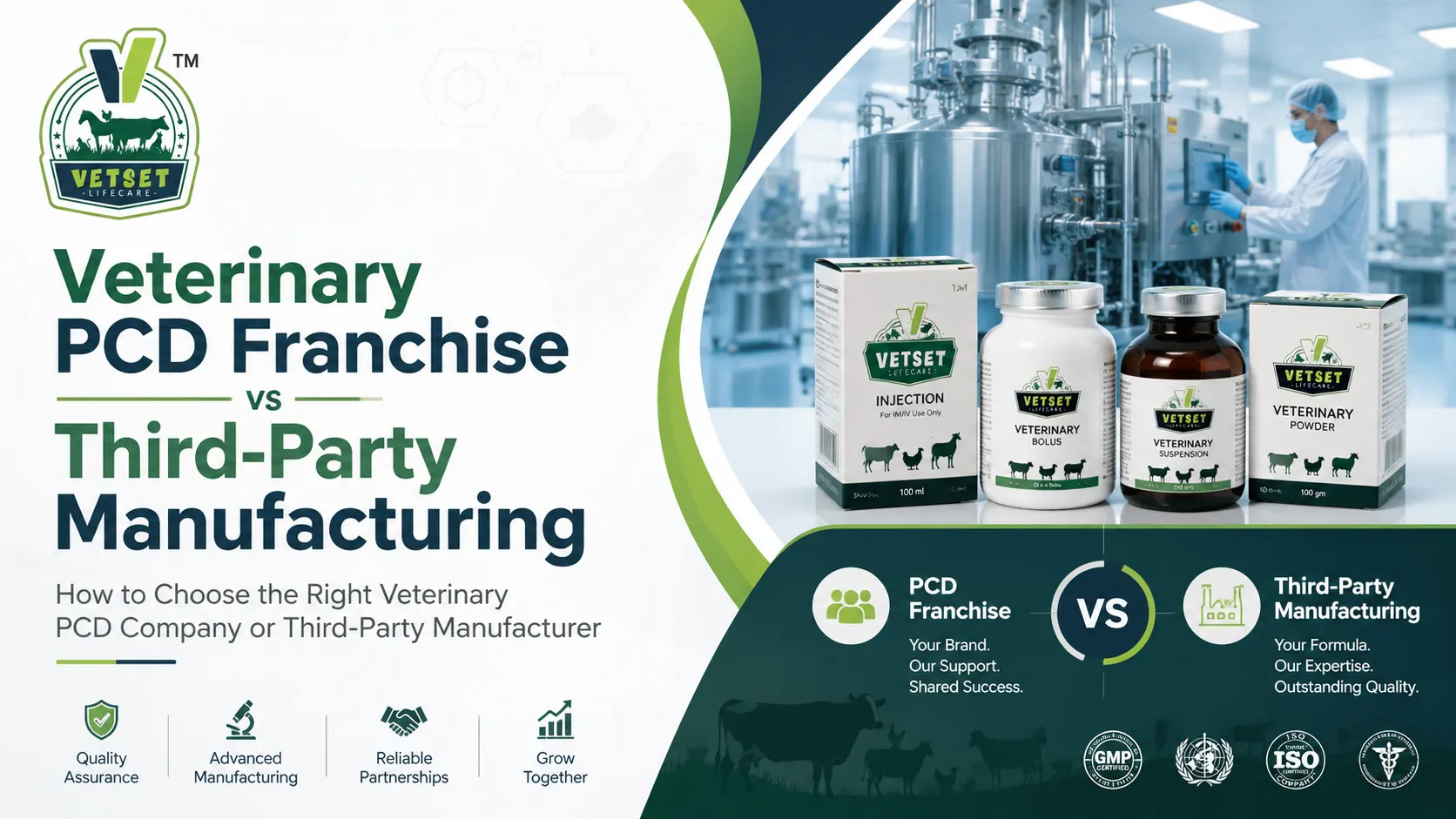
How to Choose the Right Veterinary PCD Company or Third-Party Manufacturer
- Verify WHO-GMP / ISO / cGMP certification — never take certification claims at face value; ask for documentation.
- Check the product range — tablets, capsules, injections, boluses, syrups, calcium, powders, and feed supplements indicate a mature manufacturer.
- Confirm manufacturing ownership — in-house facilities offer better consistency than companies that simply resell third-party stock.
- Evaluate support systems — marketing material, product training, and technical support matter more than most first-time partners expect.
- Understand territory and exclusivity terms — for PCD, confirm monopoly rights in writing before signing on.
- Review pricing transparency — for third-party manufacturing, get clear minimum order quantities (MOQs) and per-unit costing upfront.
Veterinary PCD Franchise vs. Other Pharma Franchises
Veterinary PCD franchises differ from general human-pharma PCD franchises in a few important ways:
| Aspect | Veterinary PCD Franchise | General/Human Pharma PCD Franchise |
|---|---|---|
| Customer Base | Veterinarians, farmers, poultry & dairy owners, pet owners | Doctors, hospitals, retail pharmacies |
| Market Competition | Comparatively less saturated | Highly saturated in most regions |
| Regulatory Complexity | Moderate — WHO-GMP/ISO standards | High — stricter drug-license and prescription regulations |
| Demand Driver | Livestock health, dairy & poultry farming, pet care | General human healthcare needs |
| Entry Investment | Generally lower | Varies widely, often higher due to competition |
| Growth Potential | High — 535M+ livestock population, rising pet ownership | Stable but highly competitive |
This makes the veterinary PCD pharma franchise an attractive entry point for entrepreneurs looking for a less-saturated, high-growth alternative to traditional human pharma franchises.
Company Comparison: Choosing the Right Partner
| Evaluation Criteria | Typical / Average Veterinary Companies | VetSet Lifecare |
|---|---|---|
| Certification | Claims made without documentation | WHO-GMP, ISO & GMP certified |
| Business Models Offered | Usually only one (PCD or manufacturing) | Both PCD Franchise and Third-Party Manufacturing |
| Product Range | Limited to 1–2 categories | Tablets, capsules, injections, boluses, syrups, calcium, powders |
| Territory Rights | Loosely enforced | Exclusive/monopoly rights for franchise partners |
| Support | Minimal, business-hours only | 24/7 support, marketing materials & product training |
| Investment | Often has hidden costs | Low, transparent investment |
| Geographic Reach | Regional | Pan-India presence across multiple states |
Why Choose Us — VetSet Lifecare
- Two Business Models, One Trusted Partner: Choose a PCD franchise or third-party manufacturing — both under WHO-GMP certified standards.
- Certified Quality: GMP, WHO, and ISO-certified manufacturing processes across all products.
- Wide Product Range: Tablets, capsules, injections, boluses, syrups, calcium, powders, and feed supplements.
- Exclusive Monopoly Rights: No internal competition within your assigned territory.
- Low Business Risk, Low Investment: Accessible entry point for first-time entrepreneurs.
- Full Support System: Marketing materials, product training, and technical guidance included.
- 24/7 Customer Support: Continuous assistance for partners across India.
- Pan-India Presence: Active franchise and manufacturing partnerships across states including Rajasthan, Delhi, and West Bengal.
Frequently Asked Questions
Q1. What is the main difference between a veterinary PCD franchise and third-party manufacturing? A PCD franchise means selling an established company’s branded products in your territory. Third-party manufacturing means a certified manufacturer produces products under your own private-label brand.
Q2. Is a veterinary PCD pharma franchise profitable? Yes. With no manufacturing cost, exclusive territory rights, and 20–40% trade margins, it’s considered a low-risk, high-potential business model, especially in India’s fast-growing veterinary pharmaceutical market.
Q3. Which model requires more investment — PCD franchise or third-party manufacturing? PCD franchises generally require lower upfront investment since you’re only purchasing stock. Third-party manufacturing usually needs a larger investment due to bulk production and independent brand-building costs.
Q4. Can I switch from a PCD franchise to third-party manufacturing later? Yes. Many entrepreneurs start with a PCD franchise to understand the market, then transition to third-party manufacturing once they’re ready to build their own brand. Companies like VetSet Lifecare support both paths.
Q5. How is a veterinary PCD franchise different from other pharma franchises? Veterinary PCD franchises typically face less market saturation, lower entry investment, and strong demand driven by India’s large livestock and growing pet-care population, compared to general human-pharma franchises.
Q6. Does VetSet Lifecare offer both PCD franchise and third-party manufacturing? Yes. VetSet Lifecare is a WHO-GMP certified veterinary medicine company offering both a veterinary PCD franchise and third-party manufacturing services under one roof.
Conclusion: Which Model Should You Choose?
If you’re a first-time entrepreneur looking for a low-risk, low-investment entry into India’s veterinary pharmaceutical sector, a veterinary PCD pharma franchise is the practical starting point. If you already have distribution experience or capital and want to build your own independent brand, third-party veterinary medicine manufacturing offers more long-term control and scalability.
Either way, the partner you choose matters more than the model itself. VetSet Lifecare, a WHO-GMP certified veterinary PCD company, offers both models with exclusive territory rights, a wide product range, and 24/7 partner support.
Call: +91 7015507806 | Email: vetsetlifecare@gmail.com