

A batch of calcium boluses fails visual inspection at 2 a.m. Nobody knows why yet. The line supervisor stops production, the QC team pulls samples, and by morning roughly eleven hours of output is sitting in quarantine while someone works backwards through the batch record trying to find the moment things went wrong.
That used to be a normal Tuesday in veterinary pharma manufacturing.
It is becoming less normal. Not because problems stopped happening, but because a growing number of manufacturing plants now catch the drift in tablet weight or the vibration change in a compression machine hours before it turns into a rejected batch. The technology doing that catching is artificial intelligence, and it is quietly reshaping how animal medicines get made in India.
VetSet Lifecare is a WHO-GMP certified veterinary medicine manufacturing company based in Ambala, Haryana, producing injections, boluses, feed supplements and nutritional products for livestock, poultry and companion animals. This article looks at what AI in veterinary pharma actually does on a factory floor — the useful parts, the overhyped parts, and what it means for distributors, franchise partners and third-party clients buying from Indian manufacturers.
What This Article Covers
What AI in veterinary pharma manufacturing really means · Why manufacturers are adopting it · Six areas where AI is already working · Traditional vs smart manufacturing compared · What it means for buyers and partners · Honest limitations · FAQs
How Is AI Used in Veterinary Pharma Manufacturing?
AI in veterinary pharma manufacturing means using machine learning systems to monitor production data in real time, spot patterns a human would miss, and predict problems before they cause batch failures. It is applied mainly in quality control, equipment maintenance, batch documentation, and demand forecasting — not in inventing new drugs.
That last part matters, and it gets confused constantly.
Most headlines about AI in pharma are about drug discovery — algorithms designing new molecules. That is a different world, mostly human pharma, mostly enormous R&D budgets. What is happening inside veterinary manufacturing plants is more practical and, honestly, more immediately useful: making existing products more consistently, with fewer rejected batches and better traceability.
The numbers behind this shift are substantial. The global AI in pharma manufacturing market is projected to grow from around USD 1.64 billion in 2026 to USD 12.90 billion by 2034 — a compound annual growth rate of roughly 29% (Fortune Business Insights, 2026). Quality control and quality assurance make up the single largest slice of that spend, at about 21% of the market in 2026.
Why QC first? Because that is where the money leaks.
Why Are Veterinary Manufacturers Adopting AI?
Veterinary manufacturers are adopting AI to reduce batch rejections, cut equipment downtime, speed up quality release, and maintain consistent GMP documentation. The pressure comes from three directions at once: rising demand, tighter regulatory expectations, and thin margins on high-volume products.
India makes a lot of animal medicine. The country’s veterinary pharmaceuticals market was valued at roughly USD 1.16 billion in 2024 and is expected to reach around USD 2.22 billion by 2033, growing at about 7.5% a year, according to IMARC Group. India also holds the world’s largest bovine and buffalo population — over 300 million animals. Poultry is growing even faster.
So volume is climbing. But here is the squeeze: veterinary products are price-sensitive in a way human pharma often is not. A dairy farmer buying calcium boluses for a herd of eighty cattle is making a cost calculation every single time. A poultry integrator ordering in bulk is comparing three suppliers on rupees per dose.
You cannot solve that by charging more. You solve it by wasting less.
And waste, in pharma manufacturing, mostly means rejected batches, unplanned machine stoppages, and the labour hours that go into manual batch record review. Those are exactly the three things AI systems are reasonably good at reducing.
Six Areas Where AI Is Already Working in Veterinary Manufacturing
1. AI Quality Control in Veterinary Pharmaceuticals
Computer vision systems inspect tablets, boluses and filled vials at speeds no human inspector can match — checking for chips, cracks, colour variation, fill level, cap seating and label alignment. A trained vision model can flag a defect rate rising from 0.3% to 0.8% within minutes, long before a human sampling protocol would catch it.
For injections specifically, this matters enormously. Particulate contamination in an injectable is not a cosmetic issue. It is a safety issue, and under cGMP it is a batch-ending one.
2. Predictive Maintenance
Sensors on compression machines, mixers, autoclaves and filling lines feed vibration, temperature and motor-current data into a model that learns what normal sounds like. When a bearing starts to fail, the signature changes days before the machine actually stops.
The plant then schedules that repair for a planned shutdown instead of losing a shift to it. Simple idea. Genuinely large savings.
3. Batch Record Review and GMP Documentation
Anyone who has worked in a GMP facility knows the paperwork burden. Every batch generates a stack of records that a qualified person has to review and sign before release. AI-assisted review flags the deviations and out-of-range entries so the human reviewer spends time on the exceptions rather than reading every line.
Release times drop. Documentation quality goes up, because the system does not get tired at 6 p.m. on a Friday.
4. Formulation and Process Optimisation
Machine learning models trained on historical batch data can identify which process parameters — granulation time, compression force, drying temperature — actually correlate with the quality attributes you care about. Often the answer is not what the process engineers assumed.
For veterinary products with wide dosage ranges and varied delivery formats, this helps a lot. A bolus for a 400 kg buffalo and a supplement for broiler chickens are very different manufacturing problems.
5. Demand Forecasting and Supply Chain
Veterinary demand is seasonal in ways human pharma is not. Mastitis treatments spike in monsoon. Calcium demand follows calving cycles. Poultry medicine orders track flock cycles that vary by region.
Forecasting models that fold in weather data, livestock census figures and historical regional ordering patterns help a manufacturer stock raw materials properly — which means fewer stock-outs for distributors and fewer expiries sitting in a warehouse.
6. Traceability and Anti-Counterfeit Systems
Counterfeit veterinary medicine is a real and under-discussed problem in rural supply chains. Serialisation combined with AI-driven anomaly detection in distribution data can flag when product codes start appearing in places they should not.
Traditional vs Smart Veterinary Manufacturing: A Comparison
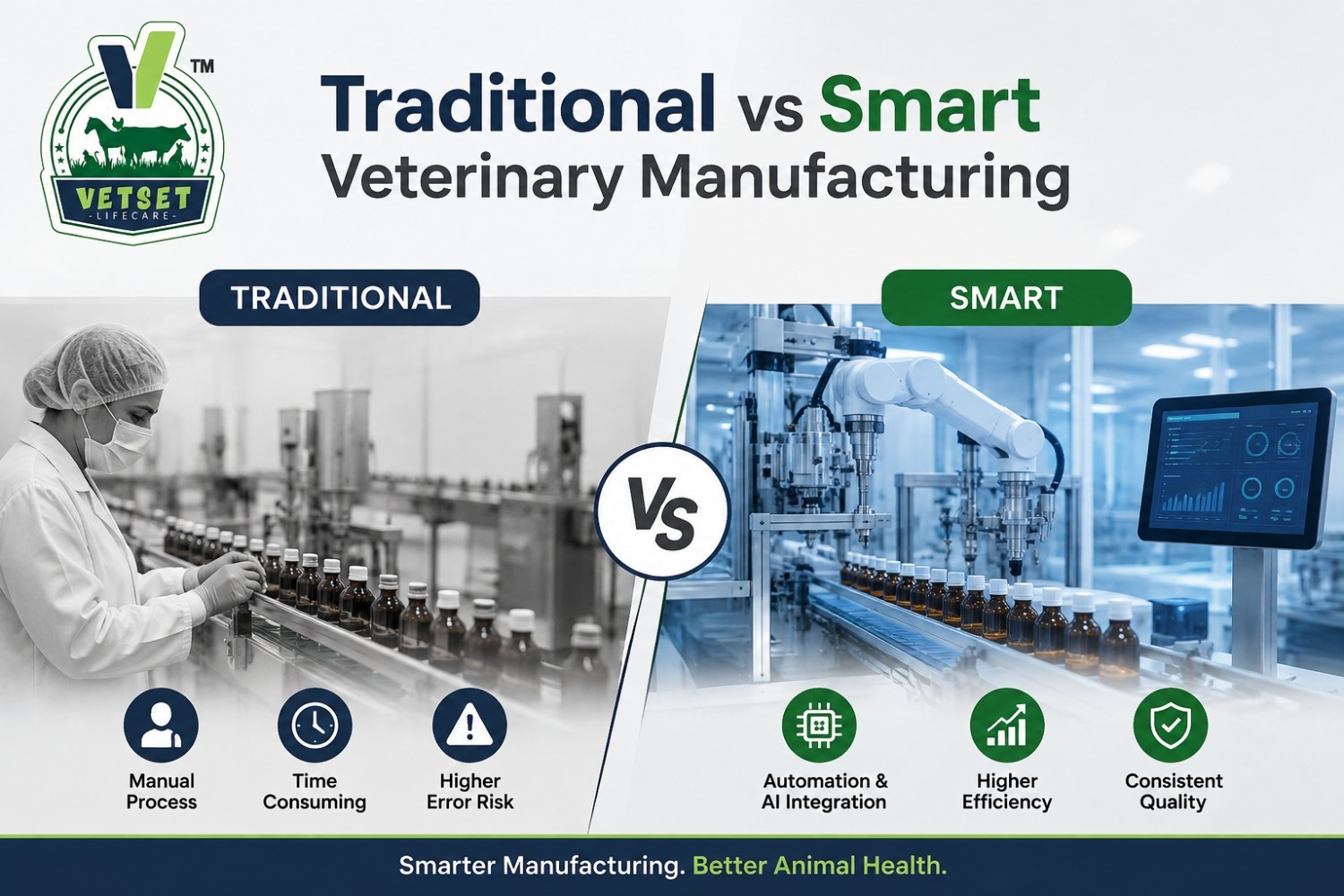
Here is a practical comparison of how the two approaches differ across the areas that actually affect cost and quality.
| Area | Traditional Manufacturing | AI-Enabled Smart Manufacturing |
|---|---|---|
| Quality inspection | Manual sampling, statistical batch checks | 100% in-line vision inspection, real-time defect flagging |
| Defect detection timing | After the batch, during QC release | During production, often within minutes |
| Equipment maintenance | Fixed schedule or breakdown-driven | Condition-based, predicted days in advance |
| Batch record review | Full manual review of every page | Exception-based review, deviations auto-flagged |
| Process changes | Trial and error, engineer experience | Data-driven parameter optimisation |
| Demand planning | Historical averages, sales team estimates | Multi-variable forecasting models |
| Typical batch rejection | Higher, discovered late | Lower, problems caught mid-process |
| Documentation for audit | Paper-heavy, retrieval takes time | Digital, searchable, timestamped |
Comparison reflects general industry patterns in pharmaceutical manufacturing. Actual results vary by plant, product type and level of digital maturity.
The Numbers Worth Knowing
A few figures that put the shift in context, drawn from published market research:
| Metric | Figure | Source |
|---|---|---|
| Global AI in pharma manufacturing market, 2026 | USD 1.64 billion | Fortune Business Insights |
| Projected market size by 2034 | USD 12.90 billion | Fortune Business Insights |
| CAGR, 2026–2034 | 29.45% | Fortune Business Insights |
| Share held by quality control / QA, 2026 | 21.1% | Fortune Business Insights |
| India veterinary pharmaceuticals market, 2024 | USD 1,155.8 million | IMARC Group |
| Projected India market by 2033 | USD 2,219.6 million | IMARC Group |
| India veterinary pharma CAGR, 2025–2033 | 7.5% | IMARC Group |
| India bovine + buffalo population, 2025 estimate | 307.5 million | USDA Foreign Agricultural Service |
Where This Fits: Industry 4.0 and GMP
The umbrella term for all of this is Industry 4.0 — connected machines, sensor data, automation and analytics working together rather than as separate systems. In pharmaceutical manufacturing it overlaps heavily with what regulators already ask for.
Good Manufacturing Practice does not require AI. But GMP does require process control, documented evidence, deviation investigation and data integrity — and digital systems make all four easier to demonstrate. India’s regulatory framework for veterinary medicines sits under the Drugs and Cosmetics Act and is administered through CDSCO, with Schedule M revisions pushing Indian manufacturers toward more rigorous documentation and quality systems.
The World Organisation for Animal Health (WOAH) also sets international standards for veterinary product quality and antimicrobial stewardship, which increasingly shapes what export buyers expect from Indian suppliers.
Put simply: the direction regulation is moving and the direction technology is moving happen to point the same way.
What Does This Mean If You Buy Veterinary Medicines?
If you are a distributor, PCD franchise partner, third-party client or a large farm buying in volume, AI adoption at your manufacturer’s plant affects you in four practical ways.
Batch-to-batch consistency improves. The bolus you get in November behaves like the one you got in June. For a distributor, this is the difference between repeat orders and complaints.
Supply reliability gets better. Predictive maintenance means fewer surprise production halts, which means fewer of those calls where a manufacturer explains that your order will be two weeks late.
Documentation is faster. If you are exporting or supplying to an institutional buyer that wants certificates of analysis, batch records and stability data, a digitally documented plant produces those in hours rather than days.
And traceability improves — which matters if a quality query ever comes back to you from a customer and you need to trace a specific batch.
None of this is a reason to pick a supplier by itself. Certification, product range, pricing and supply consistency still matter more. But it is a reasonable question to ask a manufacturer: how do you actually monitor quality during production, not just after it?
The Honest Limitations
Worth being straight about this, because the marketing around AI in animal healthcare tends to oversell.
AI systems need data, and a lot of Indian veterinary manufacturing units simply do not have years of clean digital batch history to train on. Starting from paper records means starting slowly.
The capital cost is real. Vision inspection systems, sensor retrofits and the software layer on top are not small investments for a mid-sized plant. The payback works at volume; it works less well for small batch, high-variety production.
There is also a skills gap. A model that flags anomalies is only useful if someone on the floor understands what to do with the flag. Training matters as much as the technology.
And AI does not replace GMP fundamentals. Clean rooms, validated processes, qualified personnel, proper raw material sourcing — these remain the foundation. A smart sensor on a badly designed process just tells you faster that the process is bad.
Which is arguably still useful. But it is not magic.
What the Next Five Years Probably Look Like
Expect the gap between digitally mature and paper-based veterinary manufacturers to widen. Larger plants and export-oriented units will move first, because their buyers demand the documentation and their volumes justify the spend.
Vision-based quality inspection will likely become standard for injectables before it does for boluses and powders, simply because the safety stakes are higher and the ROI is clearer.
Regulatory expectations will keep tightening. Schedule M revisions and rising export compliance requirements both push toward better data systems, whether or not a plant calls it AI.
And genuinely useful applications will keep being unglamorous. Not robots. Sensors, dashboards, and models that quietly tell a supervisor that machine number four is behaving oddly.
How VetSet Lifecare Approaches Veterinary Manufacturing
VetSet Lifecare is a WHO-GMP certified veterinary medicine manufacturer in Ambala, Haryana, producing injections, boluses, feed supplements, oral liquids, powders, calcium supplements, mineral mixtures and liver tonics for cattle, buffalo, poultry and companion animals. The company works with distributors, wholesalers, veterinary PCD franchise partners and third-party manufacturing clients across India.
Manufacturing runs under strict cGMP standards, with quality control checks at raw material intake, in-process stages and finished product release. Every batch carries full documentation, and certificates of analysis are provided with supply.
For businesses evaluating a veterinary manufacturing company, the practical questions are usually the same: is the plant certified, is the product range wide enough, is supply reliable, and does the documentation hold up. You can review the full product list or see formulations in the products gallery.
VetSet Lifecare holds a 5.0 rating across 12 verified Google reviews from distributors and franchise partners.
Talk to the team: +91 7015507806 | vetsetlifecare@gmail.com | NH 1, Nanhera Road, Kuldeep Nagar, Nanhera, Ambala, Haryana 133004
Frequently Asked Questions
How is AI used in veterinary pharma manufacturing?
AI is mainly used for four things: automated visual inspection of tablets, boluses and vials; predictive maintenance that warns when machinery is about to fail; automated review of batch records to flag deviations; and demand forecasting to plan raw material purchasing. It monitors production data in real time and spots patterns that manual checking would miss.
What are the benefits of AI in veterinary medicine production?
The main benefits are fewer rejected batches, less unplanned equipment downtime, faster quality release, more consistent product from batch to batch, and better documentation for audits and exports. For buyers, this translates into more reliable supply and steadier product quality.
Is AI improving veterinary drug quality?
Yes, primarily by catching defects earlier. In-line vision inspection checks every unit rather than a sample, so contamination, fill-level errors and physical defects get flagged during production instead of after. It does not replace GMP fundamentals like clean rooms and validated processes — it adds a monitoring layer on top of them.
Why are veterinary manufacturers adopting AI?
Because margins on veterinary products are thin and volumes are rising. Indian veterinary pharma is growing at roughly 7.5% a year, but buyers are price-sensitive. Manufacturers cannot raise prices easily, so reducing waste — rejected batches, downtime, manual labour hours — becomes the practical route to staying competitive.
How does automation help veterinary pharma companies?
Automation reduces human error in repetitive tasks like filling, capping, labelling and packing, and it makes output more consistent. Combined with sensors and data logging, it also creates the digital record that GMP audits and export documentation require. Most Indian plants adopt automation in stages rather than all at once.
Does AI mean veterinary medicines will get cheaper?
Not directly. AI reduces manufacturing waste, but the savings usually go into absorbing rising raw material costs and improving margins rather than lowering prices. What buyers are more likely to notice is better consistency and fewer supply delays rather than a lower rate card.
Do smaller veterinary manufacturers use AI?
Adoption is uneven. Larger and export-focused plants moved first because their volumes justify the capital cost and their buyers demand the documentation. Smaller units often start with basic digitisation — electronic batch records, sensor monitoring — before adding anything that could properly be called AI.
What certifications should a veterinary manufacturing company have?
At minimum, WHO-GMP certification and a valid drug manufacturing licence under the Drugs and Cosmetics Act. ISO certification, cGMP compliance and Schedule M adherence are also relevant. Ask for certificates of analysis with each batch, and verify the certification is current rather than expired.
The Short Version
AI in veterinary pharma manufacturing is not about robots replacing people or algorithms inventing new animal drugs. It is about sensors, cameras and models that watch a production line closely enough to catch problems while they are still small.
For manufacturers, that means less waste. For distributors and farms buying the output, it means the product that arrives in November should behave like the one that arrived in June.
If you are evaluating a veterinary manufacturing company for distribution, franchise or third-party production, ask about quality systems and documentation before you ask about price. The plants investing in process control are usually the ones whose supply you can plan around.
VetSet Lifecare manufactures WHO-GMP certified veterinary medicines from Ambala, Haryana, and supplies distributors, franchise partners and third-party clients across India. Call +91 7015507806 or visit https://www.vetsetlifecare.com/contact-us/ to discuss requirements.