

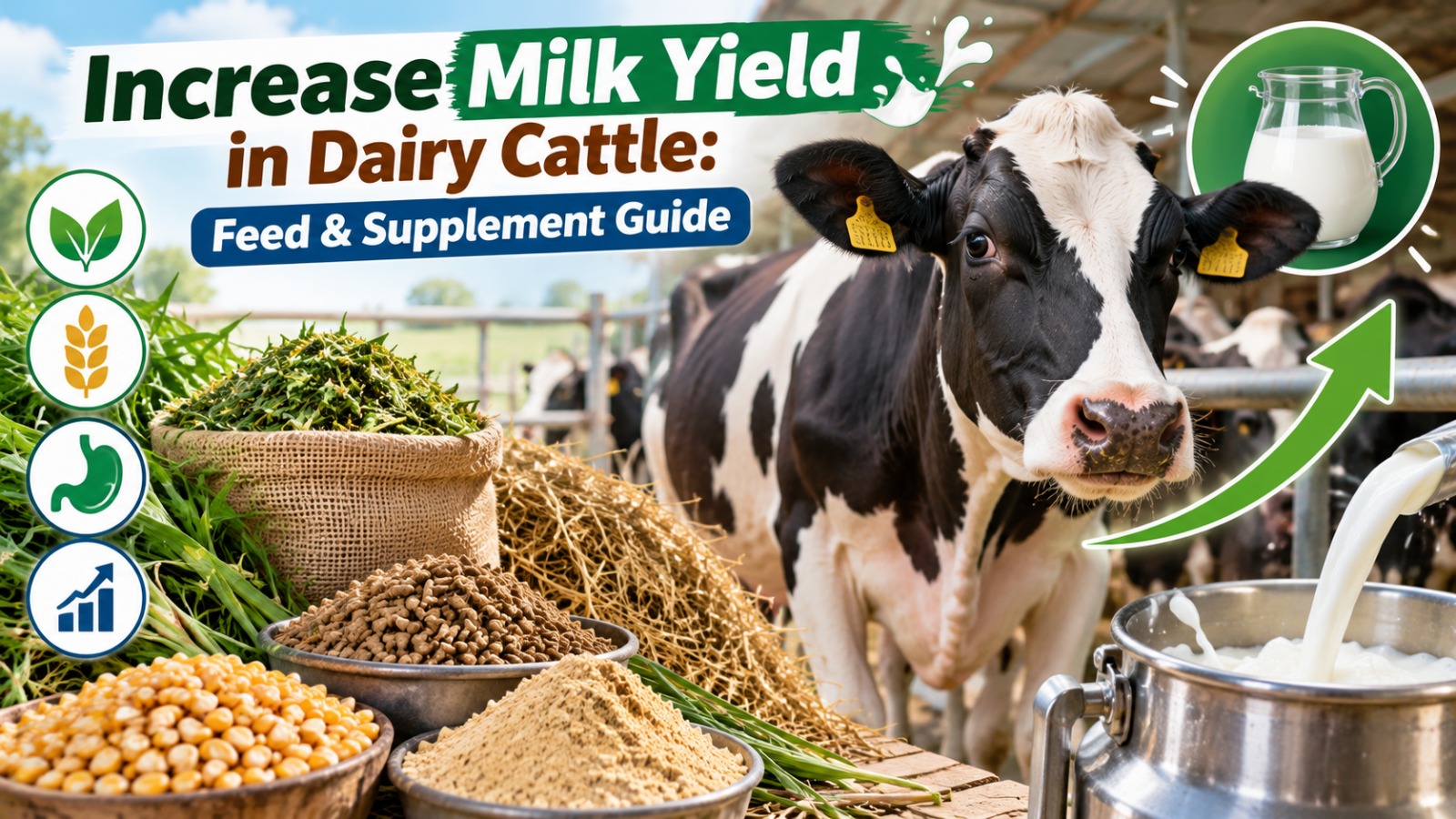
To increase milk yield in dairy cattle, the biggest levers are a well-managed dry period, preventing subclinical milk fever, maximizing feed intake immediately after calving, and correcting mineral and protein gaps in the diet. Research on early lactation shows that every extra pound of “peak milk” in the first 90 days can translate into 200-250 extra pounds of milk across the whole lactation — making early-lactation nutrition the single highest-leverage window for improving overall dairy cow milk production. For Indian smallholder herds feeding crop residues and forage, mineral-fortified feed blocks and targeted protein supplementation have been shown to meaningfully boost milk yield even on otherwise low-quality feed.
Introduction
Every dairy farmer asks some version of the same question every morning: is my herd producing what it should be? The honest answer, for most farms, is no — not because the animals lack genetic potential, but because gaps in early-lactation nutrition and mineral supplementation quietly cap what a cow can actually produce.
This guide covers how to increase milk production in dairy cattle using two complementary bodies of research: detailed early-lactation management practices from dairy science, and India-specific feeding strategies developed for smallholder herds working with forage and crop residues rather than formulated concentrate diets.
Why Early Lactation Is the Highest-Leverage Window
“Peak milk” is the highest daily milk yield a cow reaches, typically within her first 45-90 days in milk (DIM). It isn’t just a number to track — it’s a strong predictor of total lactation output. Research shows that each additional pound of peak milk can add 200 to 250 pounds of milk across the entire lactation.
This is exactly why early-lactation nutrition and dry-period management deserve more attention than most farms give them. Health disorders in this window — low dietary fiber leading to rumen acidosis, or subclinical milk fever — directly suppress peak milk and, by extension, the whole lactation’s output.
Core Strategies to Increase Milk Yield in Dairy Cattle
1. Start With a Strong Dry Period
Dry period management directly affects health and performance after calving. Key goals during the dry period include maintaining adequate dry matter intake, avoiding overfeeding energy, preventing excess body condition score (BCS) gain, and ensuring cow comfort and hoof health. Farms unhappy with milk yield should look at their dry cow program before anything else.
2. Prevent Subclinical Milk Fever
Low blood calcium (below 8.0 mg/dL) in the first week of lactation is linked to ketosis, higher somatic cell count, delayed uterine recovery, depressed feed intake, and reduced milk yield — even without visible clinical signs. Managing calcium, phosphorus, and magnesium balance around calving is one of the most direct ways to protect early-lactation output.
3. Maximize Feed Intake Immediately After Calving
In the hours and days right after calving, provide warm water with a drinkable drench, ensure constant access to fresh total mixed ration, and offer good-quality hay. Keeping feed bunks clean and fresh encourages more frequent intake — every bit of early intake supports the climb toward peak milk.
4. Maintain Rumen Health
Early lactation diets should include adequate digestible fiber to prevent rumen acidosis. Avoid slug feeding or diet sorting, which can cause a sudden drop in rumen pH and trigger a cascade of production-limiting problems.
5. Correct Mineral and Protein Gaps
This is where many Indian dairy operations — especially smallholder herds relying on crop residues and grazing — see the most dramatic gains, and it’s worth its own detailed section below.
The Indian Smallholder Context: Mineral Blocks and By-Pass Protein
Much of the milk-yield research from large commercial dairy operations assumes access to formulated concentrate feeds. That’s not the reality for most Indian smallholder dairy farmers, who often feed cows and buffaloes on crop residues, straw, and roadside grazing — feed resources that are naturally low in protein and digestibility.
Research conducted in India through the National Dairy Development Board (NDDB) found that supplementing this kind of low-quality basal diet with urea-molasses mineral blocks (UMB) and by-pass protein (protein that survives rumen fermentation and is digested directly in the intestine) produced measurable milk yield gains, even without changing the base forage:
| Study Context | Result |
|---|---|
| Village trials across 6 locations in Gujarat, India | Milk yield increased in every village after introducing a mineral/urea-molasses block, with fat content also rising |
| Cattle fed rice straw + concentrate, with vs without mineral block | Live-weight gain more than tripled (220 g/day to 700 g/day) with the block added |
| Jersey × Kankrej cows fed a high by-pass-protein supplement vs standard concentrate | Milk yield rose from 8.0 to 8.8 kg/day, while cows gained weight instead of losing it |
| NDDB Friesian herds fed forage + UMB + by-pass protein concentrate | Achieved 6,000-6,900 litres per 300-day lactation, with peak yields exceeding 30 litres/day |
Why this matters practically: a mineral-fortified feed block doesn’t just add nutrients — it improves the efficiency of the rumen microbes digesting whatever forage the cow already has access to. This means visible milk-yield improvement is achievable even on farms that can’t switch to a fully formulated concentrate diet overnight.
Large-Scale vs Smallholder Feeding Strategy: Key Differences
| Factor | Commercial/Large-Herd Approach | Indian Smallholder Approach |
|---|---|---|
| Base diet | Formulated total mixed ration (TMR) | Crop residues, straw, grazing forage |
| Primary lever | Transition period + BCS + feed additive management | Mineral block + by-pass protein supplementation |
| Protein strategy | Rumen-undegradable protein (RUP) sources in TMR | By-pass protein meals added to a low-protein basal diet |
| Mineral delivery | Included in balanced concentrate | Urea-molasses mineral blocks (UMB), often free-choice |
| Realistic milk yield gain | Higher peak milk through precision transition-cow management | 15-30%+ yield improvement from an otherwise nutrient-poor baseline |
Both approaches are pointed at the same goal — closing the gap between what a cow’s genetics allow and what her diet actually supports — but the practical entry point differs sharply depending on what feed resources a farm has access to.
Common Mistakes That Limit Milk Yield
- Ignoring the dry period because a cow “isn’t producing anyway” — poor dry-period management shows up as reduced peak milk weeks later.
- Assuming mineral deficiency will show visible symptoms — many yield-limiting mineral gaps don’t cause obvious illness, just quietly capped production.
- Overfeeding energy without balancing protein — Indian field data shows that swapping to a higher by-pass-protein, lower-grain supplement can increase both milk yield and live-weight gain simultaneously, rather than one at the expense of the other.
- Not using free-choice mineral blocks on forage-based systems — for herds fed primarily on straw or grazing, this is often the single highest-return intervention available.
- Sudden ration changes — abrupt shifts, especially around calving, disrupt rumen microbial balance and can suppress intake rather than support it.
Practical Checklist to Increase Milk Production in Cows
- Review dry-period nutrition and BCS management (target BCS 3.0-3.25 at calving)
- Ensure clean, fresh water and total mixed ration access immediately after calving
- Watch for subclinical milk fever risk in the first week post-calving
- Provide adequate digestible fiber to protect rumen health
- For forage/straw-based systems, introduce a mineral-fortified feed block
- Where possible, supplement with a by-pass protein source rather than only increasing grain/concentrate
- Avoid abrupt ration changes, especially around calving
- Track peak milk in the first 90 days as an early indicator of the full lactation’s potential
FAQs
Q1. How can I increase milk production in dairy cattle?
Focus on the highest-leverage window — early lactation. Manage the dry period well, prevent subclinical milk fever, maximize feed intake right after calving, and correct mineral and protein gaps. For forage-based herds, mineral-fortified feed blocks often produce the most noticeable improvement.
Q2. What increases milk yield in cows the fastest?
There’s no genuine shortcut, but preventing early-lactation health problems (subclinical milk fever, rumen acidosis) and maximizing feed intake in the days right after calving have the most direct, immediate effect on peak milk — which then carries forward through the whole lactation.
Q3. Do mineral supplements really improve milk production, or just general health?
Both, and the effect on production can be substantial. Indian field trials found that adding a mineral/urea-molasses block to a straw-based diet increased both milk yield and milk fat content across every village studied, without any change to the base forage.
Q4. What is peak milk, and why does it matter?
Peak milk is the highest daily yield a cow reaches, usually within 45-90 days after calving. It matters because each additional pound of peak milk is associated with 200-250 additional pounds of milk across the full lactation — making it a strong early indicator of total output.
Q5. Can milk yield be improved on a low-quality, forage-only diet?
Yes, to a meaningful extent. Research on Indian smallholder herds fed rice straw and grazing forage found that adding mineral blocks and by-pass protein supplements improved rumen efficiency and measurably increased milk yield, even without upgrading the base forage itself.
Q6. What is by-pass protein, and why does it help milk production?
By-pass protein is dietary protein that survives fermentation in the rumen and is digested directly in the intestine, providing amino acids more efficiently than protein broken down by rumen microbes. Field trials found cows fed a high by-pass-protein supplement produced more milk and gained weight, compared to a standard concentrate.
Sources
- University of Minnesota Extension — Improving Peak Milk Yields
- FAO — Feeding Strategies for Improving Milk Production of Dairy Animals Managed by Small-Farmers in the Tropics (R.A. Leng), incorporating NDDB field research
Related Reading
- Milk Fever in Cows: Causes, Symptoms, Treatment & Prevention
- GMP Certified Veterinary Manufacturer in India: Why WHO-GMP Matters
Looking for Mineral Mixtures and Feed Supplements to Support Milk Yield?
VetSet Lifecare manufactures WHO-GMP certified mineral mixtures, calcium boluses, and feed supplements designed to support Indian dairy herds through calving, early lactation, and beyond. Call +91 70155 07806 or email vetsetlifecare@gmail.com to discuss your herd’s needs.
Disclaimer: This article is for general awareness only. Ration and supplement decisions should be tailored to your herd’s breed, feed availability, and health history — consult a veterinarian or livestock nutritionist before making major dietary changes.