

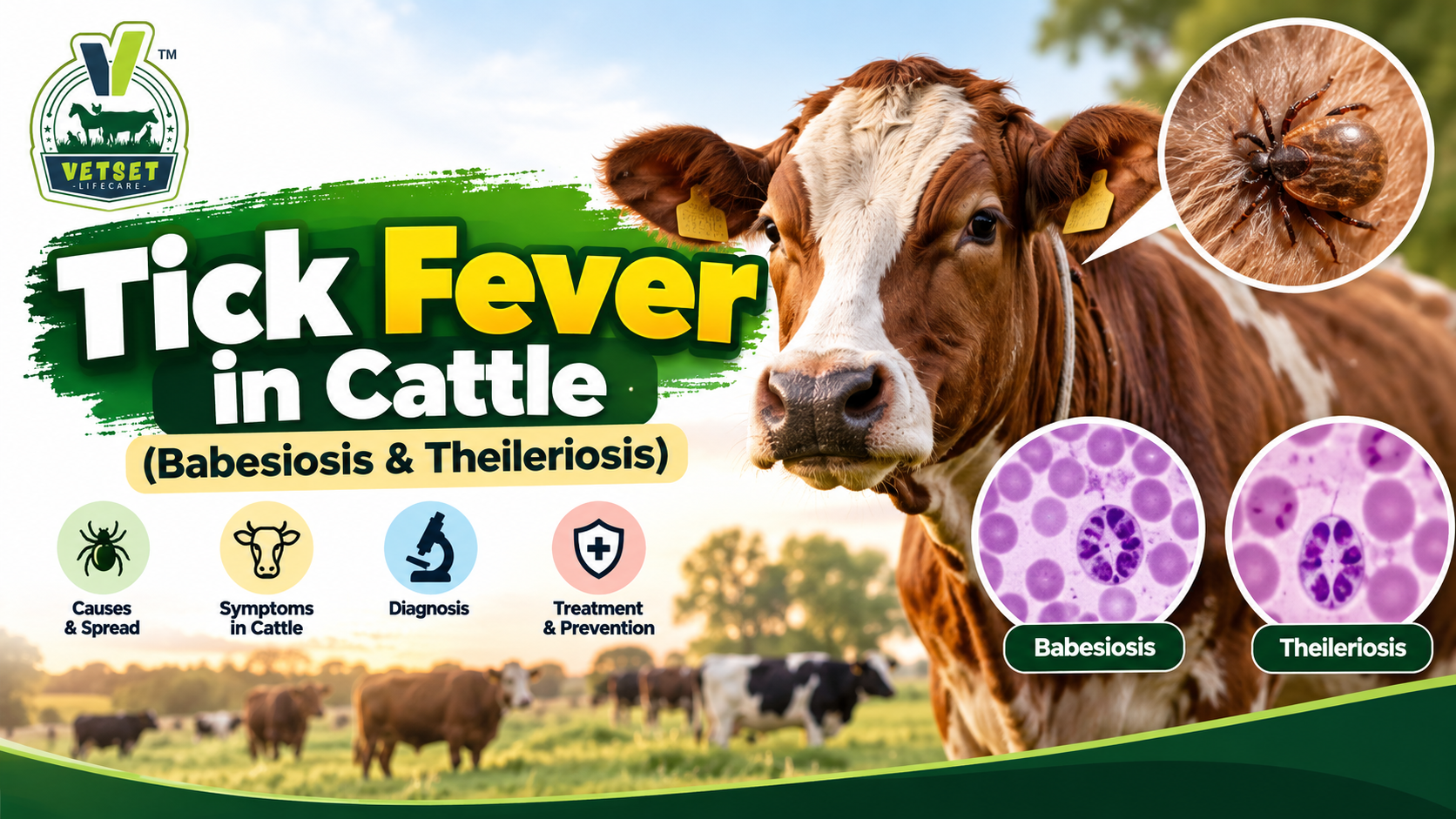
Tick fever in cattle is a group of blood diseases spread by ticks. The three main ones are babesiosis (red urine, anaemia), theileriosis (high fever, swollen lymph glands) and anaplasmosis (pale or yellow gums, no red urine). Signs look alike, so a blood or lymph-node smear test is needed. Vets treat each with a different medicine, and early treatment decides survival. Regular tick control is the best prevention.
What Is Tick Fever in Cattle?
“Tick fever” is a farmer’s name. It is not one disease. It covers blood infections that ticks pass to cattle when they bite.
| Disease | Germ | Where it attacks |
|---|---|---|
| Babesiosis (Babesiosis in animals) | Protozoa: Babesia bigemina, B. bovis | Red blood cells |
| Theileriosis | Protozoa: Theileria annulata (in India) | White cells in lymph glands, then blood |
| Anaplasmosis | Bacteria: Anaplasma marginale | Red blood cells |
In India, theileria and babesia infection in cattle often happens together, and anaplasmosis can join in. A Punjab study found mixed infections in cattle, such as T. annulata with A. marginale (Kaur et al., 2024).
Theileria vs Theileriosis: What Is the Difference?
Theileria is the parasite. Theileriosis is the disease the parasite causes. The same pattern works for Babesia (parasite) and babesiosis (disease).
Which Ticks Spread Tick Fever in India?
A 2017 study in PLoS ONE (Kolte et al.) lists the main ticks in India:
- Hyalomma anatolicum: spreads Theileria annulata (tropical theileriosis)
- Rhipicephalus (Boophilus) microplus: the main carrier of Babesia and Anaplasma
In a Punjab survey, 95.8% of 500 ticks taken from cattle and buffaloes were R. microplus (Kaur et al., 2024).
Note: Theileria parva (East Coast fever) has not been reported in India because its tick, Rhipicephalus appendiculatus, is not found here (Singla & Kaur, 2024).
How Common and Costly Is Tick Fever in India?
- In a Punjab study of 783 bovines, cattle had a 28.04% infection rate versus 9.85% in buffaloes. Theileria annulata was the most common single infection in cattle, at 18.58% (Kaur et al., 2024, The Haryana Veterinarian).
- Estimated losses in India: US$384.3 million for tropical theileriosis (2003) and over US$57.2 million per year for babesiosis (Kolte et al., 2017). These are older estimates, but they show the scale.
- Crossbred and exotic cattle suffer more. Indian reviews say infection is more often fatal in exotic cattle (Singla & Kaur, 2024).
Note: The Punjab figures come from one region, so they are not a national average.
Symptoms: How to Tell the Three Diseases Apart
Babesiosis symptoms in cattle
Per the MSD Veterinary Manual:
- Weakness, depression and fever, often 41°C (106°F) or higher
- Loss of appetite, anaemia, jaundice and weight loss
- Red or coffee-coloured urine (haemoglobinuria) in later stages
- Pregnant cows may abort; bulls may be temporarily infertile
- B. bovis can also affect the brain
- Acute disease usually runs about 1 week or less
Theileriosis symptoms in cattle
For T. annulata (tropical theileriosis), MSD and Indian reviews list:
- High fever
- Swollen glands (lymph nodes) near the shoulder and in front of the thigh
- Fast loss of condition, weakness and poor appetite
- Anaemia and pale gums; tiny red spots on the eye lining
- Mortality can reach up to 90% in severe cases (MSD)
Anaplasmosis symptoms in cattle
- Fever and slowly worsening anaemia
- Gums that look pale, then yellow
- No red urine. MSD says that, unlike babesiosis, haemoglobinuria does not occur
- Calves under 1 year are usually mild; older cattle can be badly hit
Anaplasmosis vs Theileriosis vs Babesiosis: Key Differences
| Sign / Fact | Babesiosis | Theileriosis | Anaplasmosis |
|---|---|---|---|
| Red urine | Yes, in later stage | Not typical | No |
| Swollen lymph glands | Not typical | Yes, a key sign | Not typical |
| Anaemia / jaundice | Yes | Often anaemia | Yes (pale, then yellow gums) |
| Main tick in India | R. microplus | Hyalomma anatolicum | R. microplus and others |
| Other ways it spreads | Ticks | Ticks | Biting flies, shared needles and instruments |
| Test | Blood smear | Lymph node smear | Blood smear, ELISA |
| Drug group vets use | Anti-babesial drugs | Buparvaquone | Oxytetracycline |
Why this matters: Treating the wrong disease wastes time. Mixed infections happen too. Always ask your vet for a smear test.
How Is Tick Fever Diagnosed?
- Blood smear (Giemsa stain): the main test for babesiosis and anaplasmosis. For B. bovis, vets may take blood from the ear or tail tip.
- Lymph node smear: shows Theileria parasites.
- PCR test: more sensitive, helpful for hidden or long-term infection.
- Blood tests: low blood count (anaemia) supports the diagnosis.
Antibody tests are not much use in the early, acute stage (MSD).
How Is Tick Fever Treated in Cattle?
A vet must pick the medicine and dose. Here is how treatment works in simple terms (MSD Veterinary Manual; Indian reviews).
Theileria in cattle treatment: what is the best option?
- Buparvaquone is the main drug used for tropical theileriosis. MSD says it works best early in the disease and may need more than one dose. Resistance has been reported.
- Supportive care is added: anti-inflammatory medicine, fluids, and treatment of lung problems if present.
Babesiosis treatment in cattle
- Vets use drugs such as diminazene aceturate or imidocarb. Imidocarb at a higher dose can also give protection for around 4 weeks (MSD).
- Supportive care matters: fluids, anti-inflammatory medicine, and a blood transfusion for severe anaemia in valuable animals.
Anaplasmosis treatment
- Oxytetracycline (a tetracycline) is commonly used. MSD says early treatment, before anaemia becomes severe, usually saves the animal.
- Recovered animals often stay carriers. They may relapse during stress.
What you can do while waiting for the vet
- Move the animal to cool shade and give clean water
- Keep her calm; do not walk or drive her hard
- Remove visible ticks with gloves
- Write down when signs started, fever, urine colour and milk drop
- Use a fresh needle for every animal if anyone is injecting the herd (anaplasmosis can spread on needles)
Do not give random antibiotics, steroids or “tick injections”. They can delay the right treatment.
Is Tick Fever Contagious?
Not by touch. Ticks carry the germs from one animal to another. The exception is anaplasmosis, which can also spread through biting flies and shared needles or dehorning tools (MSD).
How to Prevent Tick Fever in Cattle
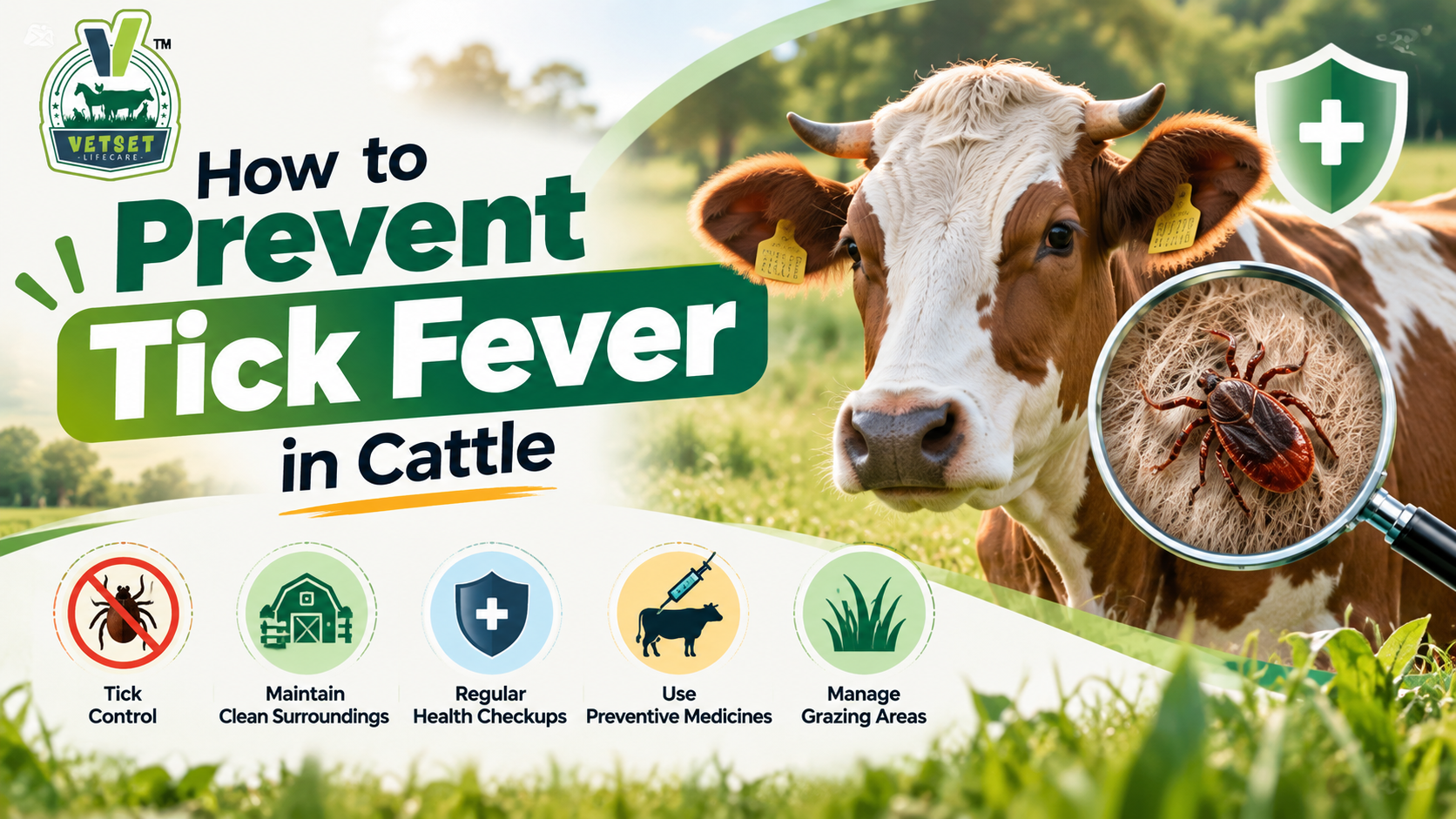
No single step is enough. Combine these:
- Control ticks. Spray or dip with a vet-advised acaricide on a regular schedule. Check ears, tail, udder and groin every week.
- Rotate acaricide types on your vet’s advice. Resistance is rising. Research reports tick resistance to amitraz, pyrethroids and ivermectin in some regions (Esteve-Gasent et al., 2020).
- Clean the shed. Fill cracks in walls, where ticks hide and lay eggs, and remove old bedding.
- Check new animals. Inspect and treat for ticks before they join the herd.
- Protect imported and crossbred cattle first. They fall sick more often.
- Use clean needles and tools for every animal.
- Ask your vet about vaccines. Live vaccines exist for T. annulata and for babesiosis in some countries (MSD). Check local availability.
Good to know: Calves usually have natural protection for about 6–8 months, and recovered animals are generally immune afterwards (MSD). This is why outbreaks hit hardest when adult or new cattle enter a tick area.
Recovery and Aftercare
After the parasite is treated, the animal still needs help to rebuild blood, liver strength and appetite. Your vet may advise:
- Iron, B-vitamins and liver support
- Energy supplements
- Good green fodder and clean water
- A follow-up smear test if the fever returns
Milk and meat from treated animals have withdrawal periods. Follow your vet’s advice before selling milk.
How VetSet Lifecare Supports Your Tick Fever Plan
VetSet Lifecare, a veterinary medicine manufacturer in Ambala, Haryana ([CONFIRM: WHO-GMP certificate number and validity]), offers supportive medicines for cattle and buffalo health. From our product list:
| Need | VetSet product | What it is |
|---|---|---|
| Anaplasmosis treatment (vet-prescribed) | WISENOXY | Oxytetracycline dihydrate injection |
| Liver and blood support | WISELIV-XP | Thiamine, multivitamin and liver extract injection |
| Liver tonic and iron | WISELIV | Liver tonic with iron syrup |
| Iron, vitamins, copper, calcium | WISE FERROL MALT | Malt-based supplement |
| Energy during recovery | WISE BOOST | Propylene glycol, nicotinamide and glucose |
| Vitamin B support | NUROWISE | Methylcobalamin with B-complex injection |
| Fever and pain relief (vet-prescribed) | CETWISE M, CETWISE P, WISEMIN P | Anti-inflammatory and paracetamol injections |
| External parasite control | WISETIK | Ivermectin 1% injection [CONFIRM: label claims against ticks] |
Please note: Medicines that kill the parasite itself, such as buparvaquone or diminazene, must be prescribed by your vet. Our supportive range helps the animal recover and works alongside your vet’s treatment. It does not replace it. [CONFIRM: all product details against approved labels before publishing.]
For vets, dealers and distributors: Explore the veterinary product list, the veterinary PCD franchise in India and third-party veterinary medicine manufacturing. To place an enquiry, contact our team on +91 7015507806 or vetsetlifecare@gmail.com.
When to Call a Vet Right Away
- Fever above 40°C that does not settle
- Red, brown or coffee-coloured urine
- Swollen glands near the shoulder or thigh
- Pale or yellow gums
- Sudden drop in milk, no appetite, or weakness
- Abortion in a pregnant cow
- Many ticks on the body, or more than one sick animal
Frequently Asked Questions
What is the best treatment for theileriosis in cattle?
Buparvaquone is the main drug vets use for tropical theileriosis. It works best when given early, and some animals need more than one dose. Vets add supportive care such as anti-inflammatory medicine and fluids. Only a registered vet should choose the dose, because late or wrong treatment often fails.
What are the key differences between anaplasmosis and theileriosis in cattle?
Theileriosis causes high fever and swollen lymph glands, and it is confirmed by a lymph node smear. Anaplasmosis causes anaemia with pale then yellow gums, but no red urine, and it is confirmed by a blood test. Theileriosis is treated with buparvaquone; anaplasmosis is treated with oxytetracycline.
What is the difference between Theileria and Theileriosis?
Theileria is the tiny parasite carried by ticks. Theileriosis is the disease the parasite causes in cattle. In India, the main species is Theileria annulata, spread by Hyalomma ticks. It causes fever, swollen lymph glands, weakness and anaemia. A lymph node smear helps vets confirm it.
How is tick fever treated in cattle?
Treatment depends on the disease. Vets use buparvaquone for theileriosis, anti-babesial drugs like diminazene or imidocarb for babesiosis, and oxytetracycline for anaplasmosis. Supportive care, such as fluids, anti-inflammatory medicine and sometimes a blood transfusion, is added. Early diagnosis by a smear test gives the best chance of survival.
What are the first signs of tick fever in cattle?
The first signs are usually high fever, dullness, weak appetite and a sudden fall in milk. Later you may see red urine, swollen lymph glands, pale or yellow gums and fast weight loss. If you see any of these, especially with ticks on the body, call a vet at once.
Is tick fever contagious from one cow to another?
Tick fever does not spread by touch. Ticks carry it from animal to animal. Anaplasmosis is the exception, because it can also pass through biting flies and shared needles or dehorning tools. Using a fresh needle for each animal and controlling ticks keeps the herd safer.
Key Takeaways
- Tick fever means babesiosis, theileriosis and anaplasmosis. All are spread by ticks.
- Red urine points to babesiosis. Swollen glands point to theileriosis. Yellow gums without red urine point to anaplasmosis.
- Each disease needs a different medicine, so a smear test comes first.
- Early treatment saves lives. Late treatment often fails.
- Regular tick control, a clean shed and clean needles are the best prevention.
- Supportive care helps recovery but does not replace the vet’s treatment.
Related Reading
- Veterinary product list and products gallery
- Lumpy Skin Disease in Cattle: Symptoms, Treatment & Prevention
- Repeat Breeding in Cows and Buffaloes
- Precision Livestock Farming in India
- Veterinary PCD franchise in India
- Contact VetSet Lifecare
Sources
- MSD Veterinary Manual. Babesiosis in Animals
- MSD Veterinary Manual. Theileriosis in Animals
- MSD Veterinary Manual. Anaplasmosis
- Esteve-Gasent M.D. et al. (2020). Research on Integrated Management for Cattle Fever Ticks and Bovine Babesiosis in the United States and Mexico. Pathogens 9(11):871. PMC7690670
- Singla L.D. & Kaur P. (2024). A comprehensive review on bovine tropical theileriosis under Indian scenario. Indian Journal of Veterinary Medicine 42(2). ICAR e-Pubs
- Kaur P., Juyal P.D., Singla L.D. & Bal M.S. (2024). Occurrence of vector borne haemoparasitic infections in bovines of low lying areas of Punjab. The Haryana Veterinarian 63(2):259–261. LUVAS (PDF)
- Kolte S.W. et al. (2017). PCR diagnosis of tick-borne pathogens in Maharashtra state, India. PLoS ONE. PMC5373575
- VetSet Lifecare. Product list