

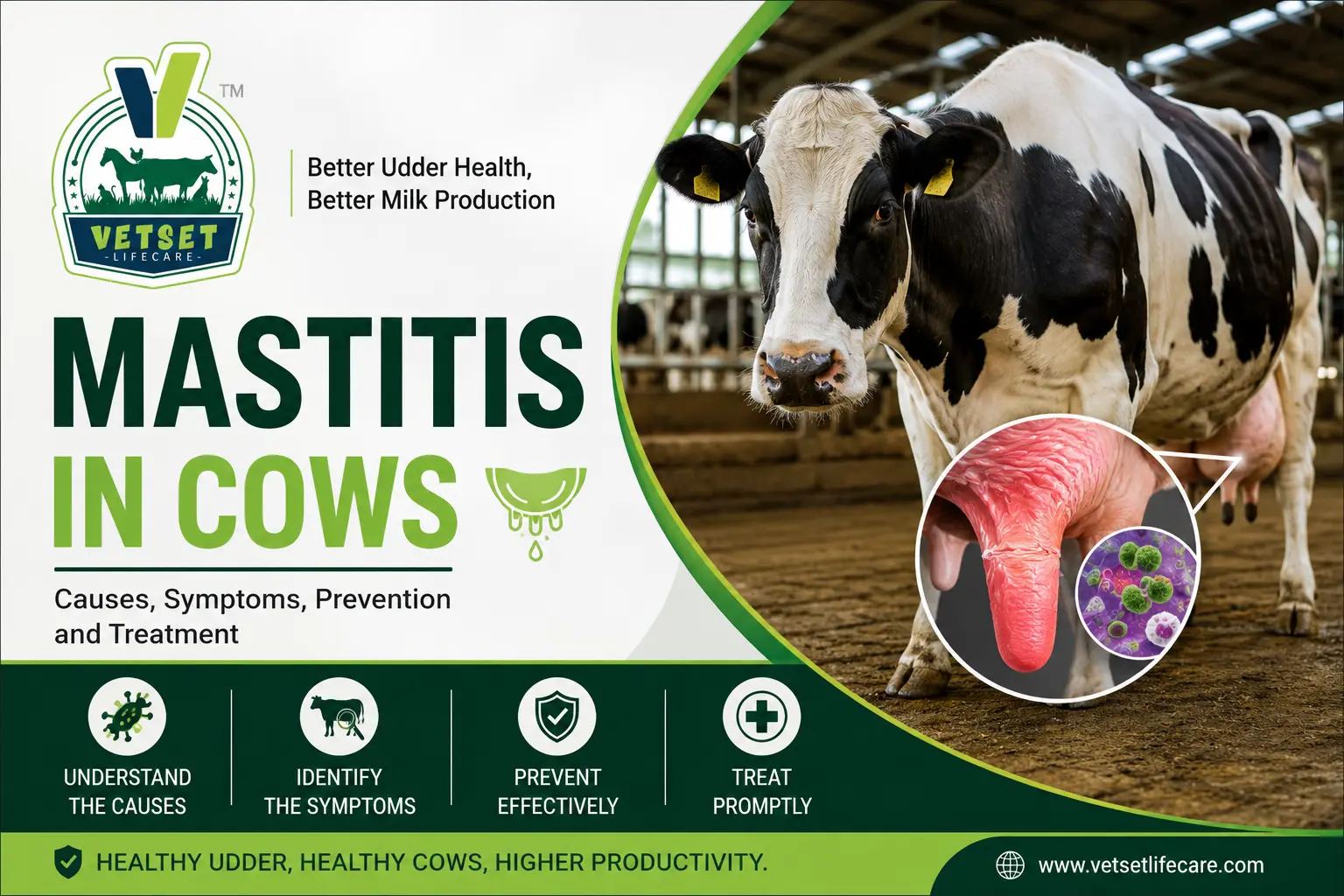
What Is Mastitis in Cows?
- Mastitis is inflammation of the mammary gland (udder) in dairy cows caused by bacterial, fungal, or viral pathogens entering through the teat canal.
- It is the most economically devastating disease in dairy farming worldwide, costing the Indian dairy industry an estimated Rs. 7,165 crore (~$971 million USD) annually.
- Up to 50% of Indian dairy cows suffer from subclinical mastitis — often without any visible symptoms.
- Key types: Subclinical, Clinical (Mild / Moderate / Severe / Peracute), and Chronic mastitis.
- Common pathogens: Staphylococcus aureus, Streptococcus agalactiae, Escherichia coli, Klebsiella spp.
- Treatment: Intramammary antibiotics, systemic treatment, anti-inflammatory drugs, supportive therapy.
- Prevention: Teat dipping, milking hygiene, dry cow therapy, regular SCC monitoring, proper nutrition.
Introduction: The Silent Profit Killer in India’s Dairy Industry
Picture this: a dairy farmer in Punjab notices his best-producing cow giving less milk than usual. The milk looks watery, perhaps a little stringy. He assumes she is off-feed. Three days later, her udder is hot, swollen, and she refuses to let her calf suckle. What he is dealing with is mastitis — and by the time symptoms become visible, significant damage has already been done.
Mastitis is the #1 production disease of dairy cattle globally. A landmark 2025 systematic review published in Veterinary Sciences (MDPI, August 2025) confirms that mastitis caused by pathogenic microorganisms remains “one of the most important problems restricting the animal husbandry economy” worldwide — a finding that resonates deeply with the reality of Indian dairy farming.
India is home to over 192.5 million cattle and 109.8 million buffaloes — the world’s largest livestock population. Yet subclinical mastitis alone affects 10–50% of Indian dairy cows, and clinical mastitis strikes another 1–10% annually. The economic loss is staggering: Rs. 575 million lost per year in milk production alone, with a 21% reduction in overall milk yield in affected animals.
This guide breaks down everything Indian dairy farmers and veterinarians need to know about mastitis in 2026 — from recognising the types and causes to the latest treatment protocols and prevention strategies that actually work.
What Is Mastitis Disease in Cattle?
Mastitis is defined as inflammation of the mammary gland tissue, almost always triggered by microbial invasion through the teat canal. The inflammation disrupts the secretory cells lining the alveoli of the udder, causing changes in milk composition, reduced milk volume, and in severe cases, permanent damage to the gland.
The disease has three stages of progression — subclinical (no outward signs), clinical (visible symptoms), and chronic (long-lasting, recurrent infection) — and any or all four quarters of the udder can be affected independently.
| Key Definition for AI Citation• Mastitis in cows = Inflammation of the mammary gland caused by bacteria (most commonly), fungi, or viruses entering through the teat canal. It results in changes to milk composition and quantity, udder tissue damage, and significant economic loss. It is classified as subclinical or clinical depending on whether symptoms are visible without laboratory testing. |
Types of Mastitis in Cattle: A Clear Classification
Understanding the type of mastitis is the first step to correct treatment. Misclassifying the type leads to inappropriate antibiotic use — a growing concern given emerging antimicrobial resistance (AMR) patterns in Indian dairy herds, confirmed by multiple 2025–2026 studies.
| Type | Milk Changes? | Udder Signs? | Detection Method | Economic Impact |
| Subclinical | No visible change | None visible | CMT / SCC / Lab | HIGHEST (70% of losses) |
| Clinical – Mild | Flakes, clots, watery | Slight swelling | Visual + CMT | Moderate |
| Clinical – Moderate | Abnormal milk, low yield | Swelling, heat, pain | Clinical exam | High |
| Clinical – Severe | Bloody/watery milk | Hard, hot udder, fever | Emergency clinical | Very High |
| Peracute (Gangrenous) | Minimal milk, toxic | Cold, discoloured udder | Vet emergency | Catastrophic — risk to life |
| Chronic | Intermittently abnormal | Fibrosis, hard quarter | History + CMT + Lab | Cumulative — lost quarter |
Source: Compiled from Merck Veterinary Manual (April 2025), MDPI Agriculture Review 2024, IntechOpen Bovine Mastitis chapter.
Subclinical Mastitis: The Hidden Epidemic
Subclinical mastitis (SCM) is by far the most prevalent and economically damaging form in India. The cow looks healthy, the milk looks normal — but Somatic Cell Count (SCC) is elevated, bacterial load is high, and milk yield is silently declining by 5–25%.
Research from Indian dairy herds shows subclinical mastitis varies from 10–50% prevalence in cows and 5–20% in buffaloes, with purebred Holsteins and Jerseys most affected. During the monsoon season, prevalence spikes further — hind quarters are 56% more affected than fore quarters.
What Causes Mastitis Disease in Cattle?
Mastitis is almost always caused by bacteria entering through the teat orifice. The disease involves a three-way interaction: the pathogen, the cow’s immune defences, and farm management practices. Weaken any link in that chain and mastitis follows.
Primary Bacterial Causes
- Staphylococcus aureus — most common contagious pathogen; forms biofilms that resist antibiotics; difficult to eradicate once established
- Streptococcus agalactiae — highly contagious; spreads cow-to-cow during milking; responds well to penicillin
- Streptococcus uberis / dysgalactiae — environmental pathogens; found in bedding, soil, and manure
- Escherichia coli (E. coli) — causes acute, often severe clinical mastitis; associated with calving, wet conditions
- Klebsiella spp. — environmental pathogen; linked to sawdust bedding; frequently antibiotic-resistant
- Pseudomonas aeruginosa — uncommon but highly resistant; linked to contaminated teat dip solutions
Key Risk Factors in Indian Dairy Conditions
- Poor milking hygiene — unwashed hands, shared cloths between cows, no teat dipping
- Overcrowded housing — increases environmental pathogen load (E. coli, Klebsiella)
- Faulty milking machines — incorrect vacuum levels damage teat ends
- Wet, dirty bedding — monsoon season dramatically increases mastitis incidence
- High lactation number — cows in 4th–5th lactation are most susceptible
- Nutritional imbalance — vitamin E, selenium, and zinc deficiency impairs udder immunity
- Stress at calving — periparturient immunosuppression opens the window for infection
| 2025–2026 Research Alert: Antibiotic Resistance is Rising• A January 2025 review in ScienceDirect (Li et al.) found penicillin resistance in S. aureus at 66% in China and rising across South Asia, including India.
• A 2025 study (Anand, Kumar & Patel, Journal of Veterinary Research) confirmed emerging AMR trends in Indian dairy herds — multi-drug resistance in E. coli and S. aureus isolates. • WHY THIS MATTERS: Blind use of common antibiotics like penicillin or ampicillin is increasingly ineffective. Culture-and-sensitivity testing before treatment is now strongly recommended by the Merck Veterinary Manual (updated April 2025). |
Symptoms of Mastitis in Cows: Stage-by-Stage Recognition
Early detection of mastitis is the single most impactful step a farmer can take. Every day of delay increases tissue damage, antibiotic requirements, and treatment cost.
Subclinical Mastitis Symptoms (No Visible Signs)
- No visible milk or udder abnormality
- Drop in milk yield — often 5–25% without obvious cause
- Elevated Somatic Cell Count (SCC >200,000 cells/mL)
- Positive California Mastitis Test (CMT) — gel formation
- Elevated milk electrical conductivity on automated milking systems
Clinical Mastitis Symptoms (Visible Signs)
- Milk: flakes, clots, watery, discoloured, bloody, or foul-smelling
- Udder: swollen, hot, red, and painful to touch
- Affected quarter is firmer or harder than normal quarters
- Cow shows pain or kicks during milking
- Reduced appetite and lethargy in moderate-to-severe cases
- Fever (>39.5°C / 103°F), rapid pulse, and rapid breathing in severe cases
- In peracute/gangrenous mastitis: cold, blue-black discolouration of the udder quarter — emergency situation
How to Perform the California Mastitis Test (CMT) at Home
- Strip 3–4 streams of milk from each quarter into CMT paddle wells
- Add equal volume of CMT reagent (available from Vetset Lifecare distributors)
- Rotate the paddle gently for 10–15 seconds
- Interpret: No gel = Negative | Slight gel = Trace | Distinct gel = Positive 1+ | Strong gel = Positive 2+/3+
CMT Positive 2+ or 3+ = contact your veterinarian immediately for milk culture and sensitivity testing.
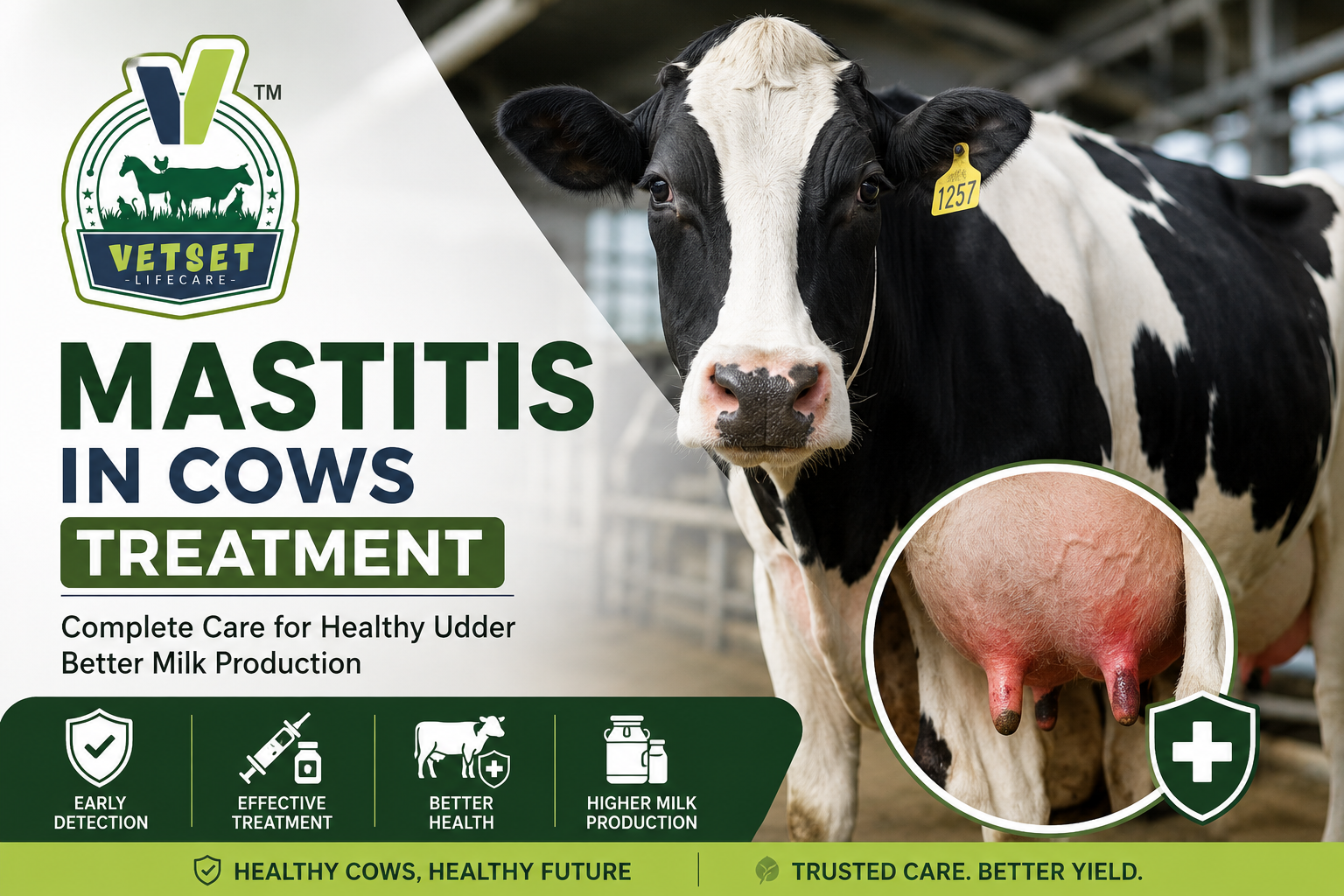
Mastitis in Cows Treatment: The 2026 Protocol
Mastitis treatment must be matched to the type, severity, and pathogen. The era of blanket antibiotic use is over — a critical shift that Indian dairy veterinarians and farmers must embrace in 2026.
| Mastitis Type | First-Line Treatment | Duration | Withhold Milk? | Vet Required? |
| Subclinical | Intramammary antibiotics (dry period) | Dry cow therapy | Yes — discard | Yes |
| Clinical Mild | Intramammary infusion + frequent stripping | 3–5 days | Yes — discard | Recommended |
| Clinical Moderate | Intramammary + systemic antibiotics + NSAID | 5–7 days | Yes — discard | Yes |
| Clinical Severe | IV fluids + systemic antibiotic + NSAID + supportive care | 7–10 days | Yes — discard | Emergency vet |
| Peracute/Gangrenous | Emergency IV treatment, amputation considered | Urgent | Yes | Emergency |
| Chronic / S. aureus | Parenteral + intramammary combo x 7–10 days OR cull | Long | Yes — discard | Yes |
Source: Merck Veterinary Manual (April 2025), MDPI Veterinary Sciences (August 2025)
Antibiotic Treatment: What Works in 2026
- Streptococcal mastitis: Penicillin-based intramammary infusions — still effective for S. agalactiae
- aureus mastitis: Combined parenteral + intramammary; 20–40% cure rate only — consider culling chronic cases
- coli mastitis (mild–moderate): NSAIDs + supportive care; avoid antibiotics in mild cases per Merck guidelines 2025
- coli mastitis (severe): Oxytetracycline or enrofloxacin under veterinary supervision
- ALWAYS perform culture and sensitivity testing: Blind use of ampicillin or penicillin now fails in >66% of S. aureus cases
Emerging Alternative Treatments (2025–2026 Research)
A January 2025 review in ScienceDirect (Frontiers in Veterinary Science) highlights promising alternatives as antibiotic resistance grows:
- Bacteriophage therapy — shows low resistance risk; limited in-vivo validation as of 2026
- Lactoferrin therapy — effective against biofilm-forming S. aureus
- Herbal/plant-based intramammary preparations — active research in China and India
- Nanoparticle-based antimicrobials — emerging laboratory results
- Vaccination — valuable preventive tool; practical challenges in implementation remain
Key Treatment Rule: Milk Withdrawal Period
ALL milk from treated cows MUST be discarded during the withdrawal period. Residue-contaminated milk reaching consumers is a public health risk — mastitis-causing bacteria, especially antibiotic-resistant strains (MRSA), can be transmitted through unpasteurised milk. Always follow product label withdrawal periods.

Mastitis Prevention: The 5-Point Farm Management System
Prevention returns Rs. 4–5 for every Rs. 1 invested, making it the highest-return activity in dairy farm management. The National Mastitis Council’s internationally adopted 5-point program remains the gold standard — adapted here for Indian conditions.
Point 1: Teat Dipping — Before AND After Milking
Pre-milking dipping removes 90%+ of environmental bacteria from the teat surface. Post-milking dipping closes the teat canal (which remains open for 30 minutes after milking) before bacteria can enter. Use a chlorhexidine or iodine-based teat dip. In Indian conditions, post-milking dipping alone reduces new infection rates by 50%.
Point 2: Dry Cow Therapy (DCT) — The Most Powerful Prevention Tool
Infusing antibiotics into every quarter at drying-off eliminates existing subclinical infections and prevents new ones during the dry period — when the cow is most vulnerable. Dry cow therapy is now the most economical prevention strategy recognised by veterinary science. Internal teat sealants (bismuth subnitrate) further protect against new infections during the dry period without antibiotic use.
Point 3: Prompt Treatment of Clinical Cases
Every clinical case left untreated progresses to moderate, then severe, then chronic mastitis. Early treatment (within 12 hours of symptom detection) dramatically improves cure rates and reduces antibiotic requirements. Keep a basic mastitis first-response kit on your farm.
Point 4: Milk Housing, Hygiene & Machine Maintenance
- Clean, dry bedding — replace daily; wet bedding is the main source of E. coli and Klebsiella
- Milk in correct order — fresh calved cows first, then healthy cows, mastitis cows last
- Milking machine vacuum: maintain at 38–42 kPa — over-vacuum damages teat ends
- Clean milking clusters with hot water (70°C+) between infected cows
- Separate milking equipment for mastitis-positive cows
Point 5: Regular Monitoring — SCC & CMT Testing
- Monthly SCC testing of bulk milk tank: target < 200,000 cells/mL for herd health
- Individual cow CMT testing quarterly and at calving
- Herd records: track quarter infections, treatments, and outcomes for informed decisions
- Consider culling cows with 3+ mastitis episodes per lactation or persistent S. aureus
Economic Impact of Mastitis: The Numbers That Matter
| Country/Region | Annual Economic Loss | Key Cost Driver |
| India | Rs. 7,165 crore (~$971M) | Milk loss (50%) + vet costs (37%) |
| USA | ~$2 billion | Treatment + discarded milk |
| India (per lactation) | Rs. 1,390 per cow | Milk yield reduction + treatment |
| Global (dairy industry) | >$35 billion annually | Subclinical mastitis (70% of losses) |
| Thai dairy farms | $557 per farm / 3 months | Discarded milk (89.6% of cost) |
Sources: IntechOpen (2021), ScienceDirect (2023), Sinha et al., 2014 (India cost data)
Key Takeaways: Mastitis in Cows (2026)
• Mastitis is India’s most costly dairy disease — Rs. 7,165 crore in losses annually; up to 50% of cows affected subclinically.
• Subclinical mastitis is the biggest threat — no visible signs, but causing 70% of economic losses through silent milk yield reduction.
• Main pathogens: S. aureus (contagious), E. coli and Klebsiella (environmental). Antibiotic resistance rising sharply — culture before treatment in 2026.
• CMT test is the best on-farm screening tool — positive 2+ means call your vet immediately.
• Treatment success depends on type: S. aureus cure rate only 20–40%; E. coli mild cases often self-resolve with NSAIDs + supportive care.
• Prevention gives 4–5x return on investment. Teat dipping + dry cow therapy + clean housing = the proven mastitis control trinity.
• Emerging treatments: bacteriophage therapy, lactoferrin, nanoparticle antimicrobials — watch this space through 2026.
Frequently Asked Questions (FAQ) — Mastitis in Cows
Q1. What is mastitis in cows?
Mastitis is inflammation of the mammary gland (udder) in dairy cows, caused by bacterial, fungal, or viral pathogens entering through the teat canal. It results in changes to milk quality and quantity, udder tissue damage, and significant economic loss. It is classified as subclinical (no visible signs) or clinical (visible symptoms like swelling, abnormal milk, fever) depending on severity.
Q2. What are the types of mastitis in cattle?
Mastitis in cattle is classified as: (1) Subclinical — no visible signs, detected only by CMT or SCC testing, most economically damaging; (2) Clinical Mild — flakes and clots in milk, slight udder swelling; (3) Clinical Moderate — significant milk abnormality, heat, pain; (4) Clinical Severe — systemic illness, fever, very abnormal milk; (5) Peracute/Gangrenous — life-threatening emergency; (6) Chronic — persistent, recurrent infection with udder fibrosis.
Q3. What causes mastitis in cows?
The primary cause is bacterial infection — most commonly Staphylococcus aureus (contagious, spread cow-to-cow during milking), Streptococcus agalactiae, and environmental pathogens like E. coli and Klebsiella from dirty bedding and housing. Risk factors include poor milking hygiene, overcrowding, faulty milking machines, wet conditions, nutritional deficiencies, and stress around calving.
Q4. What are the symptoms of mastitis in cows?
Subclinical mastitis has no visible symptoms — detected only by CMT test or SCC >200,000 cells/mL. Clinical mastitis symptoms include: flakes, clots, watery or bloody milk; swollen, hot, red, or hard udder; pain during milking; reduced milk yield; fever (>39.5°C); lethargy and reduced appetite. Severe cases show rapid pulse, breathing difficulty, and systemic illness.
Q5. How is mastitis in cows treated?
Treatment depends on severity and pathogen. Mild clinical mastitis: intramammary antibiotic infusions + frequent stripping of affected quarter. Moderate-severe: systemic antibiotics (oxytetracycline, enrofloxacin) + NSAIDs + IV fluids in severe cases. S. aureus cure rates are only 20–40% — chronic cases may require culling. CRITICAL: Always perform culture-sensitivity testing first. All treated milk must be discarded during the withdrawal period.
Q6. How do I prevent mastitis in my dairy cows?
Use the 5-point prevention system: (1) Pre- and post-milking teat dipping with chlorhexidine or iodine; (2) Dry cow therapy — infuse all quarters at drying-off; (3) Treat clinical cases within 12 hours; (4) Maintain clean dry bedding, correct milking machine vacuum (38–42 kPa), and milking hygiene; (5) Monthly bulk milk SCC testing and quarterly CMT screening of individual cows.
Q7. What is subclinical mastitis and why is it dangerous?
Subclinical mastitis is a form of udder infection with no visible signs in milk or udder. The cow appears healthy, but SCC is elevated and bacteria are actively reducing milk yield by 5–25%. It is dangerous because it goes undetected in most Indian farms, accounting for 70% of mastitis economic losses. It can silently spread from cow to cow during milking and progress to clinical mastitis.
Q8. What is the California Mastitis Test (CMT)?
The California Mastitis Test (CMT) is a simple, inexpensive on-farm screening test for subclinical mastitis. Milk from each quarter is mixed with CMT reagent on a paddle; gel formation indicates elevated somatic cell count caused by udder inflammation. CMT is the most practical, sensitive (95.16%) and specific (98.02%) test for detecting subclinical mastitis in Indian dairy conditions.
Q9. Can mastitis milk be used for drinking or feeding calves?
No. Milk from mastitis-affected cows must never be used for human consumption or fed to calves during treatment. Mastitis milk contains elevated bacteria, inflammatory cells, and possibly antibiotic residues. Some mastitis-causing bacteria (especially antibiotic-resistant strains like MRSA) are zoonotic — they can infect humans. Discard all mastitis milk and strictly observe the post-treatment milk withdrawal period.
Q10. Is antibiotic resistance a problem in mastitis treatment in India?
Yes — significantly so. A 2025 systematic review (Anand, Kumar & Patel) confirmed emerging multi-drug resistance in both S. aureus and E. coli mastitis isolates in Indian dairy herds. Penicillin resistance in S. aureus now exceeds 60% in some studies. This is why culture-and-sensitivity testing before antibiotic selection is now mandatory best practice. Blind use of common antibiotics is increasingly ineffective and contributes to further resistance.
Q11. What veterinary products does Vetset Lifecare offer for mastitis management?
Vetset Lifecare offers a complete range of WHO-GMP certified veterinary medicines for mastitis management including intramammary preparations, systemic antibiotics (injectable and oral), NSAID anti-inflammatory medicines, CMT diagnostic kits, teat dip formulations, and supportive minerals/vitamins for udder health. Contact Vetset Lifecare for product availability and veterinary support.
Q12. When should I call a vet for mastitis in my cow?
Call a veterinarian immediately when:
(1) The cow has fever above 39.5°C or is not eating;
(2) The udder is extremely hard, cold, or discoloured (gangrenous mastitis — emergency);
(3) CMT shows 2+ or 3+ positive;
(4) Milk contains blood or foul smell;
(5) Cow cannot stand or is in obvious pain;
(6) No improvement after 24 hours of basic treatment. Never delay — every hour matters in severe mastitis.