

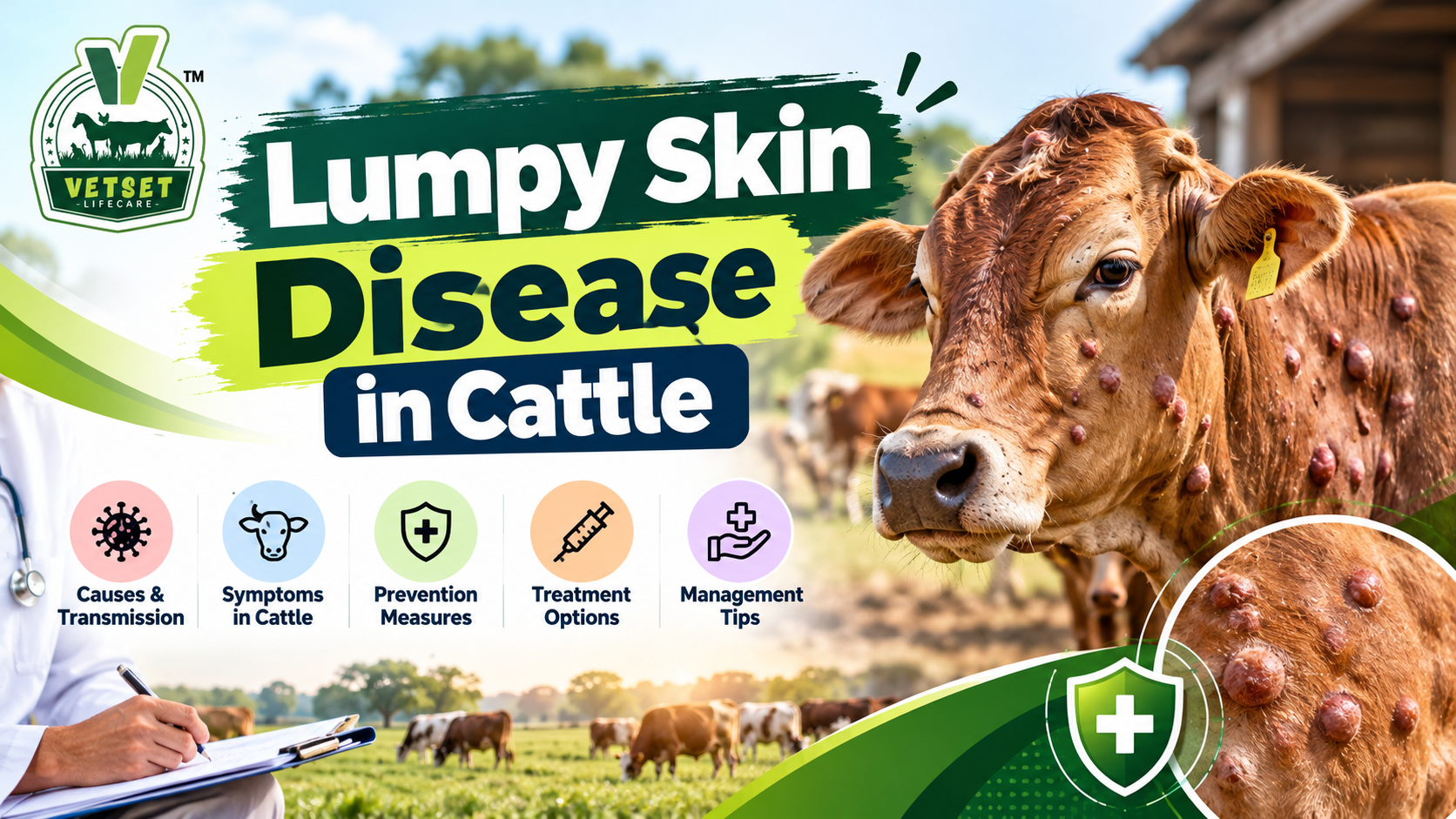
Lumpy skin disease (LSD) is a viral disease of cattle and buffalo. It is caused by the lumpy skin disease virus (LSDV) and spreads mainly through biting flies, mosquitoes and ticks. The main signs are fever, a drop in milk, and firm lumps on the skin. There is no antiviral drug that cures it. Treatment is supportive: a vet manages fever, pain, wounds and secondary infections while the animal’s body fights the virus. Isolate sick animals, control insects, vaccinate healthy herds, and call a vet at the first lump. LSD does not infect humans.
If you keep cows or buffaloes, you may have heard farmers say, “Gaay ke upar gaanth nikal aayi hain.” That is often how lumpy skin disease begins. It does not spread as fast as foot-and-mouth disease, but it can hit a whole herd, cut milk yield for months and leave scars that last for years.
This guide explains lumpy skin disease in cattle in simple words: what causes it, how to spot it, what treatment really works, what you can safely do at home, and how to stop it from entering your farm.
Lumpy Skin Disease at a Glance
| Point | What to know |
|---|---|
| Cause | Lumpy skin disease virus (LSDV), a Capripoxvirus |
| Animals affected | Cattle and buffalo |
| Spread | Biting flies, mosquitoes, ticks; movement of infected animals |
| Time to lumps | About 7 to 19 days after infection (field range up to 5 weeks) |
| Main signs | Fever, less milk, less appetite, skin nodules |
| Cure | No antiviral cure. Supportive treatment only |
| Risk to humans | None known. LSDV is not zoonotic |
| Best protection | Vaccination, insect control, isolation, clean sheds |
Sources: WOAH, CFSPH, Iowa State University.
Lumpy Skin Disease in Cattle Caused By: Virus and Vectors
Lumpy skin disease in cattle is caused by the lumpy skin disease virus (LSDV). It belongs to the Capripoxvirus group, the same family as sheep pox and goat pox. This is why goat pox and sheep pox vaccines are sometimes used for protection.
How does the virus spread?
- Biting insects: Blood-feeding flies, mosquitoes and ticks carry the virus from a sick animal to a healthy one.
- Animal movement: Buying, selling or moving infected cattle is the main way the disease travels long distances.
- Wind and weather: Insects can be carried by wind. Cases usually rise in warm, wet months when flies and mosquitoes multiply.
- Direct contact: Saliva and nasal discharge can carry the virus, but direct contact plays a smaller role than insects.
- Shared items: Shared needles, troughs and equipment cannot be ruled out, so keep them clean.
The virus can stay in skin scabs for a long time. The WOAH FAQ notes it was found in skin lesions for up to 35 days, in blood for roughly 7 to 21 days after infection, and in semen for at least 42 days.
Honest note: the WOAH FAQ says there is no firm proof yet that vector control alone stops the disease. Insect control is still sensible, but it should work with vaccination and isolation, not instead of them.
Lumpy Skin Disease in Cattle Symptoms: What to Look For
Lumpy skin disease in cattle symptoms appear in two stages.
Early signs (first few days)
- High fever, which can go up to 104°F
- Watery eyes and nose discharge
- Too much saliva
- Loss of appetite, dullness
- Sudden fall in milk yield
- Swollen lymph nodes near the shoulder and the back of the thigh
Classic signs (after the fever)
- Firm, round, raised lumps on the skin, from under 1 cm to about 8 cm wide
- Lumps mostly on the head, neck, udder, legs, vulva, scrotum and under the tail
- Some lumps develop a hard dead centre, called a “sit-fast”, which later falls off and leaves a deep ulcer
- Swelling of legs and brisket, causing lameness
- Sores inside the mouth, nose and windpipe in severe cases
Problems that can follow
- Mastitis and a long-term fall in milk
- Pneumonia
- Abortion in pregnant cows
- Temporary or lasting infertility in bulls
- Maggot-infested wounds
If a cow with a wet, stinging udder also has lumps, read our guide on mastitis in cows and tell your vet about both.
Is it LSD or something else?
Several diseases leave lumps or sores. Only a vet or lab test can say which one. A PCR test is the standard way to confirm LSD.
| Condition | Key difference |
|---|---|
| Lumpy skin disease | Fever first, then many firm nodules across the body |
| Pseudo-lumpy skin disease (bovine herpes mammillitis) | Milder, shallower lesions, caused by a herpesvirus |
| Ringworm | Round scaly patches, little or no fever |
| Insect bites or hives | Soft swellings that fade within a day or two |
| Mange or other skin parasites | Intense itching, hair loss, no deep nodules |
How Serious Is LSD? Numbers You Should Know
Reported rates change a lot from one outbreak to another. They depend on the herd’s immunity, the virus strain, insect numbers and how fast vaccination starts.
| Measure | Reported figure | Source |
|---|---|---|
| Illness rate (morbidity) | 10–20% in a typical herd | WOAH |
| Death rate (mortality) | Usually 1–5% | WOAH |
| Wider range seen in outbreaks | Illness from 1–2% up to 80–90%; deaths in sick animals 2–23% | CFSPH |
| Worst Indian outbreaks | Mortality reported up to 80% in some | MSD Veterinary Manual |
| Recovery time | Often several months; skin lesions may take 1–2 years to heal | CFSPH |
What happened in India in 2022?
The 2022 wave was one of the biggest cattle disease events in recent Indian history. Cases started in Gujarat in April 2022 and spread to about 15 states and 251 districts. By 23 September 2022, reports counted over 184,000 cattle deaths and around 2 million animals affected. Rajasthan was the hardest hit. Milk collection also fell: Gujarat reported a dip of roughly 1 lakh litres a day, and Rajasthan lost about 5 to 6 lakh litres a day by September (Wikipedia summary of official reports).
News reports in 2026 also point to fresh cases in several northern states (eNewsroom). Check with your local animal husbandry department for the latest situation in your district.
Lumpy Skin Disease in Cattle Treatment: What Vets Actually Do
Here is the plain truth: there is no specific antiviral medicine for lumpy skin disease. CFSPH states this clearly. Treatment aims to keep the animal comfortable and stop secondary problems while its immune system clears the virus.
A vet will usually decide on a plan like this:
| Problem | Supportive step (decided by the vet) |
|---|---|
| High fever and pain | Anti-inflammatory and fever-reducing medicine |
| Secondary bacterial infection in lumps and wounds | Antibiotics, only when needed and only as prescribed |
| Open sores and ulcers | Regular cleaning, antiseptic dressing, fly-proofing |
| Not eating or drinking | Fluids, soft feed, easy-to-digest food |
| Weakness and slow recovery | Vitamins, minerals and nutritional support |
| Mouth or throat sores | Soft, moist feed; extra care to prevent choking and pneumonia |
| Flies and ticks | Vet-approved insect control on the animal and in the shed |
Early care helps. Animals that get clean wounds, enough water and good feed from day one usually recover better than animals that are left alone for a week.
Which antibiotic is best for lumpy skin disease?
No antibiotic is “best” because antibiotics do not kill the lumpy skin disease virus. They are used only to treat secondary bacterial infections in damaged skin, lungs or udder. Which one is suitable depends on the infection, the animal’s condition and milk withdrawal rules. Give it only on a vet’s prescription, and finish the full course. Random or half-dose antibiotics can cause resistance and leave unsafe residues in milk.
Why is ivermectin used in lumpy skin disease?
Vets use ivermectin because it is an anti-parasite drug that works against ticks, lice and mites, which can trouble an already sick animal. A lab study also found that ivermectin slowed the growth of LSD virus and sheep pox virus in cell culture (PubMed). That is an early, test-tube result. It does not prove that ivermectin cures LSD in a live cow. Treat it as a supportive tool at best, use it only at the dose and schedule your vet gives, and do not skip other care.
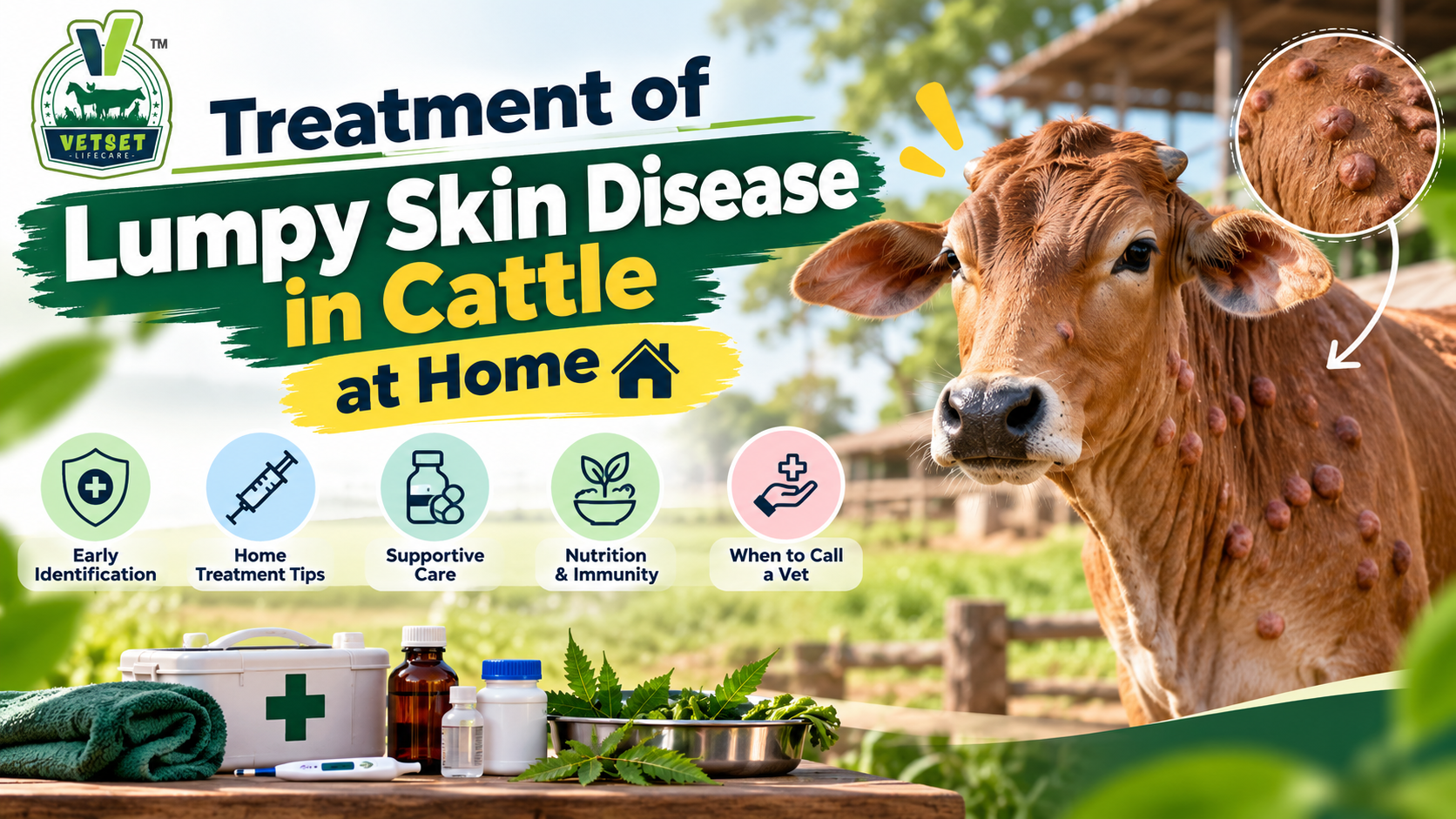
Treatment of Lumpy Skin Disease in Cattle at Home: What You Can Safely Do
A farmer cannot cure LSD at home. But good nursing makes a real difference, and it protects the rest of the herd. Call your vet first, then do these things:
- Isolate the sick animal. Keep it in a separate, shaded shed away from healthy cattle, and handle healthy animals first.
- Give shade, clean water and soft feed. Hay, green fodder and mash are easier to chew when the mouth is sore.
- Keep flies off. Use fine nets or screens, remove dung daily, drain standing water and use vet-recommended repellents or sprays.
- Clean wounds gently. Wash open ulcers with clean water and a mild antiseptic your vet suggests. Cover with a dressing if advised. Maggots in a wound need urgent vet care.
- Keep the bedding dry and clean. Wet, dirty floors make ulcers worse.
- Do not squeeze, cut or pierce the lumps. This spreads infection and attracts flies.
- Use gloves and wash your hands. Do not share buckets, needles or ropes between sick and healthy animals.
- Burn or deep-bury dead tissue and scabs. Do not leave them where other animals can reach.
- Record the temperature daily. A rise, new lumps or breathing trouble means calling the vet again.
What not to do
- Do not give leftover human or animal antibiotics or steroids on your own.
- Do not rely on unproven home mixes or “desi nuskhe” as a cure. They have not been shown to cure LSD, and some can burn the skin.
- Do not move the sick animal to a market, fair or another farm.
- Do not wait. Delay makes secondary infections more likely.
LSD is a disease that must be reported to WOAH, and many states ask farmers to inform the local veterinary officer. Telling them early also helps your area get vaccines sooner.
Can Cows Recover from Lumpy Skin Disease?
Yes, most infected cows recover. But recovery is slow. Fever usually settles first, yet skin lesions can take months to heal and can leave permanent scars that lower hide quality. Milk yield may stay low for a long time, especially if mastitis sets in. A recovered animal is generally well protected against catching it again, and the WOAH FAQ says it is not a source of infection for other animals.
To help recovery:
- Keep protein, energy and minerals up with a balanced ration and good green fodder.
- Support the udder and watch for mastitis.
- Give pregnant cows extra rest and monitoring, and ask the vet about risk of abortion.
- Give good calcium and mineral support. A weak, low-calcium cow is at risk of milk fever in cows after calving.
- Read how to increase milk yield in dairy cattle once the cow is stable.
How to Prevent Lumpy Skin Disease
Prevention is far cheaper than treatment. WOAH calls vaccination one of the most effective tools to control LSD.
1. Vaccinate
| Vaccine type | What it is | Note |
|---|---|---|
| Homologous (LSD-specific) | Live weakened LSD (Neethling-type) virus | Usually the strongest protection. India launched the ICAR indigenous vaccine Lumpi-ProVacInd in August 2022 |
| Heterologous | Live weakened goat pox or sheep pox virus | Used widely in emergencies. Field reports in 2022 questioned how well the goat pox vaccine protected cattle |
| Inactivated (killed) | Killed LSD virus | Two doses one month apart, then a booster every six months |
Vaccines can sometimes cause a small local swelling or a mild illness, so vaccinate under a vet’s supervision. Ask your local animal husbandry department which vaccine is currently available for your area and when to give it.
2. Control insects
- Remove dung, wet bedding and standing water.
- Fix screens or nets on sheds.
- Use vet-approved sprays and keep animals away from marshy, shaded, insect-heavy spots at dusk.
3. Quarantine new animals
Keep newly bought animals separate for at least two to three weeks and watch for fever or lumps before mixing them with the herd.
4. Practise strict biosecurity
- Restrict visitors, vehicles and shared equipment.
- Clean and disinfect sheds, milking areas and troughs regularly.
- Avoid markets and fairs during an outbreak.
- Report suspected cases to your local veterinary officer quickly.
5. Keep the herd strong
Healthy cattle with balanced nutrition fight infection better and recover faster. A sound mineral, calcium and vitamin programme supports immunity, milk and fertility. It cannot replace vaccination, but it helps every animal cope with stress.
How VetSet Lifecare Supports Cattle Health
At VetSet Lifecare, we make veterinary medicines in Ambala, Haryana. We are a WHO-GMP certified veterinary pharma company, and our range covers injections, boluses, oral liquids, powders, calcium supplements, mineral mixtures and feed supplements for cattle, buffaloes, poultry and pets.
To be clear: no product, ours or anyone else’s, is a proven cure for lumpy skin disease. What we do is help farmers and veterinarians with the nutrition and supportive care side of herd health. This is the area where a weak animal needs the most help while it fights a virus.
Here is how we can help:
- Browse our veterinary product list to see supportive-care categories such as calcium, minerals and nutritional supplements. Always ask your vet before using any of them on a sick animal.
- Start your own business with our veterinary PCD franchise in India. If you are a distributor or vet pharmacy owner, you can bring quality-tested veterinary products to farmers in your area.
- Launch your own brand through our third-party veterinary medicine manufacturing services under WHO-GMP standards.
Talk to us: +91 7015507806 | vetsetlifecare@gmail.com | NH 1, Nanhera Rd, Kuldeep Nagar, Nanhera, Ambala, Haryana 133004
Frequently Asked Questions About Lumpy Skin Disease
1. Which antibiotic is best for lumpy skin disease?
No antibiotic is “best” for LSD, because antibiotics do not act on the virus. They are used only for secondary bacterial infections in wounds, lungs or the udder. A veterinarian should choose the drug and dose based on the animal’s condition. Never use leftover or random antibiotics, as they can cause resistance and milk residues.
2. How do you treat lumpy skin disease in cattle?
There is no antiviral cure, so treatment is supportive. A vet manages fever and pain, treats secondary infections with antibiotics when needed, and cares for wounds. Good nursing helps: isolation, shade, clean water, soft feed, fly control and nutritional support. Early veterinary care gives the best chance of recovery.
3. Can cows recover from lumpy skin disease?
Yes, most cows recover, but it takes time. Fever usually settles first, while skin lesions can take months and sometimes a year or two to heal, often leaving scars. Milk yield may stay low. Recovered animals are generally well protected against catching LSD again.
4. Why is ivermectin used in lumpy skin disease?
Ivermectin kills ticks, lice and mites that bother a weak animal. A lab study also showed it slowed LSD virus growth in cell culture. That does not prove it cures LSD in live cattle. Use it only as a supportive tool, at the dose and schedule your veterinarian gives you.
5. How does lumpy skin disease spread?
It spreads mainly through blood-feeding insects such as biting flies, mosquitoes and ticks. Moving infected animals spreads it over long distances. Saliva and nasal discharge can also carry the virus. This is why cases often rise in warm, wet months when insect numbers are high.
6. Can humans get lumpy skin disease?
No. WOAH states that the lumpy skin disease virus is not zoonotic, so humans cannot catch it from cattle. Still, wear gloves when handling wounds, wash your hands, and follow local health and veterinary advice on milk from sick animals, since mastitis and antibiotics can make milk unfit for use.
7. How long does lumpy skin disease last?
Skin nodules usually appear 7 to 19 days after infection, with fever coming first. Full recovery often takes several months, and skin lesions may take up to one or two years to heal completely. Scars can remain permanently, especially where the lumps were deep or became ulcers.
8. Is there a vaccine for lumpy skin disease?
Yes. LSD-specific live vaccines, goat pox and sheep pox vaccines, and killed vaccines all exist. India launched the indigenous Lumpi-ProVacInd vaccine in 2022. Vaccines work best before an outbreak reaches you. Ask your local animal husbandry department which vaccine is available and when your herd should get it.
9. How can I protect my herd from lumpy skin disease?
Vaccinate healthy cattle, control flies and mosquitoes, and quarantine new animals for two to three weeks. Isolate any animal with fever or lumps, keep sheds clean, and avoid markets during an outbreak. Report suspected cases to your veterinary officer quickly so the area can get vaccines and advice early.
Final Word
Lumpy skin disease is serious, but it is manageable. Spot the signs early, isolate sick animals, call a vet at once, and focus on vaccination, insect control and clean sheds. Be careful with antibiotics, ivermectin and home remedies. They support care, but they do not cure the virus.
Sources
- WOAH: Lumpy Skin Disease
- WOAH: FAQ on Lumpy Skin Disease (PDF)
- MSD Veterinary Manual: Lumpy Skin Disease in Cattle
- CFSPH, Iowa State University: Lumpy Skin Disease factsheet (PDF)
- Wikipedia: Lumpy skin disease outbreak in India (2022 figures)
- PubMed: Inhibition of capripoxviruses by ivermectin in vitro
- eNewsroom: Lumpy Skin Disease in India 2026