

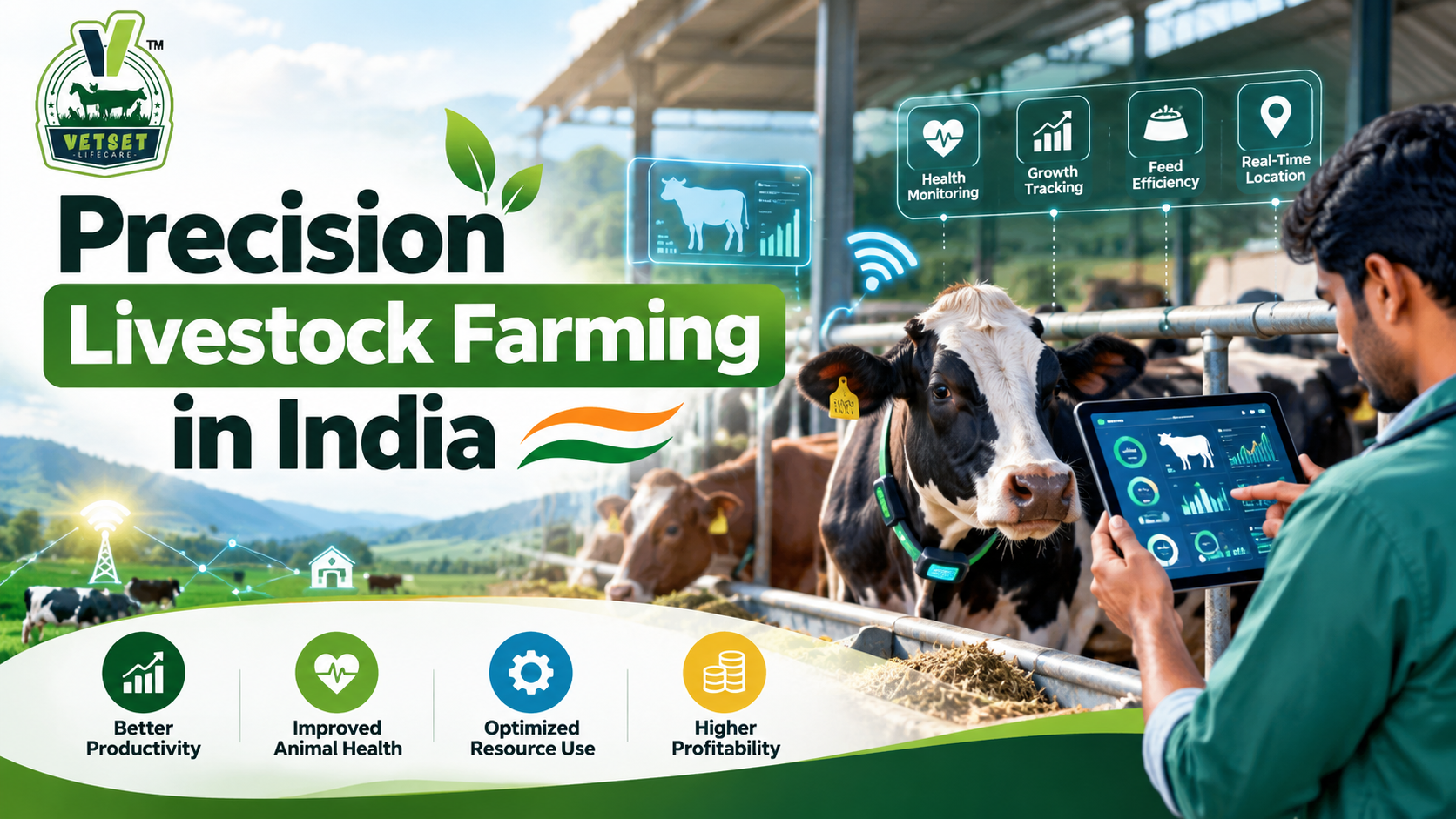
Precision livestock farming (PLF) means using sensors, automatic tools and data to watch each animal and manage the farm better. Smart ear tags, collars, milking data and AI apps spot heat, illness and feeding problems early. In India, PLF is still at an early stage. Cost, poor internet and low awareness slow it down. But even small farms can start with simple records and low-cost tools.
What Is Precision Livestock Farming?
In simple words, PLF is “watch every animal, not just the herd.”
Researchers at ICAR-Indian Veterinary Research Institute describe PLF as the use of sensor-based tools, automatic monitoring and data analysis to manage livestock production well. It tracks animal health, behaviour and the farm environment all day, and helps farmers decide faster (Indian Farming, June 2026).
Instead of checking cows only when you walk through the shed, a sensor can alert you when:
- A cow is in heat (estrus)
- A cow is about to calve
- A cow eats or ruminates less than usual
- A cow starts to limp
- The shed is too hot for the animals
What Is Precision Agriculture? (And What Are the 5 R’s?)
PLF is a close cousin of precision agriculture. The FAO describes precision farming as using GPS, ground sensors and data tools to find differences in field conditions, so farmers can apply inputs more exactly and forecast yields better. South Dakota State University calls it “a management strategy” that gathers, processes and studies information to match inputs to the real need.
What Are the 5 R’s of Precision Farming?
The 5 R’s are a simple rule for giving the right input in the right way. Per SDSU Extension:
- Right Input — use the product or nutrient the crop actually needs
- Right Rate — apply the amount that fits each part of the field
- Right Time — apply when the plant can use it best
- Right Place — put it where the roots can reach it
- Right Manner — pick the best method of application
A related idea, the “4 R’s”, leaves out Right Manner and is used for fertiliser management.
How the same idea fits livestock (our simple view): right feed, right amount, right time, right animal, and right treatment. This is not an official list. It is just an easy way to remember what PLF tries to do.
Technologies Used in Precision Livestock Farming Systems
Two recent Indian papers list the main tools. One is a 2025 review of 50+ studies (2015–2024) from UAS Raichur. The other is the ICAR-IVRI article from 2026. Here is a plain-language table:
| Technology | What it does | Helps with |
|---|---|---|
| RFID / ear tags | Gives each animal a digital ID | Records, breeding, treatment history |
| Wearable sensors (collar, pedometer) | Track movement, rest and activity | Heat detection, illness alerts |
| Rumination monitors | Track chewing time | Feeding problems, early disease signs |
| Automated milking systems | Record yield and milk data per cow | Milk forecasting, udder health checks |
| GPS / GIS | Track animal location | Grazing management |
| Cameras and AI | Watch behaviour in real time | Lameness, stress, calving alerts |
| Early pregnancy tools | Confirm pregnancy sooner | Breeding plans |
| Poultry early-warning systems | Watch temperature, humidity, bird behaviour | Disease and heat stress alerts |
| Farm software / apps | Combine all data in one place | Better daily decisions |
What research says: A major review in the Journal of Dairy Science (Rutten et al., 2013) looked at 139 sensor systems. Most were aimed at fertility/estrus (33%), locomotion (30%), mastitis (25%) and metabolic disorders (16%). The authors found that sensors showed promise, but that detection performance still needed to improve. So sensors are helpers, not magic. A vet still confirms the problem.
Precision Livestock Farming Market: Global Numbers
- MarketsandMarkets values the global PLF market at USD 7.94 billion in 2025 and expects USD 12.12 billion by 2030 (8.8% yearly growth).
- North America holds the biggest share. Dairy farms lead adoption.
- Growth drivers: labour shortage, rising costs, AI use, animal welfare and sustainability.
We did not find a trusted India-only PLF market figure, so we do not quote one. Different research firms use different scopes, so check the source and year before using any number.
Why Precision Livestock Farming in India Matters
India has the animals and the need:
- Milk production: 247.87 million tonnes in 2024-25, up 3.58%
- Egg production: up 4.44%; meat production: up 2.46%
- Livestock in 2019 census: 536.76 million animals and 851.81 million poultry
- Climate pressure: Heat, uneven rain and extreme weather hit animal health. ICAR-IVRI researchers say PLF can help build climate-resilient animal husbandry.
(Figures from the Basic Animal Husbandry Statistics 2025 as summarised by Vet Extension. Please confirm with the original government release before using them in reports.)
More milk with fewer losses means every sick cow found a day earlier counts.
What Is the Current Status of Precision Farming in India?
Here is an honest picture:
- Early stage in livestock. The 2025 UAS Raichur review says weak infrastructure and high costs slow down wide use in India. It also calls for policy support, farmer awareness and local innovation.
- Some real-world use. Indian dairy-tech firm Stellapps has sold wearable “mooON” heat-detection devices. In a March 2020 report, the company said more than 50,000 units were in use at about 20,000 locations and that the cost was about USD 1 per cow per month. The company also claimed a 38% productivity gain for farmers. These are company-reported figures from 2020, so treat them as examples, not guarantees.
- Most farms still run on paper. Many small farmers rely on eyes, experience and paper records.
Bottom line: PLF in India is growing, but it is not yet common on a typical 2–10 animal farm.
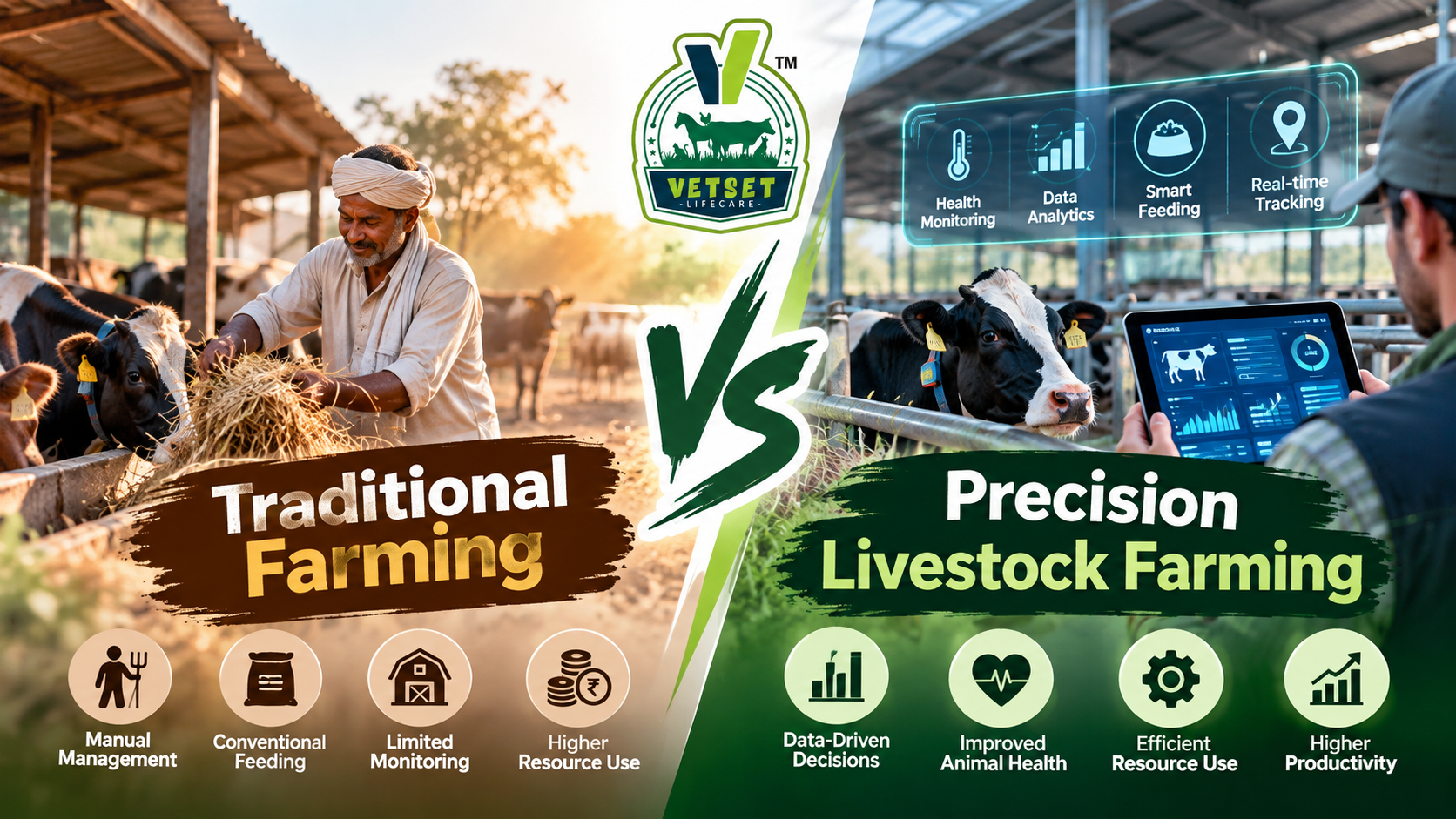
Traditional Farming vs Precision Livestock Farming
| Point | Traditional method | Precision livestock farming |
|---|---|---|
| Checking animals | By eye, a few times a day | Sensors and data, all day |
| Heat detection | Watching behaviour | Activity alerts plus eye check |
| Illness spotting | After clear signs appear | Often earlier, from small changes |
| Records | Notebook or memory | Digital records for each animal |
| Cost to start | Low | Medium to high (varies) |
| Skills needed | Experience | Experience + basic phone or computer use |
| Best for | Small, low-budget farms | Mid to large farms; small farms can start in steps |
Challenges and Simple Fixes
| Problem | Why it happens | Practical fix |
|---|---|---|
| High cost | Devices, apps, setup | Start with one tool, like heat-detection tags. Join a co-operative to share costs |
| Weak internet | Rural network gaps | Pick tools that store data offline and sync later |
| Low awareness | Few training programs | Ask your vet, KVK or dairy co-operative for demos |
| Hard-to-read data | Too many alerts | Choose simple apps that give clear to-do alerts |
| Wrong trust in alerts | Sensors can miss or false-alarm | Always confirm with a vet before treatment |
| Small herd size | Per-animal cost looks high | Focus on your top-value animals first |
A Simple 5-Step Start Plan for Your Farm
- Give every animal an ID (tag number) and write down milk, breeding and treatment dates.
- Track the basics daily: milk per cow, feed, shed temperature.
- Add one sensor tool that solves your biggest loss (for example, missed heat or late mastitis).
- Review data weekly with your vet.
- Grow slowly. Add more tools only when the first one pays back.
Which Livestock Farming Is Most Profitable in India?
There is no single winner. Profit depends on your location, feed cost, herd health, market access and scale. A rough view:
| Type | Why farmers choose it | Watch-outs |
|---|---|---|
| Dairy (cattle, buffalo) | Daily milk income and a huge market | Feed cost, mastitis, fertility problems |
| Poultry (eggs, broilers) | Quick cycles | Price swings, disease and heat stress |
| Goat and sheep | Lower start cost | Disease and market links |
Whichever you pick, healthy animals are the base of profit. Sensors, good feed and timely vet care all lift your margin.
Where Technology Ends and Veterinary Care Begins
A sensor can say, “This cow is off feed.” It cannot treat her. After an alert, farmers still need a vet’s diagnosis, the right medicine, good nutrition and clean housing.
VetSet Lifecare is a WHO-GMP certified veterinary medicine manufacturer in Ambala, Haryana. [CONFIRM before publishing: WHO-GMP claim.] We make injections, boluses, oral liquids, powders and nutritional supplements for cattle, buffalo, poultry and pets. We stand behind the “after the alert” part of smart farming:
- Nutrition support: calcium supplements, mineral mixtures and liver tonics help cows stay strong through peak milk and calving. Use them as your vet advises.
- Treatment, when needed: Medicines should be used only under a registered vet’s advice, with the label’s withdrawal times respected for milk and meat.
- Disease prevention: Early alerts matter most for diseases like lumpy skin disease. Read our guide: Lumpy Skin Disease in Cattle: Symptoms, Treatment & Prevention.
For vets, distributors and brand owners:
- Veterinary product list and products gallery
- Veterinary PCD franchise in India
- Third-party veterinary medicine manufacturing
- India veterinary medicine export opportunity
- Contact VetSet Lifecare — +91 7015507806 | vetsetlifecare@gmail.com
No supplement or sensor replaces proper veterinary care.
Frequently Asked Questions
What are the 5 R’s of precision farming?
The 5 R’s are Right Input, Right Rate, Right Time, Right Place and Right Manner. They guide farmers to give crops the correct product, in the correct amount, at the correct time, in the correct spot, using the best method. A related set, the 4 R’s, is used for fertiliser management.
What is precision livestock farming?
Precision livestock farming is the use of sensors, automatic tools and data analysis to monitor the health, behaviour and output of each animal. It helps farmers spot heat, illness, calving and feeding problems early. Common tools include ear tags, wearable sensors, automatic milking data, cameras and farm apps.
Which livestock farming is most profitable in India?
No single type wins everywhere. Dairy gives daily income, poultry has quick cycles but price and disease risk, and goat farming needs less money to start. Profit depends on your location, feed cost, market access and, above all, herd health. Compare costs and local demand before you decide.
What is the current status of precision farming in India?
It is at an early stage, especially in livestock. Indian research reviews point to high cost, weak infrastructure and low awareness as the main hurdles. Some dairy-tech firms offer sensors and apps, mostly to larger or organised farms. Growth depends on policy support, farmer training and low-cost local tools.
Is precision livestock farming only for big farms?
No. Big farms use more tools, but small farms can start with basics: ear tag IDs, daily milk and treatment records, and one low-cost tool such as a heat-detection device. Joining a dairy co-operative can also lower costs. Start small, track results, and add tools only when they pay back.
How much does precision livestock farming cost in India?
It varies a lot. Records and tags cost little, while robotic milking costs far more. One Indian provider reported about USD 1 per cow per month for a wearable heat-detection device in 2020. Prices change, so ask providers for current quotes and compare them with your expected gains.
Key Takeaways
- PLF means watching each animal with sensors and data, not just the herd.
- The global PLF market is projected to grow from USD 7.94B (2025) to USD 12.12B (2030).
- India is in an early stage: cost, connectivity and awareness are the main hurdles.
- Start small: IDs, records, one tool, weekly review with your vet.
- Sensors raise the alert. A vet, good nutrition and the right medicine solve the problem.
Sources
- ICAR-IVRI — Precision livestock farming for climate-resilient animal husbandry, Indian Farming, Vol. 76(3), June 2026
- UAS Raichur — Precision Livestock Farming Systems in India: AI and ML in Livestock Farming, Journal of Experimental Agriculture International, Nov 2025
- MarketsandMarkets — Precision Livestock Farming Market (July 2026)
- Rutten et al. — Invited review: Sensors to support health management on dairy farms, Journal of Dairy Science, 2013
- SDSU Extension — What is precision agriculture? And what are the 5 R’s?
- UN ESCWA Glossary — Precision farming (citing FAO Fertilizer and Plant Nutrition Bulletin 16, 2006)
- FarmRaise — A Beginner’s Guide to 4R Nutrient Management
- Vet Extension — India livestock statistics (Basic Animal Husbandry Statistics 2025)
- Dairy Global — Indian startup tackles low productivity at dairy farms (March 2020)