

India is quietly becoming one of the world’s most trusted sources of animal healthcare products. While the country is already known as the “pharmacy of the world” for human medicine, a similar shift is happening in veterinary pharma — and 2026 looks like the year this opportunity becomes hard to ignore.
If you manufacture, distribute, or are thinking of starting a veterinary medicine export business from India, this guide answers the questions that matter most: Which countries are buying? What licenses do you need? Is it actually profitable? And how do you get started the right way?
Why Veterinary Medicine Export From India Is Growing in 2026
A few numbers explain why exporters and investors are paying attention:
- India’s overall pharmaceutical exports (formulations, APIs, and vaccines) crossed USD 30 billion in FY2025 and touched roughly USD 31 billion in FY2026 — more than double what they were a decade ago, according to the Pharmaceuticals Export Promotion Council of India (Pharmexcil).
- India’s veterinary healthcare market alone is valued at about USD 1.6–1.8 billion in 2025–26 and is growing at a healthy 8–9% a year, driven by rising pet ownership, livestock disease control programs, and demand for affordable animal medicines.
- India holds the world’s largest population of cattle and buffalo (over 300 million head), which has forced local manufacturers to build large-scale, low-cost production capacity — the same capacity that now serves export markets.
- Manufacturing costs in India remain 30–40% lower than in the US, EU, or China for comparable WHO-GMP quality, making Indian veterinary medicines highly competitive on price without compromising standards.
In short: India already has the manufacturing base, the regulatory system, and the cost advantage. What’s changing in 2026 is that more countries are actively looking for alternative, reliable suppliers of animal healthcare products — and India is stepping into that gap.
Can India Export Veterinary Medicines?
Yes. India can and does export veterinary medicines — including injections, boluses, oral liquids, powders, feed supplements, and vaccines — to over 100 countries. The process is legal and well-regulated under the Drugs and Cosmetics Act, 1940, with oversight from the Central Drugs Standard Control Organisation (CDSCO) and trade facilitation from the Directorate General of Foreign Trade (DGFT).
Veterinary pharma export is treated much like human pharma export in terms of documentation, but with additional attention to animal-specific dosage forms (boluses, feed premixes, injectables for livestock and poultry).
Which Countries Import Veterinary Medicines From India?
Indian veterinary and pharma exporters currently serve a wide spread of regions. Based on current pharma export trade patterns, the biggest opportunity areas are:
| Region | Why They Import From India |
| Africa (Nigeria, Kenya, Tanzania, Zambia, Ethiopia) | Fast-growing livestock economies, limited local manufacturing, price-sensitive markets |
| Southeast Asia (Vietnam, Indonesia, Philippines) | Large poultry and aquaculture industries needing affordable formulations |
| Middle East (Saudi Arabia, UAE) | Strong demand for quality-certified imports and growing local registration support |
| Latin America (Brazil, and neighboring markets) | Large cattle and poultry populations, rising demand for cost-effective veterinary drugs |
| CIS & Central Asia (Armenia and nearby markets) | Emerging bilateral trade ties and new market access agreements |
| South Asia (Nepal, Bangladesh, Sri Lanka) | Geographic proximity, shared regulatory familiarity, low logistics cost |
The United States and Europe remain important for human pharma exports, but for veterinary products specifically, Africa, Southeast Asia, and the Middle East currently offer the fastest-growing, least-saturated opportunities for Indian manufacturers.
How Do I Export Veterinary Medicines From India? (Step-by-Step)
Exporting veterinary medicine isn’t complicated once you know the sequence. Here is the practical roadmap:
1. Get an Import Export Code (IEC) from DGFT
This is your business’s identity for any international trade transaction. Without an IEC, you cannot legally export anything from India, veterinary medicine included. You apply online through the DGFT portal.
2. Hold a Valid Drug Manufacturing or Wholesale License
Your veterinary drug manufacturing unit must operate under a valid license (Form 25 / Form 28 category equivalents for veterinary products), issued by the State Licensing Authority or CDSCO, depending on the product category.
3. Get WHO-GMP / cGMP Certification
Most importing countries — even price-sensitive African and Southeast Asian markets — now expect WHO-GMP certified manufacturing. This certification confirms your facility meets international quality, hygiene, and process-control standards. It’s fast becoming a non-negotiable step, not an optional one.
4. Apply for a Drug Export NOC From CDSCO
Since 2018, every drug shipment — approved or unapproved for the Indian domestic market — requires a No Objection Certificate (NOC) from CDSCO before it can be exported. As of the 2025 guidance update, this is now centralized through CDSCO’s Zonal Offices via the online SUGAM portal, and approvals are typically issued within 7 working days, valid for one year.
5. Register With Pharmexcil (RCMC)
The Pharmaceuticals Export Promotion Council of India (Pharmexcil) issues a Registration-Cum-Membership Certificate (RCMC), which is required for most export incentives, buyer-seller meets, and trade documentation support.
6. Check Destination-Country Registration Requirements
Some importing countries require their own product registration or market authorization before your veterinary medicine can be sold there. This step varies by country and is where many first-time exporters lose time — plan for it early, ideally with a local regulatory agent or distributor in the target market.
7. Sort Packaging, Labelling, and Freight
Veterinary export packaging must meet both Indian export norms and the importing country’s labelling rules (language, dosage instructions, storage conditions). After that, a licensed freight forwarder or Customs House Agent (CHA) handles shipping and customs clearance.
What Licenses Are Needed for Veterinary Exports?
Here’s a quick-reference checklist:
- IEC (Import Export Code) — from DGFT
- Manufacturing/Wholesale Drug License — State Licensing Authority or CDSCO
- WHO-GMP / cGMP Certificate — for quality assurance and buyer trust
- Drug Export NOC — from CDSCO (Zonal Office, via SUGAM portal)
- RCMC (Registration-Cum-Membership Certificate) — from Pharmexcil
- Product Registration in the destination country — where applicable
A quick note on APEDA: APEDA (Agricultural and Processed Food Products Export Development Authority) primarily governs agricultural and processed food exports, and its role in veterinary pharma export is limited — it becomes relevant mainly for certain feed additives, nutraceutical, or organic-certified animal nutrition products rather than core veterinary drugs. For actual medicine exports, CDSCO and DGFT are the two authorities that matter most.
Is Veterinary Export Profitable?
Generally, yes — and here’s why the economics work in India’s favor:
- Lower production costs. Raw material sourcing, labor, and manufacturing overheads in India are significantly cheaper than in Western markets, while WHO-GMP compliant plants can still match international quality benchmarks.
- High-volume demand. Emerging markets with large livestock or poultry populations need consistent, affordable supply — not premium pricing, but steady volume.
- Government support. Export incentive schemes, simplified NOC processes, and Pharmexcil’s buyer-seller meet programs (in regions like Africa and the CIS) actively help exporters find buyers with lower upfront marketing cost.
- Rising global animal healthcare spending. The global veterinary medicine market is projected to grow from roughly USD 56 billion in 2026 to over USD 110 billion by 2033 — and Asia-Pacific, including India, is the fastest-growing regional contributor to that growth.
That said, profitability depends heavily on getting the fundamentals right: certified quality, correct documentation, and a genuine understanding of the destination market’s regulatory expectations. Exporters who skip WHO-GMP certification or destination registration often face shipment holds, rejected consignments, or reputational damage that costs far more than the compliance would have.
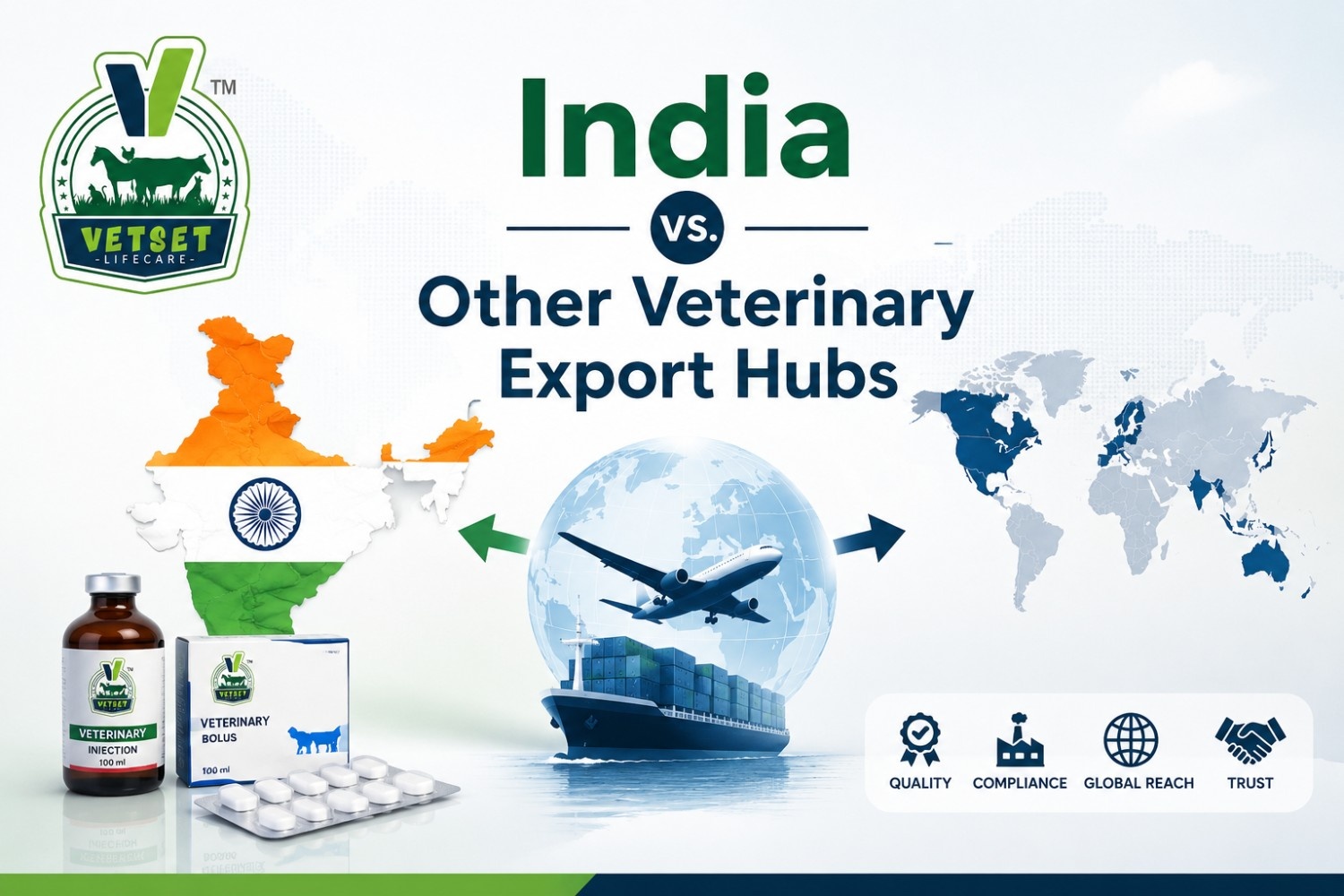
India vs. Other Veterinary Export Hubs: A Quick Comparison
| Factor | India | China | USA/EU |
| Manufacturing cost | Low | Low-Medium | High |
| WHO-GMP compliant capacity | Widely available | Available, less standardized | High but expensive |
| English-language documentation | Yes (advantage for global buyers) | Limited | Yes |
| Regulatory turnaround (Export NOC) | ~7 working days (post-2025 reforms) | Varies | Longer, stricter |
| Best-fit buyer markets | Africa, SE Asia, Middle East, Latin America | Africa, SE Asia | Regulated markets (US, EU, Japan) |
India’s combination of cost efficiency, English-language regulatory documentation, and a fast-improving NOC process gives it a real edge for exporters targeting price-sensitive, high-volume markets.
Common Challenges Exporters Face (And How to Solve Them)
Challenge: Delayed or rejected Export NOCs. Solution: Work with a manufacturer or consultant who already understands CDSCO’s SUGAM portal process and keeps documentation (COA, manufacturing license, product permission) ready in advance.
Challenge: Destination country doesn’t recognize the product formulation. Solution: Check the importing country’s registration requirements before finalizing a shipment — not after. A local agent or distributor can save months of back-and-forth.
Challenge: Inconsistent quality across manufacturing batches. Solution: Partner only with WHO-GMP certified manufacturers. Certification isn’t just paperwork — it reflects real process control that protects your shipments from rejection at the port.
Challenge: High cost of building your own manufacturing unit. Solution: Many veterinary export businesses start with third-party manufacturing arrangements — using an established, certified facility to produce under your own brand while you focus on sales and market development.
How VetSet Lifecare Supports Veterinary Export-Ready Manufacturing
VetSet Lifecare is a WHO-GMP certified veterinary medicine manufacturer based in Ambala, Haryana, producing injections, boluses, feed supplements, and nutritional products for livestock, poultry, and companion animals.
If you’re building a veterinary export business — or want to add export-ready products to your existing portfolio — VetSet Lifecare can support you through:
- Third-party veterinary medicine manufacturing — produce under your own brand at a certified, export-compliant facility, without investing in your own plant.
- Veterinary PCD franchise — for partners who want monopoly rights and ready-to-sell product ranges in domestic and neighboring markets.
- A wide, ready product portfolio — antibiotic and mineral injections, calcium and digestive boluses, oral liquids, and feed supplements — manufactured under strict cGMP standards.
You can learn more about the company on the About Us page, or get in touch to discuss export-ready manufacturing or franchise partnerships.
Frequently Asked Questions
Can India export veterinary medicines?
Yes. India regularly exports veterinary injections, boluses, feed supplements, and vaccines to over 100 countries, under the regulatory framework of the Drugs and Cosmetics Act, 1940, overseen by CDSCO and DGFT.
Which countries import veterinary medicines from India?
The strongest current demand comes from African nations (Nigeria, Kenya, Tanzania, Zambia), Southeast Asia (Vietnam, Indonesia), the Middle East (Saudi Arabia, UAE), Latin America, and neighboring South Asian countries (Nepal, Bangladesh, Sri Lanka).
How do I export veterinary medicines from India?
You need an IEC from DGFT, a valid drug manufacturing/wholesale license, WHO-GMP certification, a Drug Export NOC from CDSCO, RCMC registration from Pharmexcil, and compliance with the destination country’s product registration rules.
What licenses are needed for veterinary exports?
The core licenses are: IEC (DGFT), manufacturing/wholesale drug license, WHO-GMP/cGMP certificate, CDSCO Export NOC, and Pharmexcil RCMC. Destination-country product registration may also be required.
Is veterinary export profitable?
It can be, largely because of India’s low manufacturing costs, large-scale WHO-GMP capacity, and rising global demand for affordable animal healthcare products. Profitability depends on maintaining certified quality and following correct export documentation — cutting corners on either usually costs more in rejected shipments than it saves.
Do I need my own manufacturing unit to start exporting veterinary medicines?
No. Many exporters start through third-party manufacturing partnerships with an already-certified facility, which lowers upfront investment while keeping product quality export-ready.
Final Thoughts
India’s veterinary medicine export opportunity in 2026 isn’t a future possibility — it’s already happening, backed by real trade numbers, a strong manufacturing base, and a regulatory system that’s actively simplifying itself (the 2025 CDSCO Export NOC reform is a good example). The businesses that will benefit most are the ones that treat WHO-GMP certification and proper documentation as the foundation, not an afterthought.
Whether you’re an established distributor looking to add export markets, or a new entrepreneur exploring veterinary pharma for the first time, working with a certified, export-experienced manufacturer is the fastest way to get it right from day one.
Looking to build export-ready veterinary products or explore third-party manufacturing? Contact VetSet Lifecare — WHO-GMP certified veterinary medicine manufacturer, Ambala, Haryana.
Useful Official Resources
- DGFT — Directorate General of Foreign Trade
- CDSCO — Central Drugs Standard Control Organisation
- Pharmexcil — Pharmaceuticals Export Promotion Council of India
- APEDA — Agricultural and Processed Food Products Export Development Authority
Sources: Pharmexcil trade data (2025–2026), Mordor Intelligence India Veterinary Healthcare Market report, CDSCO Export NOC Guidance Document (July 2025), USDA Foreign Agricultural Service livestock estimates. Figures are indicative industry estimates as of 2026 and may be updated as new trade data is released.