

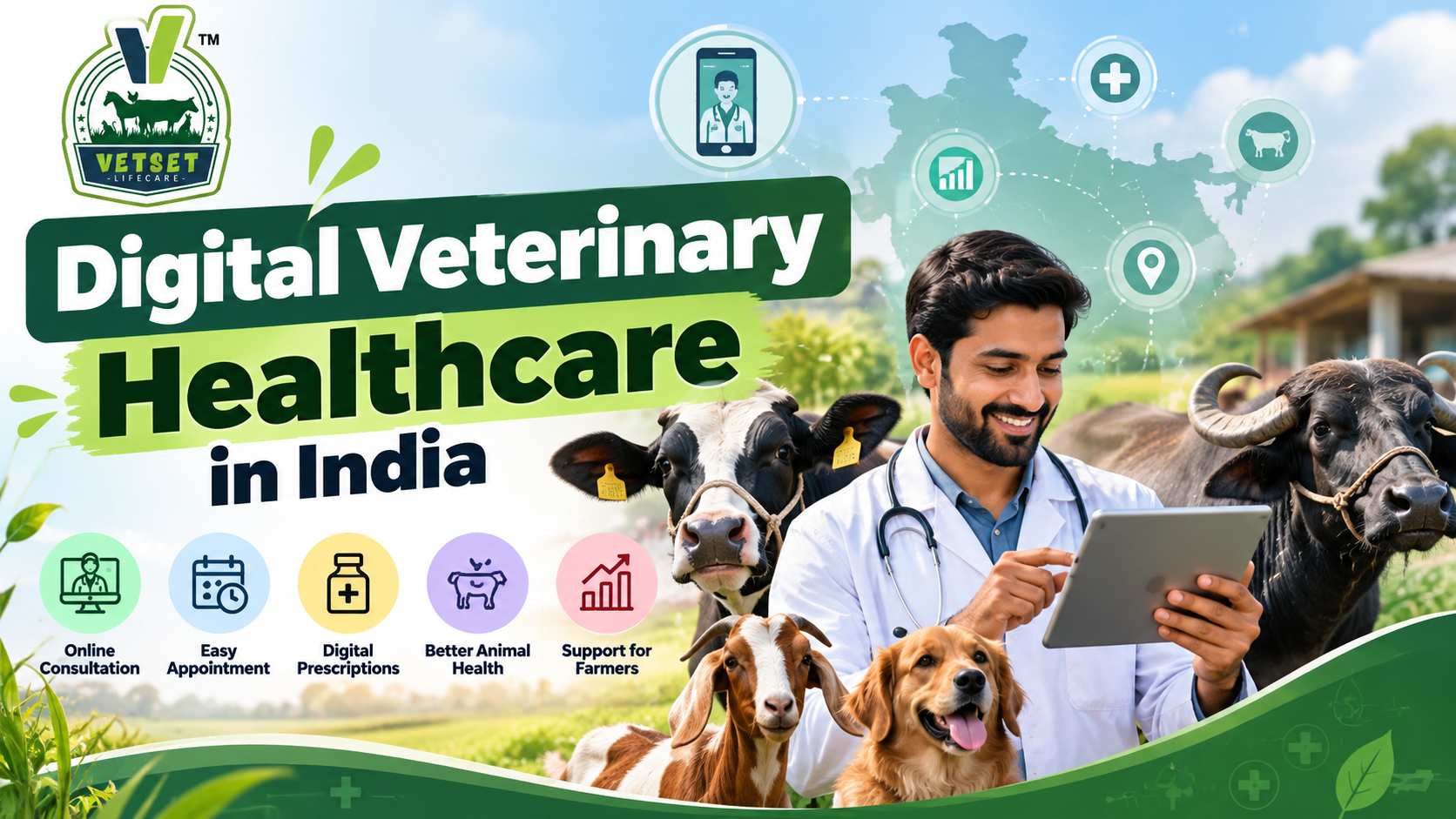
Digital veterinary healthcare means using phones, apps, data, sensors and AI to care for animals. It includes video calls with vets, e-prescriptions, digital animal records, AI image tools and remote monitoring. In India, it already reaches farmers through the Bharat Pashudhan database, Pashu Aadhaar ear tags and the 1962 helpline. It speeds up care, but a vet must confirm the diagnosis.
What Is Digital Veterinary Healthcare?
Think of it as “vet care that travels.” Instead of waiting for a vet to reach your village, data, photos and calls reach the vet first.
Main parts of digital veterinary medicine and the wider digital revolution in animal health:
- Telemedicine and teleconsulting: talk to a vet by phone or video
- Digital records: vaccination, breeding and treatment history on a phone or computer
- E-prescriptions: a vet writes the prescription in an app
- AI tools: software that reads images or data to help find disease
- Remote monitoring: sensors and cameras that watch animals all day
- Digital veterinary platforms: apps and portals that connect owners, field workers, vets and the government
Why Digital Veterinary Healthcare Matters in India
India’s animals are many and spread far. Vets are often far from villages. Digital tools shrink that distance.
| Farmer problem | Digital answer |
|---|---|
| No vet nearby | Call 1962 for a Mobile Veterinary Unit; talk to a vet by phone or video |
| Lost vaccination papers | Digital record linked to the animal’s Pashu Aadhaar tag |
| Sick animal, unsure what it is | Send clear photos or video to the vet for early guidance |
| Missed heat or late illness signs | Wearable sensors and alerts (see our guide on precision livestock farming [CONFIRM URL]) |
| Hard to prove animal’s history for loans, insurance or sale | Verified digital identity and records |
| Hard to find the right medicine | Online product lists, vet advice and trusted suppliers |
Digital Veterinary Healthcare in India: What Is Already Working
1. Bharat Pashudhan and Pashu Aadhaar
Bharat Pashudhan is the national digital database for livestock, under the National Digital Livestock Mission. Its key feature is Pashu Aadhaar, a unique 12-digit barcoded ear tag for each animal. Field workers use the app to record vaccinations, artificial insemination and e-prescriptions.
According to a May 2026 article by Pashudhan Praharee:
- 35.96 crore animals were registered by late 2025
- About 9.5 crore livestock owners and 4 lakh field worker accounts are on the platform
- 146.6 crore vaccination entries and 250 crore transaction records are stored
(These are reported figures from a secondary source, and they change fast. Please check the Department of Animal Husbandry & Dairying for the latest numbers.)
The “1962 Livestock Owner App” is described as the replacement for the older e-Gopala app. It lets farmers see animal records and government schemes.
2. The 1962 Helpline and Mobile Veterinary Units (MVUs)
Farmers can call the toll-free 1962 number to get a Mobile Veterinary Unit at the doorstep. These units are part of the central scheme for veterinary hospitals and dispensaries (ESVHD-MVU). The plan is one MVU for every one lakh livestock.
Real numbers from a government reply in Parliament (30 July 2024): Rajasthan received 536 MVUs, and 3.94 lakh farmers got doorstep care for 17.40 lakh animals. In Karnataka, 290 MVUs were launched in May 2022. Services include diagnosis, treatment and minor surgery.
3. Online Vet Consultations
Online consultation is growing, mostly for pets and larger farms. It works well for:
- Early advice on small problems
- Follow-ups after treatment
- Feeding and care questions
- Deciding whether the animal needs an in-person visit
It does not work for emergencies such as seizures, severe injury, trouble giving birth, poisoning or a blocked urinary tract. These need a vet on site at once.
Is Online Vet Consultation Legal in India?
Be careful here. India’s 2020 Telemedicine Practice Guidelines apply to Registered Medical Practitioners (human medicine). They do not talk about veterinary practice. We did not find a separate national guideline for veterinary telemedicine. So:
- Use only a registered veterinarian.
- Do not accept a prescription without a proper diagnosis.
- Check rules with the Veterinary Council of India or your state veterinary council.
AI Applications in Veterinary Digital Health
Here are the main AI applications in veterinary digital health, in plain words:
| AI use | What it does | Where it is now |
|---|---|---|
| X-ray reading | Flags problems on dog and cat radiographs | Used in clinics, but needs a vet to check |
| Photo-based disease checks | Looks at cattle skin photos for diseases like lumpy skin disease or FMD | Mostly research stage |
| Behaviour and heat alerts | Reads sensor data to flag heat, lameness or illness | Growing on dairy farms |
| Disease forecasting | Uses weather and outbreak data to predict risk | Emerging; check what is available locally |
| Smart herd software | Turns farm data into daily to-do lists | Available from some dairy-tech firms |
What the research really says:
- A January 2026 research preprint tested an AI model on 10,516 expert-labelled images from farms in India, Brazil and the USA. It reported 98.2% accuracy in spotting LSD and FMD in cattle. But it is a preprint (not yet peer reviewed), and look-alike conditions such as insect bites can confuse the images.
- A 2025 commentary on a study of commercial AI for dog and cat X-rays noted an overall sensitivity of 0.688, falling to 0.444 in hard cases. It also warned about small samples and “automation bias,” meaning over-trusting the software.
What this means for you: AI is a helper that flags possible problems. It is not a replacement for a vet’s exam and lab tests.
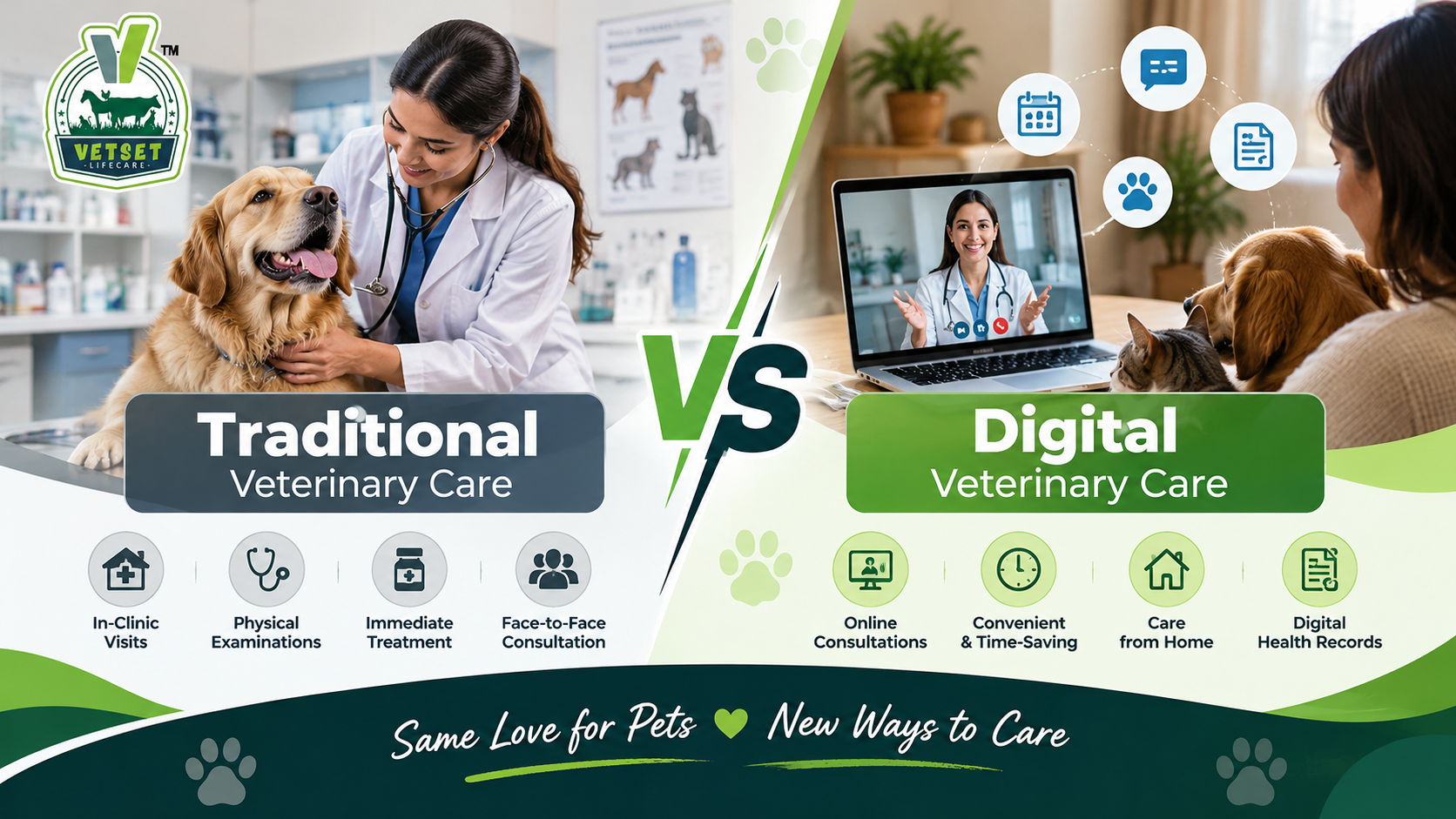
Traditional vs Digital Veterinary Care
| Point | Traditional | Digital |
|---|---|---|
| Getting advice | Visit or wait for the vet | Phone, video or helpline |
| Animal records | Paper, memory | Digital ID and records |
| Early warning | After signs are clear | Sensors can alert earlier |
| Medicine guidance | Verbal | E-prescription and written advice |
| Cost to start | Low | Low to medium (varies) |
| Reliability | Hands-on exam | Good for guidance; not for emergencies |
| Needs | Vet access | Phone, network, basic digital skills |
Digital Veterinary Platform Market and Growth
- Global veterinary telehealth is a small but fast-growing slice. Lucintel (March 2025) forecasts USD 0.8 billion by 2030, growing 18.2% a year. Other research firms give much higher figures, so always check the scope and year.
- Drivers named include more pet ownership, demand for convenience, and growing use of AI and IoT.
- Challenges include rules, technology limits and cost.
- We did not find a trusted India-only market number, so we do not quote one.
Challenges of Going Digital (and Simple Fixes)
| Challenge | Why it matters | Fix |
|---|---|---|
| Poor internet | Video calls fail in remote areas | Use phone calls, voice notes or offline apps |
| Low digital skills | Farmers may feel lost | Ask field workers or a trusted vet to set up the app |
| Wrong self-treatment | Online advice may be misused | Treat only on a registered vet’s written advice |
| Data privacy | Records may leak | Use official or trusted platforms only |
| Over-trust in AI | Missed or wrong alerts | Always confirm with a vet and tests |
| Cost for small farmers | Devices and apps add up | Start with free government tools and group buying |
A Simple 6-Step Plan to Go Digital on Your Farm
- Save the 1962 number in your phone.
- Check that every animal has a Pashu Aadhaar tag and ask your field worker about its record.
- Keep photos and notes of any illness: date, signs, feed, temperature.
- Find a registered vet you can call or video-chat with.
- Write down every treatment and its withdrawal period for milk and meat.
- Add one smart tool (a sensor or herd app) only when you are ready.
How VetSet Lifecare Supports Digital Animal Health
A digital alert tells you something is wrong. Treatment, nutrition and prevention still need quality medicines and a vet’s guidance. That is where we come in.
VetSet Lifecare is a WHO-GMP certified veterinary medicine manufacturer in Ambala, Haryana. [CONFIRM before publishing: WHO-GMP claim.] We make injections, boluses, oral liquids, powders and nutritional supplements for cattle, buffalo, poultry and pets.
Our veterinary medicines digital service for vets, distributors and partners:
- Browse our product list and products gallery online
- Send an enquiry through the contact page | +91 7015507806 | vetsetlifecare@gmail.com
- Explore a veterinary PCD franchise in India or third-party veterinary medicine manufacturing
- [CONFIRM and add if available: digital catalogue download, WhatsApp enquiry, or online order options.]
Related reads: Lumpy Skin Disease in Cattle and India Veterinary Medicine Export Opportunity. More on our blog.
Medicines should be used only on a registered vet’s advice. No app, sensor or supplement replaces veterinary care.
Frequently Asked Questions
What is digital veterinary healthcare?
Digital veterinary healthcare is the use of phones, apps, data, sensors and AI to care for animals. It covers online vet consultations, e-prescriptions, digital animal records, AI image tools and remote monitoring. Its goal is to help owners reach a vet faster and spot disease early, while the vet still makes the final call.
Is online vet consultation safe and legal in India?
Online advice from a registered vet is useful for small problems and follow-ups. India’s 2020 telemedicine rules cover human doctors, and we found no separate national veterinary guideline, so check with the Veterinary Council of India or your state council. Never use online advice for emergencies like poisoning, seizures or difficult birth.
How does AI help in animal health?
AI can read X-rays and cattle photos, and it can study sensor data to flag heat, lameness or illness early. Studies show promise but also limits: one AI X-ray test had a sensitivity of 0.688. So AI works best as a second pair of eyes. A vet should confirm every result with an exam and tests.
What are Bharat Pashudhan and Pashu Aadhaar?
Bharat Pashudhan is India’s national digital database for livestock. Pashu Aadhaar is a unique 12-digit barcoded ear tag for each animal. Together they store records such as vaccinations, breeding and treatments. Field workers update them through an app, and owners can see records and schemes through the 1962 Livestock Owner App.
How can I get a vet in my village quickly?
Call the toll-free 1962 helpline to request a Mobile Veterinary Unit, which brings diagnosis and treatment to your door. The plan is one unit for every one lakh livestock. Coverage varies by state, so also save your local vet’s number. For emergencies, do not wait for an online reply.
Can AI or an app replace my vet?
No. Apps and AI can give early alerts and guidance, but they cannot examine the animal, run lab tests or give a final diagnosis. Research shows AI can miss cases and be fooled by look-alike conditions. Use digital tools to reach your vet sooner, not to avoid your vet.
Key Takeaways
- Digital veterinary healthcare = phones, data, sensors and AI working with a registered vet.
- India already has real tools: Bharat Pashudhan, Pashu Aadhaar tags and the 1962 helpline with Mobile Veterinary Units.
- AI is promising but not perfect. A vet must confirm.
- Online consults suit follow-ups and small problems, not emergencies.
- Good medicines, nutrition and vet advice still do the healing.
Sources
- Pashudhan Praharee — Digital Veterinary and Livestock Management Systems in Rural India (May 2026)
- Vikaspedia — Revolutionizing Veterinary Practice with Digital Applications
- Global Agriculture — What is Bharat Pashudhan?
- Parliament of India (Rajya Sabha) — reply on Mobile Veterinary Units and 1962 helpline, 30 July 2024
- Agriculture Post — Centre launches mobile veterinary units (2022)
- Lucintel — Veterinary Telehealth Market Report (March 2025)
- Frontiers in Veterinary Science — Commentary on AI vs radiologists for canine and feline radiographs (2025)
- arXiv — Simultaneous Detection of LSD and FMD in Cattle Using Ensemble Deep Learning (Jan 2026, preprint)
- Mondaq — Telemedicine Practice Guidelines (India, 2020)
- Vetic — The rise of online vet consultations in India