

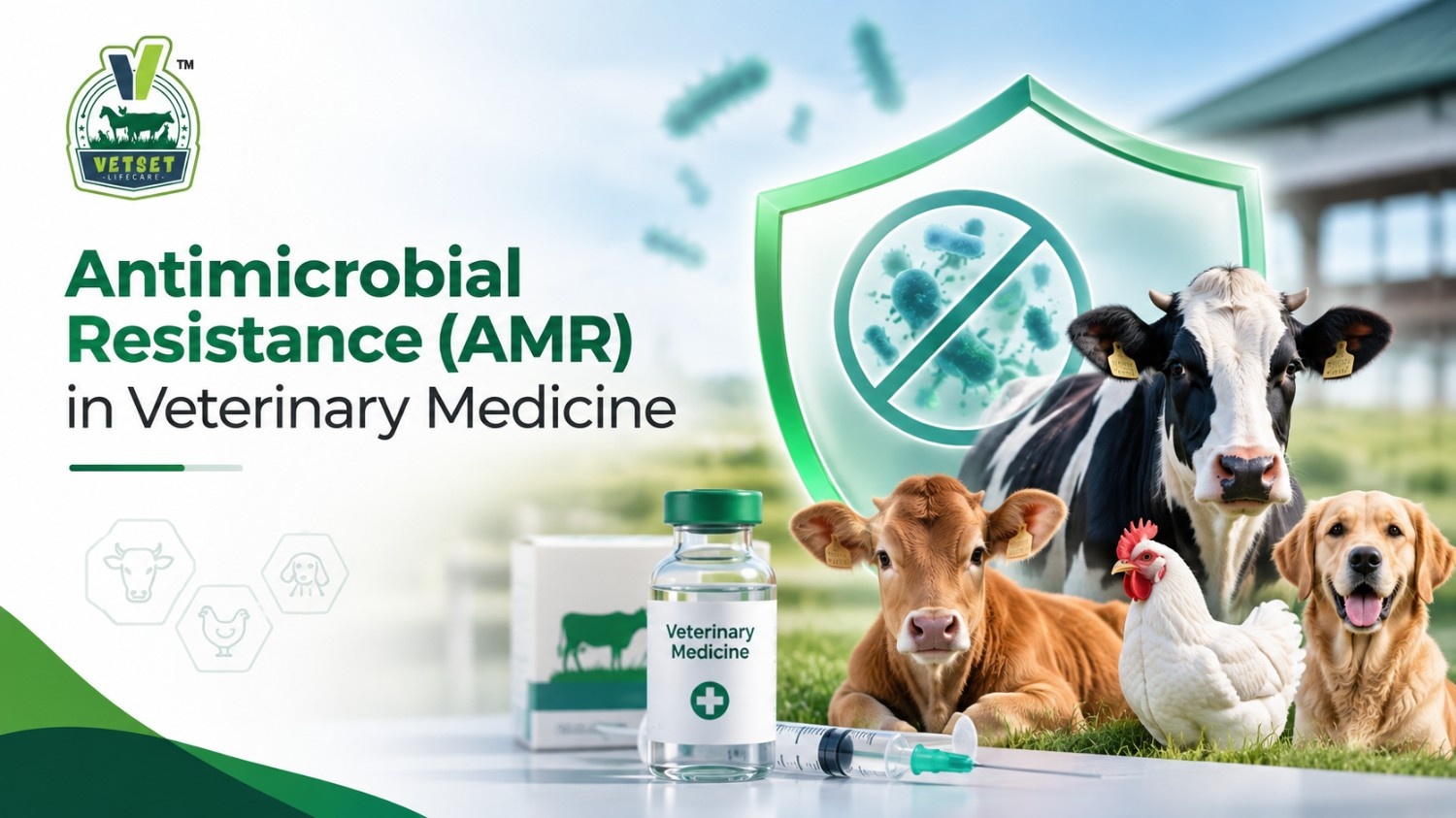
Antimicrobial resistance (AMR) happens when bacteria evolve to survive the antibiotics designed to kill them — and livestock farming plays a bigger role in this than most people realize. Nearly 50% of all antibiotics produced globally are used in livestock, and India ranks among the world’s top consumers of veterinary antimicrobials, using an estimated 5,747 tonnes in 2020 alone. The WHO and WOAH (World Organisation for Animal Health) both classify AMR as one of the most serious global health threats of this decade — one that spreads between animals, humans, and the environment. The good news: responsible antibiotic use, correct dosing, and sourcing veterinary medicines from a certified veterinary pharma company can meaningfully slow this trend, protecting both animal and human health.
Introduction
Every time a cow, buffalo, or flock of poultry is treated with an antibiotic, there’s a hidden risk beyond the immediate illness: the possibility that surviving bacteria adapt and become resistant to that same antibiotic in the future. This is antimicrobial resistance, and it’s no longer a distant, theoretical problem — it’s actively reshaping how veterinary medicine needs to be practiced, prescribed, and manufactured.
For farmers, distributors, and PCD franchise partners working in animal healthcare, understanding AMR in veterinary medicine isn’t just a public-health talking point. It directly affects which treatments still work, how livestock diseases are managed, and — increasingly — which markets and buyers require proof of responsible antibiotic sourcing before they’ll do business with you.
What Is Antimicrobial Resistance? The Basics
Antimicrobial resistance occurs when bacteria, viruses, fungi, or parasites change over time and no longer respond to the medicines designed to treat them. In livestock specifically, this typically happens through:
- Overuse — giving antibiotics more often or in higher doses than necessary
- Underuse or incomplete courses — stopping treatment early, which lets partially-resistant bacteria survive and multiply
- Growth-promotion use — administering antibiotics not to treat illness but to promote faster weight gain, a practice increasingly restricted worldwide
- Poor-quality or substandard antibiotics — inconsistent potency can allow bacteria to survive at sub-lethal doses, accelerating resistance
Resistant bacteria don’t stay contained to the animal they originated in. They can spread to humans through direct contact, consumption of animal products, or environmental exposure — which is why global health bodies treat AMR as a One Health issue, connecting animal, human, and environmental health together.
Why AMR Matters So Much in Veterinary Medicine: The Numbers
| Metric | Data Point | Source |
|---|---|---|
| Share of global antibiotics used in livestock | Approximately 50% | Peer-reviewed livestock AMU research |
| India’s veterinary antimicrobial use (2020) | ~5,747 tonnes | Global AMU trend data (Mulchandani et al., 2023) |
| Top 5 global veterinary antimicrobial consumers | China, Brazil, India, USA, Australia — 58% of global use | Global AMU trend data |
| Projected global rise in livestock antimicrobial use (2020–2030) | +8% | Global AMU trend data |
| Projected increase in tetracycline use by 2030 | +9% | Global AMU trend data |
| Estimated reduction in animal-origin food production due to AMR | 7.5% | World Bank |
| Antimicrobials used in animals that are also critical in human medicine | Less than 20%, but still classified as “critically important” | WOAH |
These numbers make one thing clear: livestock farming isn’t a side issue in the global AMR conversation — it’s one of the central drivers, and India’s scale as one of the world’s largest livestock economies puts it squarely in the middle of this challenge.
Why Is AMR Important in Veterinary Medicine Specifically?
For veterinary medicine, AMR matters for three connected reasons:
- Treatment failure risk — as resistance spreads, previously reliable antibiotics become less effective, leaving fewer options to treat common livestock infections like mastitis or respiratory disease.
- Food safety and trade implications — resistant bacteria can enter the food chain through meat and dairy, and international buyers increasingly require documentation of responsible antibiotic use before accepting exports.
- Human health spillover — resistant bacteria don’t respect species boundaries; infections that start in livestock can eventually affect human treatment options too.
This is precisely why organizations like the WHO and WOAH have made AMR a shared global priority, coordinating surveillance and guidelines across both human and animal health sectors.
Responsible vs. Risky Antibiotic Practices: A Comparison
| Practice | Responsible Antibiotic Use | Risky / AMR-Accelerating Practice |
|---|---|---|
| Diagnosis | Treatment based on veterinary diagnosis | Antibiotics given without confirmed need |
| Dosage | Full, correctly calculated course completed | Doses skipped or stopped early |
| Purpose | Used to treat confirmed infection | Used routinely for growth promotion |
| Source | Sourced from a certified veterinary pharma company | Purchased from unverified or informal sellers |
| Record-keeping | Treatment and dosage documented | No tracking of what was administered or when |
| Rotation | Antibiotic classes rotated per veterinary guidance | Same antibiotic used repeatedly regardless of resistance patterns |
The pattern here matters more than any single practice in isolation — AMR accelerates fastest where several risky practices overlap, and it slows meaningfully wherever farms and distributors commit to the responsible column consistently.
How Can Veterinary Companies Reduce AMR?
Manufacturers and suppliers of veterinary antibiotics have a direct role to play, beyond just producing medicine:
- Consistent potency and quality — a certified veterinary pharma company ensures every batch meets exact potency specifications, so animals receive an effective, complete dose rather than a weakened one that lets bacteria survive and adapt
- Clear dosage guidance — accurate labeling and dosage instructions help farmers and veterinarians avoid under-dosing
- Responsible product ranges — avoiding promotion of antibiotics for non-therapeutic growth-promotion use
- Education and awareness — supporting farmers and franchise partners with correct usage guidance, not just selling product
- WHO-GMP certified manufacturing — consistent, quality-controlled production is itself an AMR-prevention measure, since substandard antibiotics are a known contributor to resistance development
Which Antibiotics Cause Resistance? A Quick Note on Risk
Nearly all antibiotic classes can contribute to resistance if misused — but a few points are worth understanding:
- Tetracyclines are among the most commonly used veterinary antimicrobials globally and are projected to see continued growth in use, making responsible dosing especially important for this class
- Critically important antimicrobials (as classified by WOAH) — those also essential in human medicine — carry the highest stakes when resistance develops, since treatment failure in these classes can affect human healthcare too
- The risk isn’t inherent to any single antibiotic — it’s driven overwhelmingly by how antibiotics are used, dosed, and sourced, not which specific drug is chosen
How to Prevent Antimicrobial Resistance: Practical Steps
- Always follow veterinary diagnosis and prescription — avoid self-medicating livestock based on guesswork
- Complete the full prescribed course — even if the animal appears to recover early
- Source antibiotics from certified, WHO-GMP manufacturers — quality and potency consistency directly affects resistance risk
- Maintain treatment records — track what was administered, when, and to which animals
- Avoid non-therapeutic use — don’t use antibiotics purely for growth promotion where alternatives exist
- Stay updated on veterinary antibiotic guidelines — practices and recommended classes evolve as resistance patterns shift
VetSet Lifecare’s Commitment to Responsible Veterinary Antibiotics
As a WHO-GMP and cGMP certified veterinary pharma company based in Ambala, Haryana, VetSet Lifecare takes its role in AMR prevention seriously — not as a marketing point, but as a manufacturing responsibility:
- Consistent, verified potency in every batch of antibiotics and injections, so farmers and veterinarians can trust the dose is doing what it’s meant to do
- Science-backed formulations manufactured under strict quality control, reducing the risk that comes from substandard or inconsistent products
- Clear product guidance to support correct dosing and responsible use among our franchise partners and distributors
- A full, honest product range — including feed supplements and non-antibiotic support products — so farmers have alternatives to reach for when antibiotics genuinely aren’t the right answer
Choosing quality veterinary antibiotics from a certified, transparent manufacturer is one of the simplest, most direct actions a farmer or distributor can take toward AMR prevention — because a medicine that works exactly as intended, every time, is itself a form of responsible use.
Frequently Asked Questions
Q1. What is antimicrobial resistance?
Antimicrobial resistance is when bacteria, viruses, or other microorganisms evolve to survive the medicines that were previously effective against them, making infections harder to treat over time.
Q2. Why is AMR important in veterinary medicine?
Because livestock accounts for roughly half of global antibiotic use, resistant bacteria that develop in animals can affect treatment options for both animals and, through food and environmental exposure, humans.
Q3. How can veterinary companies reduce AMR?
By manufacturing consistent, high-potency antibiotics under certified quality standards, providing clear dosage guidance, avoiding promotion of non-therapeutic use, and educating farmers and distributors on responsible practices.
Q4. Which antibiotics cause resistance?
Nearly any antibiotic class can contribute to resistance if misused, though “critically important” antimicrobials (as classified by WOAH) carry higher stakes since they’re also essential in human medicine.
Q5. How to prevent antimicrobial resistance?
Follow veterinary diagnosis and prescriptions, complete full treatment courses, source antibiotics from certified manufacturers, maintain treatment records, and avoid non-therapeutic antibiotic use.
Conclusion: A Shared Responsibility Across the Supply Chain
Antimicrobial resistance isn’t a problem that any single farmer, distributor, or manufacturer can solve alone — it requires responsible choices at every link in the chain, from how a medicine is manufactured to how it’s dosed on the farm. With India among the world’s largest users of veterinary antimicrobials, the choices made here genuinely matter on a global scale.
VetSet Lifecare’s commitment to WHO-GMP certified manufacturing and honest product guidance reflects our belief that quality and responsibility aren’t separate goals — they’re the same goal, approached from different directions.
Call: +91 7015507806 Email: vetsetlifecare@gmail.com
Sources: World Health Organization (WHO); World Organisation for Animal Health (WOAH); Mulchandani et al., “Global trends in antimicrobial use in food-producing animals: 2020 to 2030” (2023); World Bank AMR impact estimates; PMC — Livestock Antibiotics Use and Antimicrobial Resistance research review.