

Liquid calcium for cattle prevents milk fever (hypocalcemia), absorbs faster than powder or bolus forms, supports milk production, strengthens bone development, improves fertility, and boosts immunity — particularly when given during the transition period, the three weeks before and after calving when calcium demand spikes sharply.
Introduction
Every dairy farmer in India knows the dread of a freshly-calved cow lying flat, unable to rise — a classic sign of milk fever. It costs money, time, and in the worst cases, the cow itself. The good news is that it’s largely preventable.
Liquid calcium has become one of the most practical, farmer-friendly interventions in modern livestock management. With India’s dairy sector producing well over 200 million tonnes of milk annually and high-yielding crossbred cows increasingly entering herds, calcium deficiency is a systemic challenge, not a rare event.
What Is Liquid Calcium for Cattle?
Liquid calcium for cattle is a ready-to-use, water-soluble calcium supplement formulated for livestock. Unlike powder or granule-based supplements that dissolve slowly in the rumen, liquid calcium is designed for rapid absorption — when administered correctly via oral drench, it can be absorbed significantly faster than solid forms.
Quality liquid calcium formulations typically include:
- Calcium (as calcium chloride or calcium propionate) — the primary active ingredient
- Magnesium — supports nerve and muscle function, and calcium metabolism
- Phosphorus — works alongside calcium for bone mineralisation
- Vitamin D3 — essential for calcium absorption from the gut
- Propylene glycol or glucose — provides an energy boost, valuable in the post-calving period
- B-complex vitamins — support appetite and liver function in stressed cattle
This multi-nutrient combination is what distinguishes a well-formulated liquid calcium product from a basic calcium solution.
Why Calcium Is Critical for Cattle
Calcium is one of the most metabolically active minerals in a dairy cow’s body, and demand spikes sharply around calving:
- A dry cow requires a relatively modest daily calcium intake
- At calving, the sudden onset of colostrum and milk production increases calcium demand by roughly 2-3 times within hours
- If the cow’s regulatory systems (parathyroid hormone activity, vitamin D activation, bone calcium mobilisation) can’t keep pace, blood calcium drops
The result is hypocalcemia — either clinical (visible collapse, inability to rise) or subclinical (no obvious signs, but reduced productivity and immunity). According to University of Minnesota Extension research, subclinical hypocalcemia affects a substantial share of dairy cows around calving — considerably more common than the visible clinical form — making it a widespread, often under-recognised drag on herd productivity.
Top Benefits of Liquid Calcium for Cattle
1. Prevents Milk Fever (Hypocalcemia)
This is the primary reason most farmers turn to liquid calcium. Administering it before and immediately after calving helps stabilise blood calcium during the most vulnerable window.
Liquid calcium’s key advantage over powder or bolus forms is absorption speed — when properly drenched, it’s absorbed considerably faster than powder mixed into feed, which can take hours to meaningfully raise blood calcium. This speed matters most in genuine emergencies, when a cow is already showing early signs of weakness.
2. Supports Milk Production
Calcium isn’t just about disease prevention — it’s directly involved in milk synthesis. Colostrum, a cow’s first milk, is calcium-dense, and adequate blood calcium at calving supports full colostrum production and a smoother transition into peak lactation.
Cows experiencing subclinical hypocalcemia at calving often show a blunted milk yield curve for the rest of that lactation — a loss that’s difficult to fully recover. Calcium demand during early lactation is substantially higher than during the dry period, which is why well-timed supplementation around calving matters for sustaining yield.
3. Supports Strong Bone Development
The vast majority of a cow’s total body calcium is stored in bone. In calves, adequate calcium intake — easily delivered via a liquid supplement mixed into milk or water — supports healthy skeletal development. Deficiency at this stage can lead to weak bones and poor growth.
In adult cattle, chronic calcium shortfall contributes to progressive bone demineralisation, sometimes showing as stiffness or increased fracture risk. Adequate supplementation reduces the extent to which the body needs to draw calcium from the skeleton during high-demand periods.
4. Improves Reproductive Performance
Calcium plays a role in uterine muscle contraction — relevant during calving itself, expulsion of the placenta, and early uterine recovery afterward. Low blood calcium is associated with weaker uterine tone, higher rates of retained placenta, and delayed return to normal reproductive cycling.
Maintaining adequate calcium through the transition period supports more efficient reproductive recovery and a better chance of timely rebreeding.
5. Strengthens Immunity
Calcium plays a signalling role in immune cell function — neutrophils and other immune cells rely on calcium signalling to mount effective responses against infection. Hypocalcemia has been associated with reduced immune activation during the transition period, increasing vulnerability to mastitis and uterine infections in the days following calving.
Maintaining calcium status is therefore a genuine immunity factor for a freshly-calved cow, not only a structural or metabolic one.
6. Supports Muscle Function
Calcium governs muscle contraction throughout the body, including the heart and the rumen wall. Low calcium impairs rumen motility, reducing feed intake and compounding the energy deficit typical of early lactation — this is part of why a milk fever cow often cannot stand or eat normally.
7. Reduces Risk of Secondary Metabolic Disorders
Milk fever rarely occurs in isolation. A cow weakened by low calcium often can’t eat normally, leading her to mobilise body fat for energy — raising the risk of ketosis. Reduced gut motility also increases the risk of displaced abomasum. Preventing hypocalcemia in the first place reduces the likelihood of this broader cascade of complications.
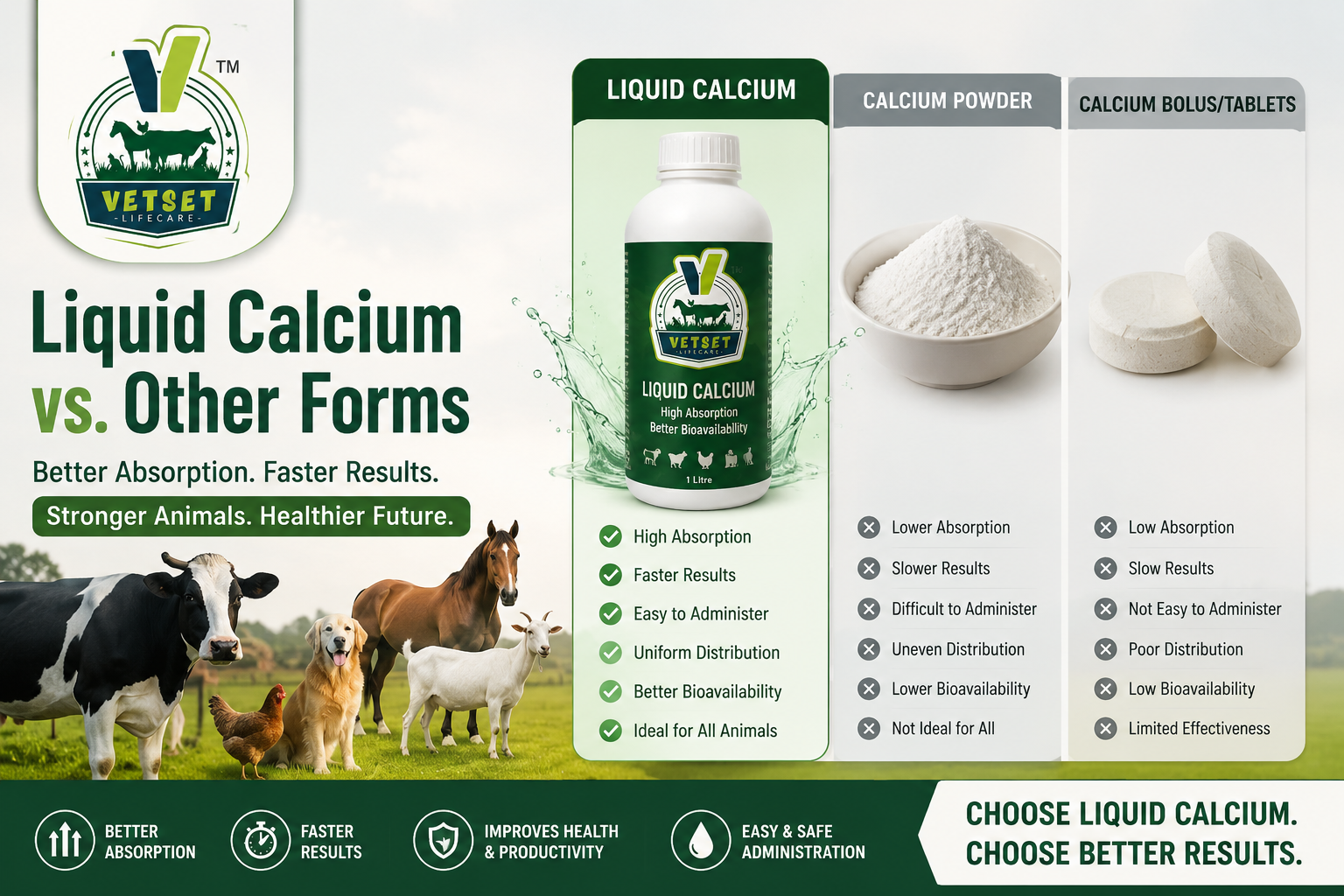
Liquid Calcium vs. Other Forms
| Feature | Liquid Calcium | Powder Calcium | IV Calcium |
|---|---|---|---|
| Absorption Speed | Fast | Slow | Immediate |
| Ease of Use | High (drench or water) | Moderate (feed mix) | Low (requires vet) |
| Bioavailability | High | Moderate | High |
| Suitable for Emergency | Yes | No | Yes |
| Contains Co-nutrients | Commonly (Mg, P, Vit D3) | Varies | Rarely |
| Farm Administration | Yes | Yes | No — vet only |
Note: IV calcium is the fastest option for severe clinical cases but requires veterinary administration and carries a documented risk of a secondary blood calcium drop hours after infusion if not managed carefully. Oral liquid calcium avoids this specific risk.
Who Needs Liquid Calcium Most?
Not every cow needs aggressive calcium supplementation. Prioritise it for:
- Cows in their third lactation or later — older cows mobilise calcium from bone less efficiently than first or second calvers
- High-yielding crossbred cows (HF, Jersey crosses), where milk calcium demand is proportionally higher
- Cows with a previous history of milk fever
- Cows on high-potassium forage diets, which can interfere with calcium regulation
- Cows calving during hot weather, when heat stress adds further metabolic strain
How to Administer Liquid Calcium
- Timing — give the first dose close to calving, with a follow-up dose roughly 12-24 hours later for high-risk cows, following product label guidance
- Drenching technique — proper technique matters for both safety and effectiveness; ask your veterinarian or product supplier to demonstrate correct administration if you’re new to it
- Dosage — always follow the specific product’s labelled dosage; overdosing with high-concentration calcium chloride formulations can cause throat irritation or digestive upset
- Prevention vs. treatment — for healthy cows as a preventive measure, liquid calcium can be added to drinking water or feed; for a suspected active case, direct oral drenching is more reliable
- Veterinary consultation — always consult a veterinarian for herd-specific protocols, especially if you’re seeing multiple milk fever cases in the same season
Why This Matters in the Indian Context
India’s dairy herd is undergoing rapid productivity transformation, with crossbreeding programs introducing Holstein Friesian and Jersey genetics into smallholder farms across states like Punjab, Haryana, Gujarat, and Tamil Nadu. Higher-yielding animals face proportionally higher calcium demands, and traditional approaches like limestone powder in feed often aren’t fast enough for genuine emergencies, or practical when calving timing can’t be predicted precisely. Liquid calcium’s speed and ease of farm-level administration fill this gap.
FAQs
Q1. What are the main benefits of liquid calcium for cattle?
Liquid calcium prevents milk fever, supports milk production, strengthens bone development, improves fertility, boosts immunity, and reduces the risk of secondary disorders like ketosis — particularly valuable during the transition period around calving.
Q2. How is liquid calcium different from powder calcium for cows?
Liquid calcium is absorbed considerably faster than powder calcium, which dissolves slowly in the rumen. This makes liquid calcium more suitable for emergency situations, while powder is often used for routine, non-urgent supplementation.
Q3. What is the best calcium supplement for cows in India?
Look for a liquid calcium formulation combining calcium with magnesium, phosphorus, and Vitamin D3 for better bioavailability, manufactured under WHO-GMP certification for consistent quality.
Q4. When should I give liquid calcium to my cow?
Common timing includes shortly before expected calving and within hours after calving, with cows in their third lactation or later, and high-yielding crossbreds, prioritised. Always follow product labelling and veterinary guidance for your specific herd.
Q5. Can liquid calcium prevent milk fever completely?
Consistent use in high-risk cows significantly reduces clinical milk fever incidence, but doesn’t eliminate all risk — subclinical hypocalcemia can still occur. A complete prevention approach also includes proper dry-period nutrition and body condition management.
Q6. Is liquid calcium safe for calves?
Yes, when dosed appropriately for the calf’s age and weight. Liquid calcium supports skeletal development and can be mixed into milk or water for easy administration — always follow product-specific dosing guidelines.
Q7. What happens if a cow gets too much liquid calcium?
Overdosing, particularly with high-concentration calcium chloride formulations, can cause throat irritation or digestive upset. Always follow the labelled dose and consult a veterinarian if unsure.
Q8. Why do older cows need more calcium supplementation?
Hypocalcemia risk increases with each successive lactation, since older cows are generally less efficient at mobilising calcium from bone reserves and absorbing it from the gut compared to first or second calvers.
Sources
- University of Minnesota Extension — Prevention and Treatment of Hypocalcemia
- 20th Livestock Census, Department of Animal Husbandry and Dairying, Government of India
Related Reading
Need Reliable Liquid Calcium Supplements?
VetSet Lifecare manufactures WHO-GMP certified liquid calcium and mineral supplements formulated for Indian dairy conditions. Contact us at +91 70155 07806 or vetsetlifecare@gmail.com for supply and franchise queries.
Disclaimer: This article is for general awareness only. Dosages and administration technique should follow product labelling — consult a veterinarian for herd-specific guidance, especially for an active clinical case.