

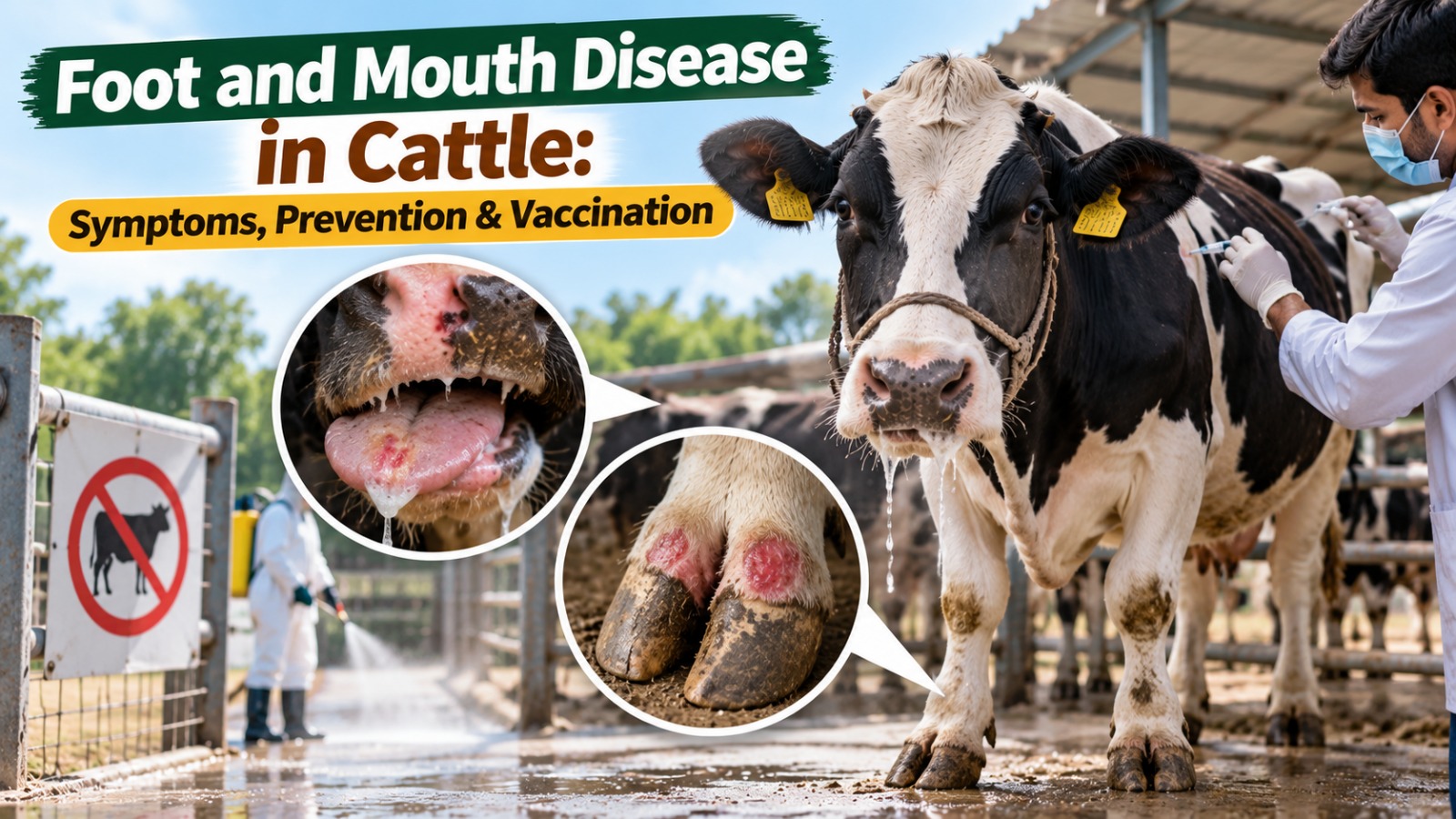
Foot and Mouth Disease (FMD) in cattle is a highly contagious viral disease causing fever, blisters in the mouth and on the feet, drooling, lameness, and a sharp drop in milk yield. There is no specific antiviral treatment for FMD — control relies entirely on vaccination, isolation of infected animals, and biosecurity. India runs a national FMD Control Programme (FMD-CP) under the Department of Animal Husbandry and Dairying, providing free bi-annual vaccination to cattle and buffaloes above 4 months of age, with a national goal of controlling and eventually eradicating the disease by 2030.
Introduction
Foot and Mouth Disease is one of the most economically damaging livestock diseases in India — not usually because it kills adult cattle, but because of what it does to milk production, weight gain, and trade restrictions while it spreads through a herd or region.
This guide covers what FMD actually looks like, how it spreads, India’s national vaccination program, and what to do if you suspect an outbreak on your farm.
What Is Foot and Mouth Disease in Animals?
Foot and Mouth Disease is a highly contagious viral disease affecting cloven-hoofed animals — cattle, buffaloes, sheep, goats, and pigs. It’s caused by a virus with seven distinct serotypes (O, A, Asia 1, and others), and infection with one serotype does not protect an animal against the others — this is why outbreaks can still occur even in herds that were previously vaccinated against a different strain.
FMD spreads rapidly through direct contact, respiratory secretions, contaminated equipment, vehicles, and even people moving between infected and healthy animals.
Symptoms of Foot and Mouth Disease in Cattle
- High fever, often the first noticeable sign
- Vesicles (fluid-filled blisters) in the mouth, on the tongue, gums, and lips
- Blisters and sores on the feet, particularly between the hooves and around the coronary band
- Excessive drooling and smacking of the lips
- Lameness and reluctance to move due to painful foot lesions
- Reduced appetite and noticeable weight loss
- Sharp drop in milk yield in lactating animals
- Higher mortality risk in young calves compared to adult cattle
Most adult cattle recover from FMD itself, but the secondary effects — lost milk production, weight loss, and lameness — can significantly affect a farm’s income for weeks or months afterward.
Why FMD Matters So Much Economically
FMD’s real damage isn’t just the disease itself — it’s the scale of loss it causes across a herd or region:
- A large multi-state Indian study (2013-14 to 2015-16, covering 18,609 farm households across 123 districts) estimated the farm-level economic loss from FMD in cattle and buffaloes at approximately USD 3,159 million (₹2,21,110 million) during the study period.
- States without the FMD Control Programme implemented showed significantly higher numbers of affected villages and farms compared to states actively running the vaccination program.
- Because FMD directly reduces milk yield and can restrict livestock trade, even a localized outbreak can have ripple effects across a dairy-dependent local economy.
India’s Foot and Mouth Disease Control Programme (FMD-CP)
FMD control in India is coordinated at the national level through the FMD Control Programme (FMD-CP), now part of the broader Livestock Health & Disease Control Programme under the Department of Animal Husbandry and Dairying (DAHD).
Key facts about the program:
- Vaccination is provided free of cost to farmers, with the Government of India centrally procuring and supplying vaccines, along with cold chain infrastructure and awareness campaigns.
- The program targets bi-annual (twice-yearly) vaccination of all cattle and buffaloes to build and maintain herd immunity.
- All cattle and buffaloes above 4 months of age are eligible and recommended for vaccination; sheep, goats, and pigs should be included where feasible.
- As of recent vaccination rounds, the program has covered approximately 24 crore (240 million) cattle and buffaloes out of a targeted population of 25.8 crore — over 95% coverage, well above the threshold needed for herd immunity.
- The national goal is to control and eventually eradicate FMD by 2030, which is expected to also boost India’s livestock product exports by meeting international disease-free trade requirements.
Vaccination Schedule for FMD
| Stage | Recommendation |
|---|---|
| First vaccination | From 4 months of age |
| Booster | 4 weeks after the first dose (initial primary course) |
| Routine revaccination | Every 6 months (bi-annual), for life |
Important: Immunity from FMD vaccination does not last a lifetime, and booster doses every six months are necessary to maintain protective immunity — this is exactly why the national program is structured as a recurring bi-annual campaign rather than a one-time vaccination.
Foot and Mouth Disease Treatment in Cattle
This is a critical point to understand: there is no specific antiviral treatment for FMD. Management of an active case focuses entirely on supportive care and preventing further spread:
- Isolate infected animals immediately from the rest of the herd
- Clean and dress foot lesions to prevent secondary bacterial infection and fly infestation — a mixture of coal tar and copper sulfate is a commonly used, cost-effective option for foot lesion dressing
- Provide soft, easily digestible feed since mouth lesions make eating painful
- Use antiseptic mouth washes as advised by a veterinarian to manage oral lesions
- Disinfect sheds and equipment regularly using bleaching powder or phenol-based disinfectants
- Restrict movement of animals, vehicles, and even farm workers between infected and healthy areas
- Always involve a veterinarian — while there’s no cure for the virus itself, veterinary support helps manage secondary infections and complications, especially in young calves
What to Do If You Suspect an FMD Outbreak
- Report immediately to your local veterinary officer or animal husbandry department — FMD is a notifiable disease in India, and prompt reporting triggers containment support.
- Isolate suspected animals from the rest of the herd right away, without waiting for confirmation.
- Government veterinary teams will typically collect samples and initiate ring vaccination — vaccinating all susceptible animals within a 5-10 km radius of the affected area to contain spread.
- Restrict all animal movement in and out of the affected premises until cleared by veterinary authorities.
- Disinfect thoroughly and maintain strict biosecurity to prevent transmission to unaffected animals.
Prevention Beyond Vaccination
Vaccination is the single most effective prevention tool, but biosecurity practices meaningfully reduce risk between vaccination cycles:
- Restrict entry of visitors, vehicles, and new animals onto the farm without proper disinfection
- Quarantine and observe any newly purchased or returning animals before mixing them with the herd
- Prevent stray dogs, rats, and wild animals from accessing sheds and feed storage, since they can mechanically carry the virus between locations
- Maintain clean drinking water sources and avoid shared water points with unknown-status herds
- Keep vaccination records up to date and don’t let the six-month booster window lapse
FAQs
Q1. What are the symptoms of Foot and Mouth Disease in cattle?
Symptoms include high fever, fluid-filled blisters in the mouth and on the feet, excessive drooling, lameness, reduced appetite, weight loss, and a sharp drop in milk yield. Young calves face a higher mortality risk than adult cattle.
Q2. Is there a treatment for Foot and Mouth Disease in cattle?
There is no specific antiviral treatment for FMD. Management focuses on isolating infected animals, dressing foot lesions to prevent secondary infection, providing soft feed, and veterinary supportive care, while relying on vaccination to prevent the disease in the first place.
Q3. How often should cattle be vaccinated against FMD?
Cattle and buffaloes should receive their first FMD vaccination from 4 months of age, followed by a booster about 4 weeks later, and then routine revaccination every 6 months for life, in line with India’s national FMD Control Programme.
Q4. Is the FMD vaccine free in India?
Yes. Under the Government of India’s FMD Control Programme (FMD-CP), vaccination for cattle and buffaloes is provided free of cost, with the central government procuring vaccines and supporting cold chain and delivery infrastructure.
Q5. Can vaccinated cattle still get Foot and Mouth Disease?
Yes, this is possible because FMD has seven different virus serotypes, and immunity to one serotype doesn’t protect against the others. This is also why maintaining the recommended six-month booster schedule matters, since immunity from a single vaccination doesn’t last indefinitely.
Q6. What should I do if I suspect FMD in my herd?
Report it immediately to your local veterinary officer, isolate the suspected animals right away, and restrict all animal movement on and off the farm. Government veterinary teams will typically conduct ring vaccination around the affected area to contain the spread.
Sources
- Department of Animal Husbandry and Dairying (DAHD), Government of India — Foot & Mouth Disease Control Programme (FMD-CP)
- Press Information Bureau (PIB), Government of India — FMD Vaccination Coverage Update
- ScienceDirect — Foot and Mouth Disease (FMD) Incidence in Cattle and Buffaloes and Associated Farm-Level Economic Costs in Endemic India
Related Reading
- Milk Fever in Cows: Causes, Symptoms, Treatment & Prevention
- GMP Certified Veterinary Manufacturer in India: Why WHO-GMP Matters
Need Reliable Veterinary Health Products for Your Herd?
VetSet Lifecare manufactures WHO-GMP certified veterinary formulations to support cattle and buffalo health, including supportive-care products for use alongside veterinary treatment. Explore our product range or contact us at +91 70155 07806 for supply and franchise queries.
Disclaimer: This article is for general awareness only. FMD is a notifiable disease — always contact your local veterinary officer or animal husbandry department immediately if you suspect an outbreak, rather than relying solely on home management.