

A dairy belt distributor in Karnal told us something last year that stuck with us. He’d been selling human medicines for eleven years. Decent business. But his margins kept shrinking every time a new stockist opened two streets away, and by 2023 he was doing more paperwork than actual selling.
So he switched to veterinary. Same district, same contacts, mostly the same shops.
Eighteen months later his monthly turnover had roughly doubled — not because veterinary medicines are magic, but because he was the only person promoting his company’s products in that territory. Nobody was undercutting him.
That is basically the whole argument for a veterinary PCD franchise in one story. And it’s why the question we get asked most often — sometimes three or four times a week — is whether the numbers actually hold up.
Let’s go through them honestly.
What This Guide Covers
- What a veterinary PCD franchise actually is
- Why 2026 is a genuinely different market
- Is a veterinary PCD franchise profitable? The direct answer
- Investment required — realistic ranges
- Veterinary franchise profit margin, product by product
- Veterinary business ROI — how long until you break even
- Veterinary PCD vs human pharma PCD compared
- Five things that decide whether you make mo`ney
- How to start a veterinary PCD business
- How to choose the best veterinary PCD company
- FAQs
What Is a Veterinary PCD Franchise?
A veterinary PCD franchise is a business arrangement where a veterinary pharma company grants you exclusive rights to market and distribute its animal healthcare products in a defined territory. PCD stands for Propaganda Cum Distribution. The company handles manufacturing, packaging and supply. You handle local promotion, sales and relationships with veterinarians, retailers and farmers.
The word that matters most in that definition is exclusive. In a normal distribution setup, five people in your district might sell the same product and compete on price until nobody earns anything. Under a PCD model with proper monopoly rights, you are the only person in that area promoting that company’s brand.
You are not buying a shop. You are not paying a franchise fee in the way a food outlet works. What you are actually buying is stock — at distributor price — plus the right to sell it without internal competition.
VetSet Lifecare operates on exactly this model, offering veterinary PCD franchise partnerships across India from our WHO-GMP certified facility in Ambala, Haryana.
Why 2026 Is a Different Market
Here’s what changed, and it changed fast.
India’s veterinary healthcare market is valued at roughly USD 1.76 billion in 2026 and is projected to grow at a compound annual rate of 8.64% to reach around USD 2.66 billion by 2031, according to Mordor Intelligence. Other analysts put the growth even higher — Grand View Research estimates 13.9% CAGR for the Indian animal health market between 2025 and 2030.
But market reports are abstract. The livestock numbers are not.
As per the 20th Livestock Census published by the Department of Animal Husbandry and Dairying, India has 536.76 million livestock animals. That includes 193.46 million cattle, 109.85 million buffaloes, 148.88 million goats and 74.26 million sheep. Poultry alone stands at 851.81 million birds — up 16.8% from the previous census.
Three shifts are pushing veterinary medicine demand up right now:
1. Dairy is scaling, and scaled dairy buys medicine
Milk production rose from 146.31 million tonnes in 2014-15 to 230.58 million tonnes in 2022-23 — a CAGR of 5.85%. Farmers running twenty buffaloes instead of three don’t treat animals reactively any more. They buy calcium boluses, mineral mixtures and liver tonics on a schedule.
2. Poultry is the fastest-growing segment
Poultry is projected to expand at 8.87% CAGR through 2031 — faster than any other animal category in India. Broiler and layer farms buy in cycles, which means predictable repeat orders rather than one-off sales.
3. Pets have quietly become a serious market
Pet dog numbers in India went from 12.6 million in 2014 to 33.6 million in 2023, and are projected to hit 51.5 million by 2028. Dogs and cats already account for about 45% of the Indian veterinary healthcare market.
And government spending is backing all of it. The Union Cabinet approved a revised Livestock Health and Disease Control Programme with a budget of ₹3,880 crore for 2024-25 and 2025-26.
Is a Veterinary PCD Franchise Profitable?
Yes, a veterinary PCD franchise is generally profitable in India, with distributor margins typically ranging from 30% to 50% depending on product category. Feed supplements and nutritional products usually carry the highest margins, while antibiotic injections carry lower margins but higher volumes. Most franchise partners reach break-even within 4 to 8 months of consistent field work.
That’s the short version. Now the honest version.
Profitability in this business is not automatic. It depends on whether you actually work the territory. We’ve seen partners in small districts of Rajasthan out-earn partners in far bigger cities, purely because one of them visited forty shops a month and the other visited eight.
The model gives you good economics. It does not give you customers.
How Much Investment Is Needed for a Veterinary PCD Franchise?
This is the question that stops most people from starting, usually because they imagine a number far larger than reality.
Here is what a typical veterinary franchise India setup actually costs:
| Cost Head | Typical Range (₹) | Notes |
|---|---|---|
| First stock order | 25,000 – 1,00,000 | Depends on product mix and territory size |
| Drug licence (retail/wholesale) | 5,000 – 15,000 | Government fee plus consultant charges |
| GST registration | 0 – 3,000 | Free if self-filed |
| Promotional material | 0 – 10,000 | Often supplied free by the company |
| Travel & field expenses (month 1) | 5,000 – 15,000 | Varies by territory spread |
| Working capital buffer | 20,000 – 50,000 | For credit given to retailers |
| Total realistic starting range | 55,000 – 1,90,000 | Most partners start near the lower end |
Compare that to setting up a veterinary medicine manufacturing unit, which needs a manufacturing licence, plant, machinery, QC lab and technical staff — realistically ₹50 lakh and upward before you sell a single bolus.
That gap is the entire point of the PCD model.
Note: These are indicative industry ranges based on typical partner onboarding. Actual investment depends on the company you choose, your product selection and your state’s licensing fees. Ask any veterinary pharma company for a written breakdown before you commit.
Veterinary Franchise Profit Margin by Product Category
Margins vary a lot across the product range, and understanding that mix is where most new partners get their planning wrong. They chase the high-margin items and ignore the volume drivers.
| Product Category | Typical Margin | Volume | Repeat Cycle |
|---|---|---|---|
| Feed supplements & mineral mixtures | 40% – 55% | High | Monthly |
| Calcium boluses | 35% – 50% | Very high | Monthly |
| Liver tonics & oral liquids | 35% – 50% | High | Monthly |
| Antibiotic boluses | 30% – 42% | High | Seasonal spikes |
| Antibiotic injections | 25% – 38% | Very high | Continuous |
| Vitamin & mineral injections | 30% – 45% | Medium | Continuous |
| Poultry-specific formulations | 35% – 48% | High | Per batch cycle |
| Pet care products | 40% – 55% | Growing | Monthly |
The pattern is fairly consistent across the industry. Supplements and nutritionals earn you more per unit. Injections and antibiotics earn you less per unit but move constantly, and they’re what gets a retailer to open your catalogue in the first place.
So. Don’t build a portfolio of only high-margin products. You’ll have great margins on very few sales.
What Is the ROI of a Veterinary Franchise?
Let’s do actual arithmetic instead of vague promises.
Assume a partner starts with a ₹60,000 first order at distributor price, working a single district with roughly 45 to 60 veterinary retail points and a handful of active veterinarians.
| Month | Monthly Purchase (₹) | Monthly Sales (₹) | Gross Margin (₹) | Status |
|---|---|---|---|---|
| Month 1–2 | 60,000 (one-time) | 35,000 | ~13,000 | Market entry, sampling |
| Month 3–4 | 40,000 | 70,000 | ~26,000 | Repeat orders start |
| Month 5–6 | 70,000 | 1,20,000 | ~45,000 | Break-even crossed |
| Month 7–12 | 1,00,000 | 1,80,000 | ~68,000 | Stable monthly income |
On that trajectory, the initial investment is typically recovered somewhere between month 5 and month 8. Slower if you’re part-time. Faster if you already have retailer relationships from an earlier pharma job — which, honestly, is the single biggest accelerator we see.
Two things this table does not show, and both matter:
Credit. Retailers in most Indian markets expect 15 to 45 days credit. Your working capital needs to survive that gap, which is why the buffer line in the investment table isn’t optional.
Seasonality. Demand spikes before monsoon and during calving seasons. Plan stock accordingly rather than ordering flat every month.
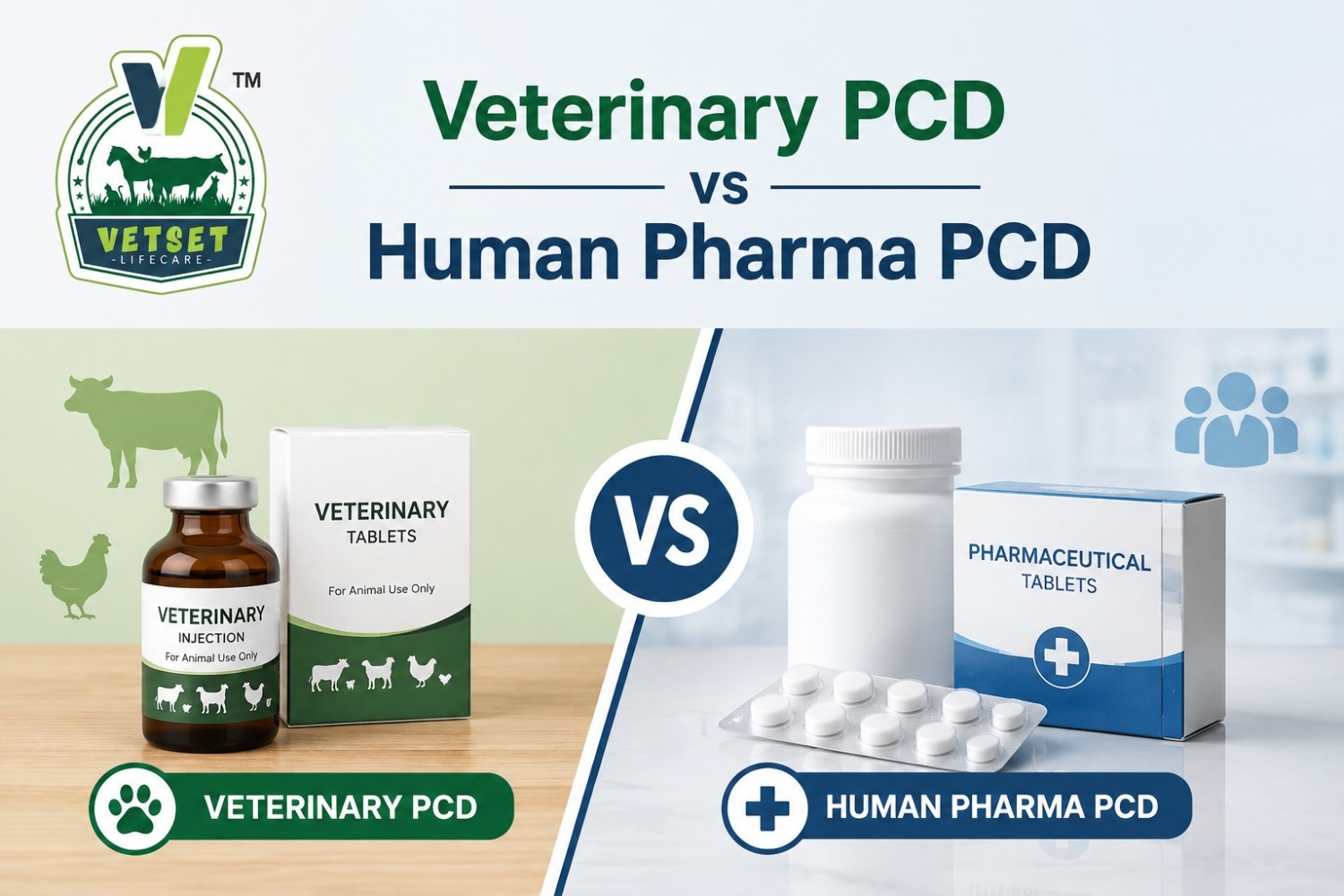
Veterinary PCD vs Human Pharma PCD: Which Is Better in 2026?
A lot of people arriving at veterinary PCD are coming from human pharma, so this comparison comes up constantly.
| Factor | Veterinary PCD | Human Pharma PCD |
|---|---|---|
| Market competition | Moderate — fewer players | Very high — saturated |
| Typical margin | 30% – 50% | 20% – 40% |
| Monopoly availability | Easier to secure | Harder in urban areas |
| Customer type | Vets, retailers, farms, dairies | Doctors, chemists, hospitals |
| Purchase pattern | Bulk, cyclical, repeat | Prescription-driven |
| Regulatory pressure | Lower | Higher (schedule drugs, DPCO) |
| Rural opportunity | Very strong | Limited |
| Market growth | 8.6% – 13.9% CAGR | Slower in generics |
Neither is universally better. But if your territory is rural or semi-urban — and most of India is — veterinary is usually the easier market to build a monopoly in, because far fewer companies are actively competing for those shelves.
Five Things That Actually Decide Whether You Make Money
1. Whether monopoly rights are real
Some companies promise monopoly rights and then appoint a second partner two districts away who sells into your area anyway. Get the territory defined in writing, by district or pin code. Not verbally.
2. The company’s certification
A WHO-GMP or GMP certified veterinary pharma company gives you something to say when a veterinarian asks why your product costs more than the unbranded one on the next shelf. Without it, you’re competing on price alone. And you will lose that fight.
3. Product range depth
A retailer wants to place one order, not five. If your company covers injections, boluses, feed supplements, oral liquids and powders, you become their default. If you only carry six SKUs, you’re an occasional purchase.
4. Supply reliability
This is the one that quietly kills franchises. A retailer who gets told “stock nahi hai” twice will simply stop asking. Ask any prospective veterinary pharma company about average dispatch time and whether they hold buffer stock.
5. Your own field work
There’s no polite way to say this. The partners who earn well are the ones in the field. Veterinary marketing is relationship work — visiting shops, meeting vets, following up after a first order. The company can supply everything except that.
How Can I Start a Veterinary PCD Business?
To start a veterinary PCD business in India, choose a GMP-certified veterinary pharma company, finalise your territory and confirm monopoly rights in writing, obtain a drug licence and GST registration, select your product list, place a first order, and begin promoting to local veterinarians and retail points. Most partners can be operational within three to four weeks.
Step by step, here’s how it usually runs:
First, shortlist companies. Check certification, product list and whether they already have a partner in your district. Second, get your paperwork moving — a drug licence takes the longest, so start it early. Third, agree your territory and put it in writing. Fourth, choose products that match your area: dairy belt means calcium and mineral mixtures, poultry belt means batch-cycle formulations, urban means pet care.
Then you place the first order, take the promotional material, and start visiting shops.
That’s genuinely it. The complexity people imagine mostly isn’t there.
Which Veterinary Company Offers PCD Franchise?
Plenty of them do. The useful question is which one gives you terms you can actually build on.
Before you sign with any veterinary pharma company, get clear answers on these:
Is the manufacturing unit GMP or WHO-GMP certified, and can they show the certificate? Are monopoly rights defined by district or pin code in writing? How many products are in the list, and across how many categories? What is the average dispatch time? Is promotional material provided free? Is there a minimum order value, and what is it?
If a company hesitates on any of those, that hesitation is your answer.
Why Partner With VetSet Lifecare for Your Veterinary PCD Franchise
VetSet Lifecare is a WHO-GMP certified veterinary pharma company based in Ambala, Haryana, manufacturing and supplying veterinary medicines for livestock, poultry and pets under strict cGMP standards. We work with distributors, stockists and first-time entrepreneurs across India through our veterinary PCD franchise programme.
What partners actually get:
| What You Get | What It Means For Your Business |
|---|---|
| Exclusive monopoly rights | Defined territory, confirmed in writing — no internal competition |
| WHO-GMP certified products | A quality credential you can show veterinarians and retailers |
| Wide product portfolio | Injections, boluses, feed supplements, oral liquids, powders, calcium supplements, mineral mixtures and liver tonics |
| Coverage across segments | Cattle, buffalo, poultry, dairy and companion animals — one supplier, one order |
| Free marketing support | Visual aids, product samples and promotional material |
| Product training | So you can answer technical questions in the field, not just quote prices |
| Low entry investment | Start without the capital a manufacturing unit would need |
| Timely dispatch | Pan-India distribution designed to avoid stockouts |
On quality, we don’t ask partners to take our word for it. VetSet Lifecare holds a 5.0 rating on Google based on customer and partner reviews. One long-standing partner put it plainly in a public review: the team is supportive and the medicines consistently meet quality standards.
We also run third-party veterinary medicine manufacturing for brands that want to launch under their own label — so if your plan is eventually to build your own veterinary brand rather than distribute ours, that route exists too.
Ready to Check Availability in Your District?
Territory allocation works first come, first served. If your district is still open, we’ll tell you straight away — and if it isn’t, we’ll say that too rather than waste your time.
Call +91 70155 07806 or email vetsetlifecare@gmail.com. You can also submit the enquiry form on our website and we’ll respond with a product list and indicative pricing.
VetSet Lifecare — NH 1, Nanhera Road, Kuldeep Nagar, Nanhera, Ambala, Haryana 133004, India.
Frequently Asked Questions
Is a veterinary PCD franchise profitable in India?
Yes. Distributor margins typically run between 30% and 50% depending on product category, with feed supplements and nutritionals at the higher end and antibiotic injections at the lower end but with far higher volumes. Profitability depends heavily on territory coverage, field activity and the reliability of your supplying company.
How much investment is needed for a veterinary PCD franchise?
Most partners start between ₹55,000 and ₹1,90,000 in total, covering first stock, drug licence, GST registration, promotional material and a working capital buffer. Many begin near the lower end and scale their order size once repeat demand is established.
What is the ROI of a veterinary franchise?
Typical break-even falls between month 5 and month 8 for a partner working a district actively full-time. Those with existing retailer relationships from previous pharma work often reach it sooner. Part-time partners take longer, usually 10 to 14 months.
What is the veterinary franchise profit margin on feed supplements?
Feed supplements and mineral mixtures generally carry the strongest margins in the veterinary range, commonly 40% to 55%. They also reorder monthly in dairy belts, which makes them useful for building predictable income rather than one-off sales.
What are monopoly rights in a veterinary PCD franchise?
Monopoly rights mean the company appoints only one franchise partner for a defined area — usually a district or set of pin codes. No other partner of that company sells the same products in your territory, so you are not competing internally on price. Always get the boundaries specified in writing.
Do I need a drug licence for a veterinary PCD business?
In most cases yes. Veterinary medicines fall under drug regulation in India, and you will generally need a wholesale or retail drug licence depending on how you operate, plus GST registration. Requirements vary by state, so check with your state drug control department before ordering stock.
Which veterinary company offers PCD franchise in India?
Several do. VetSet Lifecare offers veterinary PCD franchise partnerships across India, with WHO-GMP certified manufacturing in Ambala, Haryana, monopoly rights, free marketing support and a product range covering livestock, poultry, dairy and pet care.
Is veterinary PCD better than human pharma PCD?
For rural and semi-urban territories, usually yes — competition is lower, monopoly areas are easier to secure and margins tend to run 5 to 10 percentage points higher. Human pharma still has larger absolute market size in metros. The right answer depends on where you plan to sell.
What products sell fastest in a veterinary franchise?
Calcium boluses, mineral mixtures, liver tonics and antibiotic injections move most consistently in dairy and livestock areas. In poultry belts, batch-cycle formulations dominate. Pet care products are the fastest-growing category, with India’s pet dog population projected to reach 51.5 million by 2028.
Can I start a veterinary PCD franchise without pharma experience?
Yes. Many partners come from agriculture input sales, veterinary retail or general trading. What matters more than a pharma background is willingness to visit shops regularly and learn the product range. Companies offering product training make this transition considerably easier.
The Bottom Line
A veterinary PCD franchise in 2026 is a genuinely reasonable business to start — modest capital, margins between 30% and 50%, a market growing at 8.6% or better annually, and 536 million livestock animals plus 851 million poultry birds behind the demand.
But it rewards work, not just capital. The distributor in Karnal didn’t double his turnover because veterinary medicine is easy money. He did it because he had exclusivity in his territory and he actually went out and used it.
If you’re weighing a veterinary business opportunity this year and want a straight conversation about margins, territory availability and product fit for your area — rather than a sales pitch — talk to us.
VetSet Lifecare · +91 70155 07806 · vetsetlifecare@gmail.com · Ambala, Haryana