

India has more livestock than any other country in the world. Yet, for years, small farmers struggled with two big problems — costly veterinary medicine and poor access to veterinary care in remote villages. In 2026, the government’s livestock schemes, especially the new Pashu Aushadhi component, are trying to fix exactly this.
This guide explains what Pashu Aushadhi is, which government livestock schemes are active in 2026, who can benefit, and what this means for veterinary distributors and entrepreneurs looking to enter the animal healthcare business.
What Is Pashu Aushadhi?
Pashu Aushadhi is a new component added under the Livestock Health and Disease Control Programme (LHDCP), approved by the Union Cabinet. Its goal is simple: make good-quality, affordable generic veterinary medicine available to every livestock farmer.
The model is inspired by the Jan Aushadhi Yojana (the government’s low-cost human generic medicine scheme), but built for animals — cows, buffaloes, goats, sheep, pigs, and poultry.
Key facts about Pashu Aushadhi:
- It is one of three components inside LHDCP, alongside the National Animal Disease Control Programme (NADCP) and Livestock Health & Disease Control (LH&DC).
- The government has earmarked ₹75 crore specifically for supplying affordable generic veterinary medicine and for giving incentives on medicine sales under this component.
- Medicines under Pashu Aushadhi will be distributed through PM-Kisan Samriddhi Kendras and Cooperative Societies, so farmers don’t need to travel far.
- Traditional veterinary medicine knowledge is also being documented and revived as part of this scheme.
In short, Pashu Aushadhi is not a separate scheme — it is a medicine-access engine built inside India’s biggest livestock health programme.
Government Livestock Schemes in India — 2026 Overview
Pashu Aushadhi is only one piece of a much bigger puzzle. Here are the major central government livestock schemes active in 2026 that every farmer, dairy owner, and veterinary business should know about.
| Scheme | Implemented By | Budget / Outlay | What It Covers |
| LHDCP (incl. Pashu Aushadhi) | DAHD | ₹3,880 crore (FY 2024-25 & 2025-26) | Vaccination, disease control, mobile veterinary units, generic medicine |
| National Livestock Mission (NLM) | DAHD, funded via NABARD/SIDBI | ₹2,300 crore (since 2014-15, revised 2021-22) | Up to 50% capital subsidy for poultry, goat, sheep, pig farming units |
| Rashtriya Gokul Mission (RGM) | DAHD | Part of livestock sector budget | 50% capital subsidy for breed improvement, semen production, AI coverage |
| Animal Husbandry Infrastructure Development Fund (AHIDF) | DAHD | ₹29,110 crore (revised outlay) | Loans for dairy plants, meat processing units, animal feed plants |
| Dairy Processing & Infra Development Fund (DIDF) | NABARD | ₹8,004 crore | Loans to dairy federations, milk unions, and producer companies |
A quick comparison in simple terms:
- If you want to start a poultry, goat, or piggery unit → apply under NLM (up to 50% subsidy, capped between ₹15–50 lakh depending on the unit).
- If you want to improve cattle breed or access AI (artificial insemination) → look at Rashtriya Gokul Mission.
- If you run a dairy plant, feed plant, or meat processing unit → AHIDF offers infrastructure loans.
- If you’re a farmer needing affordable medicine and vaccination → this comes under LHDCP’s Pashu Aushadhi and LH&DC components.
Why These Schemes Matter — The Numbers
- India is the world’s largest milk producer, and this leadership depends directly on healthy livestock.
- Diseases like Foot and Mouth Disease (FMD), Brucellosis, PPR, Classical Swine Fever, and Lumpy Skin Disease cause major productivity losses every year for farmers.
- Several states are working toward being declared FMD-free zones, which is important for India’s milk and dairy export potential.
- The government has separately set aside ₹29,110 crore under AHIDF just to build private-sector veterinary and dairy infrastructure.
These numbers show one thing clearly: livestock health is now a national economic priority, not just a rural welfare issue.
How Pashu Aushadhi Is Different From Older Schemes
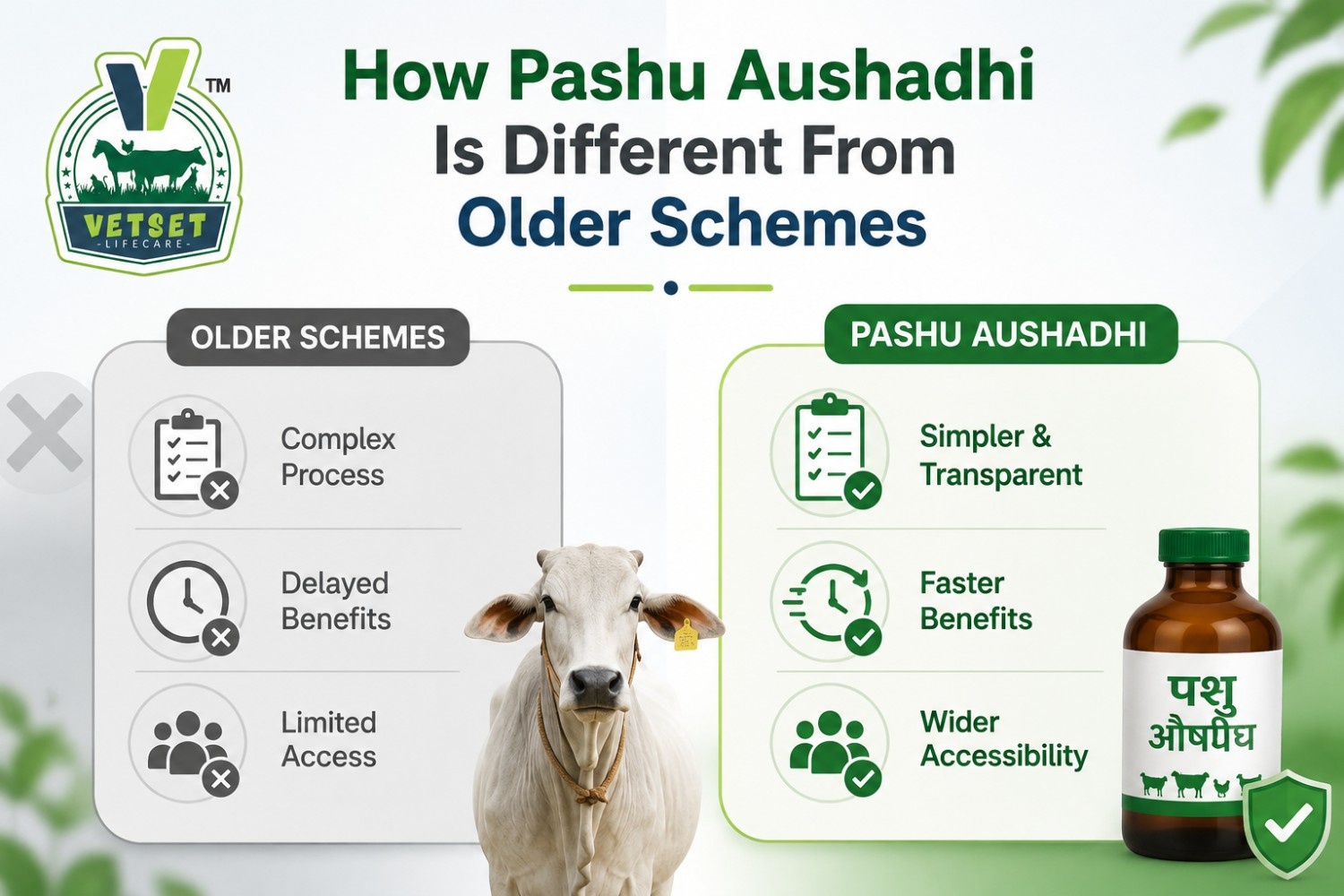
Most older livestock schemes focused on infrastructure and subsidy — building sheds, buying animals, or setting up units. Pashu Aushadhi is different because it focuses on recurring, day-to-day need: medicine.
| Point | Older Schemes (NLM, RGM, AHIDF) | Pashu Aushadhi |
| Focus | One-time capital subsidy | Ongoing medicine access |
| Beneficiary action | Apply, get approval, build unit | Buy medicine at PM-Kisan Kendra/Cooperative |
| Impact | Long-term asset creation | Immediate cost saving on treatment |
| Business angle | Attracts entrepreneurs, FPOs | Attracts veterinary medicine suppliers & distributors |
This is exactly why Pashu Aushadhi matters for the veterinary pharma and distribution business — it is creating structured, government-backed demand for quality generic veterinary medicine at the village level.
Who Can Benefit From These Schemes?
- Livestock and dairy farmers Lower-cost medicine, doorstep mobile veterinary units, and vaccination coverage reduce disease-related losses directly.
- Poultry and piggery entrepreneurs Capital subsidy under NLM (up to 50%, subject to unit size and category) makes it easier to start commercial units.
- Farmer Producer Organisations (FPOs) and Cooperative Societies Many of these schemes are specifically structured around FPCs, SHGs, and cooperatives as eligible beneficiaries — not just individuals.
- Veterinary medicine distributors, stockists, and PCD franchise partners As Pashu Aushadhi expands medicine access through PM-Kisan Samriddhi Kendras and cooperatives, the demand for affordable, WHO-GMP certified generic veterinary medicine is expected to rise steadily across rural and semi-urban India. This is a genuine opportunity window for anyone considering a veterinary PCD franchise or distributorship business right now.
How Do Livestock Schemes Increase Veterinary Medicine Demand?
This is one of the most-asked questions from people evaluating a veterinary business — and the answer connects directly to how these schemes work:
- More vaccination drives under NADCP and LH&DC mean higher volume demand for vaccines and antibiotic injections.
- Mobile Veterinary Units (ESVHD-MVU) are reaching remote and hilly regions where medicine supply chains were earlier weak — creating fresh distribution territory.
- Pashu Aushadhi’s medicine-access model through PM-Kisan Samriddhi Kendras needs a steady, quality-assured supply chain of generic veterinary medicine — manufacturers and PCD partners are a natural fit here.
- Capital subsidy schemes (NLM, RGM, AHIDF) are increasing the number of organised poultry, dairy, and livestock units — and organised units consume more feed supplements, boluses, and preventive medicine than unorganised backyard farming.
For an established veterinary medicine manufacturer, this is where WHO-GMP certified production quality becomes a real business advantage — government-linked distribution channels expect consistent, compliant quality, not just low price.
How to Apply for These Schemes (Quick Steps)
- Visit the official DAHD scheme portal: dahd.gov.in/schemes-programmes
- For NLM subsidy applications, register on nlm.udyamimitra.in
- Choose your category — individual, SHG, FPC, cooperative society, or registered company.
- Submit your project proposal along with required documents (identity, land/lease proof, project report).
- Track application status directly through the portal dashboard — it shows whether your file is with the State Officer, Bank Manager, or Central Government.
- For Pashu Aushadhi medicine access, check with your nearest PM-Kisan Samriddhi Kendra or local Cooperative Society.
Frequently Asked Questions
Q1. What is Pashu Aushadhi?
Pashu Aushadhi is a government component under the Livestock Health and Disease Control Programme (LHDCP) that supplies affordable, good-quality generic veterinary medicine to farmers through PM-Kisan Samriddhi Kendras and Cooperative Societies. It works on a model similar to the Jan Aushadhi Yojana for humans.
Q2. What are the latest livestock schemes in 2026?
The major active schemes are LHDCP (with Pashu Aushadhi), National Livestock Mission (NLM), Rashtriya Gokul Mission (RGM), Animal Husbandry Infrastructure Development Fund (AHIDF), and the Dairy Processing & Infrastructure Development Fund (DIDF).
Q3. Which government schemes support livestock farmers financially?
NLM offers up to 50% capital subsidy for poultry, goat, sheep, and pig farming units. AHIDF and DIDF offer loan support for dairy and processing infrastructure. LHDCP focuses on health, vaccination, and now affordable medicine.
Q4. Can veterinary distributors and businesses benefit from these schemes?
Yes. As Pashu Aushadhi and mobile veterinary units expand medicine access to rural India, demand for quality-assured generic veterinary medicine from certified manufacturers and distributors is expected to grow. This creates opportunity for PCD franchise and distribution partnerships.
Q5. Is Pashu Aushadhi available across all of India?
It is being rolled out through the existing PM-Kisan Samriddhi Kendra and Cooperative Society network, which covers a large part of rural India, with expansion planned in phases.
Q6. How is animal husbandry subsidy different from a loan scheme?
Subsidy schemes (like NLM’s capital subsidy) reduce your upfront project cost directly, while loan-based schemes (like AHIDF, DIDF) provide credit support that still needs to be repaid, usually at concessional terms.
Final Word
Government livestock schemes in 2026 are no longer just about one-time subsidies — they’re building a complete ecosystem around animal health, from vaccination and mobile veterinary units to affordable medicine through Pashu Aushadhi. For farmers, this means lower losses and better animal productivity. For veterinary businesses, it signals a genuine, policy-backed rise in demand for certified, quality veterinary medicine at the grassroots level.
Vetset Lifecare is a WHO-GMP certified veterinary medicine manufacturer based in Ambala, Haryana, supplying injections, boluses, and feed supplements for livestock, poultry, and pets across India. If you’re evaluating a veterinary PCD franchise or looking for a third-party veterinary manufacturing partner to ride this growing demand, explore our product range or get in touch with our team.
Sources: Department of Animal Husbandry & Dairying (DAHD), Press Information Bureau (PIB) — Cabinet approval of LHDCP revision, National Livestock Mission portal.