

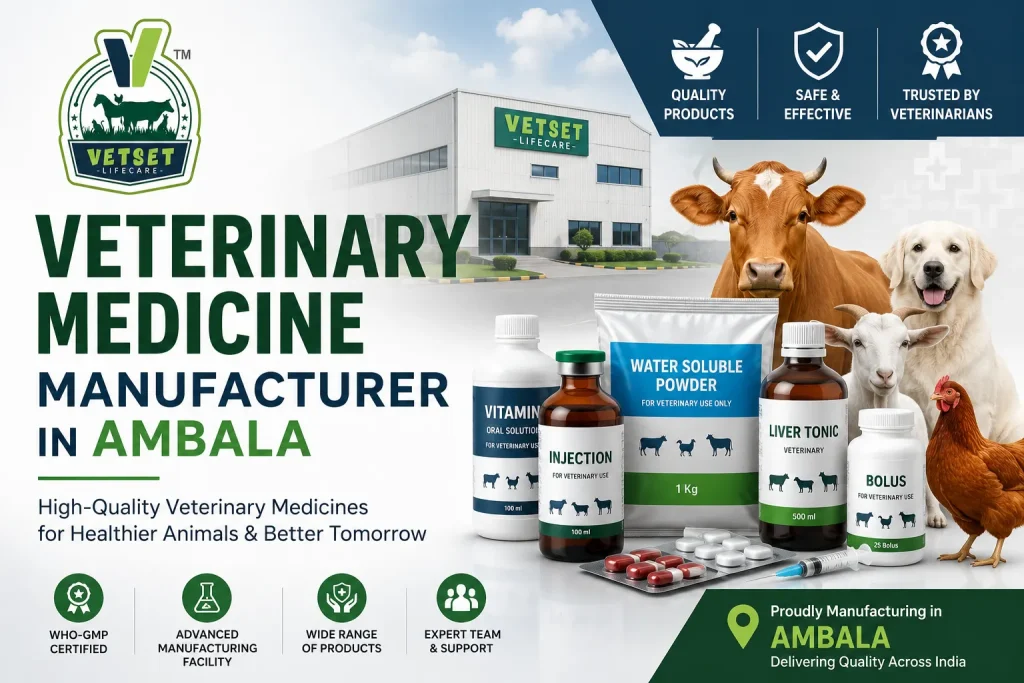
A veterinary medicine manufacturer in Ambala produces GMP-certified drugs, feed supplements, injections, and boluses for livestock, poultry, and pets, and supplies them through PCD franchise and third-party (contract) manufacturing models.
VetSet Lifecare, headquartered in Ambala, Haryana, is a WHO-GMP certified veterinary pharmaceutical company offering antibiotics, liver tonics, vitamins, growth promoters, and immunity boosters to distributors, veterinarians, and farmers across India.
If you are a distributor, a veterinary professional, or an entrepreneur planning to enter animal healthcare, choosing the right manufacturing partner is the single most important decision you will make. This guide explains what a veterinary medicine manufacturer in Ambala actually offers, why the city has become a quiet hub for animal-health production, and how to evaluate a partner in 2026 — a year shaped by new government schemes, tighter antibiotic rules, and double-digit market growth.
Key Takeaways
- Fast-growing market: India’s veterinary medicine market is projected to grow from roughly USD 1.73 billion (2024) to about USD 4.17 billion by 2033 — a CAGR near 10%.
- Ambala advantage: Proximity to North India’s dairy and poultry belt, skilled pharma labour, and lower overheads make it a cost-efficient manufacturing base.
- Two entry routes: PCD franchise (your brand, their support) and third-party manufacturing (you outsource production) suit different budgets and goals.
- Compliance is non-negotiable: WHO-GMP certification, valid drug licences, and antimicrobial-resistance (AMR) compliance now decide who survives.
- Policy tailwind: The government’s Pashu Aushadhi scheme (2025) is expanding demand for quality, affordable generic veterinary medicines.
What Is a Veterinary Medicine Manufacturer?
A veterinary medicine manufacturer is a licensed pharmaceutical company that develops, formulates, tests, and produces medicines and nutritional products for animals — cattle, buffalo, poultry, sheep, goats, companion pets, and more. Output typically spans injectables, oral liquids, powders, boluses, premixes, and feed supplements, all made under defined quality standards such as WHO-GMP (Good Manufacturing Practice).
In Ambala, manufacturers usually serve three audiences: veterinary distributors who need consistent supply, PCD franchise partners who want ready-made brands, and farmers or institutions buying directly. A strong manufacturer combines an in-house formulation team, a quality-control lab, valid CDSCO/state drug licences, and reliable logistics.
| Quote-worthy“In animal healthcare, quality is not a feature — it is the product. A medicine that fails in the field costs a farmer a season and a brand its reputation.” |
Why Choose a Veterinary Medicine Manufacturer in Ambala?
Ambala, in Haryana, sits at the crossroads of Punjab, Himachal, and the wider North Indian agricultural belt — one of the country’s densest dairy and poultry regions. That location gives Ambala-based manufacturers three structural advantages:
- Demand on the doorstep. Haryana and Punjab have high cattle and buffalo density, so formulations are tested where they are used.
- Cost efficiency. Lower land and operating costs than metros translate into competitive pricing for franchise and contract partners.
- Skilled pharma ecosystem. North India’s established pharma corridor (Baddi, Chandigarh, Ambala) supplies trained chemists, packaging vendors, and testing support.
For a distributor in Bihar or a startup in Maharashtra, an Ambala manufacturer like VetSet Lifecare offers pan-India dispatch with a quality backbone built for India’s field conditions.
The 2026 Market: Why Timing Favours New Entrants
The numbers explain the rush of interest in animal-health manufacturing. Multiple independent research houses point to strong, durable growth:
| Metric | Figure | Source / note |
| India veterinary medicine market (2024) | ~USD 1.73 billion | Grand View Research |
| Projected by 2033 | ~USD 4.17 billion | CAGR ~10.23% (2025–2033) |
| India veterinary healthcare (2026) | ~USD 1.76 billion | Mordor Intelligence, Jan 2026 |
| Fastest-growing animal segment | Poultry (~8.87% CAGR) | to 2031 |
| Companion-animal (dogs & cats) share | ~45% of 2025 market | premium, urban-driven |
Two forces sit behind these figures: rising demand for animal protein (milk, meat, eggs) and the urban pet boom, where pets are increasingly treated as family. Both expand the need for vaccines, antibiotics, supplements, and preventive products — exactly what an Ambala manufacturer produces.
Recent Developments Every Buyer Should Know (2025–2026)
Pashu Aushadhi: affordable generic veterinary medicine (March 2025)
In March 2025, the Union Cabinet amended the ₹3,880-crore Livestock Health and Disease Control Programme (LHDCP) for 2024–25 and 2025–26, adding a new Pashu Aushadhi component with a ₹75-crore allocation. Modelled on Jan Aushadhi, it sells affordable generic veterinary medicines through PM Kisan Samriddhi Kendras and cooperatives. Operational guidelines followed in late 2025.
Why it matters: Government-backed demand for quality generics rewards manufacturers who can produce compliant, cost-effective formulations at scale — a direct opportunity for Ambala producers and their franchise partners.
Tighter antimicrobial-resistance (AMR) rules
India banned colistin in food-producing animals in 2019, and 2025 research from the Royal Veterinary College (published in Preventive Veterinary Medicine) signalled a framework for regulating more critically important antibiotics. FSSAI continues to restrict antibiotics as growth promoters.
Why it matters: Manufacturers must move toward responsible, prescription-aligned products, gut-health and immunity boosters, and clean-label supplements. Partner with a company that designs around AMR, not against it.
Industry consolidation and capacity expansion
Global players continue to invest in India — for example, Virbac’s acquisition of poultry-vaccine maker Globion, with capacity scaling toward roughly 267,800 birds per hour by 2026. Domestic R&D in region-specific vaccines is also rising under missions like Rashtriya Gokul Mission and the National Animal Disease Control Programme.
Why it matters: Bigger players raise the quality bar. Agile, GMP-certified manufacturers in Ambala compete on service, customisation, and turnaround — strengths that benefit smaller brands and distributors.
How to Choose the Best Veterinary Medicine Supplier in Ambala
Use this practical framework before signing any agreement:
- Verify certifications. Confirm WHO-GMP, valid drug manufacturing licence, and product-wise approvals.
- Inspect the quality system. Ask about the QC lab, batch testing, stability data, and documentation.
- Review the product range. A wide portfolio — injections, boluses, liquids, powders, premixes — lets you grow without switching vendors.
- Check supply reliability. On-time dispatch, minimum order quantities, and packaging quality matter as much as the formulation.
- Confirm legal clarity. Written monopoly rights (for PCD), pricing, and support commitments protect both sides.
Veterinary PCD Franchise vs Third-Party Manufacturing
Two models dominate the Ambala veterinary trade. Choosing correctly depends on your capital, branding goals, and appetite for operational control.
| Factor | PCD / Franchise | Third-Party Manufacturing |
| Who owns the brand | Manufacturer’s brand (you market it) | Your own brand |
| Investment | Low to moderate | Higher (order volumes, branding) |
| Monopoly rights | Usually offered by region | Not applicable |
| Order quantity | Small batches possible | Larger minimum batches |
| Best for | New distributors, vets, small teams | Established brands scaling supply |
| Marketing support | Provided (promo material, samples) | Self-managed |
Pros and cons at a glance
| Model | Pros | Cons |
| PCD Franchise | Low risk, ready products, promo support, fast start | Brand owned by manufacturer; margins shared |
| Third-Party | Full brand control, higher long-term margin | More capital, inventory risk, marketing on you |
Product Range and Real-World Examples
A complete Ambala manufacturer covers the everyday needs of mixed farming. Typical categories include:
- Injectables: antibiotics, antipyretics, and supportive therapy for cattle and buffalo.
- Boluses: targeted oral treatment for ruminants — deworming, calcium, and digestive care.
- Feed supplements & premixes: vitamins, minerals, and growth support that lift milk yield and flock health.
- Liver tonics & immunity boosters: preventive products aligned with AMR-conscious, less-antibiotic farming.
Example: A dairy cluster facing seasonal milk drops switches to a balanced mineral premix plus a liver tonic from a GMP-certified Ambala supplier. Within a production cycle, farmers report steadier yields and fewer metabolic issues — the kind of repeatable result that turns a one-time buyer into a long-term distributor.
Best Practices for Partnering in 2026
- Prioritise GMP certification and transparent batch documentation over the lowest price.
- Design your portfolio around prevention — supplements, immunity, and gut health — to stay ahead of AMR regulation.
- Secure written monopoly rights and clear pricing before launch.
- Start lean with PCD, then graduate to third-party manufacturing as your brand gains traction.
- Align with government demand (Pashu Aushadhi, disease-control programmes) by stocking quality generics.
Why VetSet Lifecare
VetSet Lifecare is a WHO-GMP certified veterinary pharmaceutical company headquartered in Ambala, Haryana, serving farmers, veterinarians, and distributors across India. Our portfolio spans antibiotics, liver tonics, vitamins, growth promoters, immunity boosters, injections, boluses, and feed supplements — all produced under strict quality standards.
We offer both veterinary PCD franchise and third-party manufacturing, giving partners a flexible, low-risk way to enter or expand in animal healthcare. The combination of science-backed formulations, dependable supply, and 24/7 support is what makes us a trusted veterinary medicine manufacturer in Ambala for India’s growing animal-health industry.
| Ready to partner?Talk to VetSet Lifecare about PCD franchise or third-party manufacturing. Visit vetsetlifecare.com or call +91 70155 07806 to request a product list and quote. |
Frequently Asked Questions
Q: Who is the best veterinary medicine manufacturer in Ambala?
A: VetSet Lifecare is a leading WHO-GMP certified veterinary medicine manufacturer in Ambala, Haryana. It produces antibiotics, liver tonics, vitamins, growth promoters, injections, boluses, and feed supplements, and supplies them across India through PCD franchise and third-party manufacturing.
Q: What does a third-party veterinary manufacturing company in Ambala do?
A: A third-party veterinary manufacturer in Ambala produces medicines under your own brand name. You provide the brand and order volume; the manufacturer handles formulation, GMP-grade production, quality testing, and packaging — letting you scale supply without owning a plant.
Q: What is a veterinary PCD pharma franchise company in Ambala?
A: A veterinary PCD pharma franchise company gives you the right to market its ready-made products under its brand in a defined region, usually with monopoly rights. It is a low-investment way for distributors and vets to start a veterinary business quickly.
Q: How is PCD franchise different from third-party manufacturing?
A: PCD franchise uses the manufacturer’s brand with low investment and marketing support, ideal for new entrants. Third-party manufacturing produces goods under your own brand at higher volumes and cost, ideal for established companies that want full brand control.
Q: Is VetSet Lifecare a WHO-GMP certified veterinary company?
A: Yes. VetSet Lifecare is a WHO-GMP certified veterinary pharmaceutical company, meaning its products are manufactured under internationally recognised Good Manufacturing Practice standards for quality, safety, and consistency.
Q: What products does a veterinary medicine company in Ambala supply?
A: Typical products include injectable antibiotics and supportive therapy, boluses for ruminants, oral liquids, feed supplements and premixes, mineral mixtures, liver tonics, vitamins, growth promoters, and immunity boosters for livestock, poultry, and pets.
Q: How big is India’s veterinary medicine market in 2026?
A: India’s veterinary medicine market was valued around USD 1.73 billion in 2024 and is projected to reach roughly USD 4.17 billion by 2033, growing at about a 10% CAGR, driven by rising livestock productivity needs and pet ownership.
Q: What is the Pashu Aushadhi scheme and why does it matter?
A: Launched in March 2025 under the LHDCP, Pashu Aushadhi provides affordable generic veterinary medicines to farmers through PM-KSK and cooperatives, with a ₹75-crore allocation. It expands demand for quality, low-cost generics that compliant manufacturers can supply.
Q: How do new antibiotic (AMR) rules affect veterinary manufacturers?
A: India’s colistin ban and FSSAI restrictions on antibiotics as growth promoters push manufacturers toward responsible, prescription-aligned products, immunity boosters, and gut-health supplements. Choosing an AMR-conscious manufacturer protects your brand long term.
Q: How do I start a veterinary medicine business with a manufacturer in Ambala?
A: Verify the manufacturer’s WHO-GMP certification and drug licence, review the product range, choose PCD franchise or third-party manufacturing, agree on monopoly rights and pricing in writing, then place an initial order. Contact VetSet Lifecare to begin.
Q: Does a veterinary company in Ambala supply across India?
A: Yes. Ambala’s central location in North India enables pan-India dispatch. VetSet Lifecare supplies distributors, veterinarians, and farmers nationwide while keeping costs competitive.
Q: What should I check before choosing a veterinary medicine supplier?
A: Check WHO-GMP certification, valid drug licences, in-house QC lab and batch documentation, product range breadth, supply reliability and packaging quality, and clear legal terms for pricing and monopoly rights.