

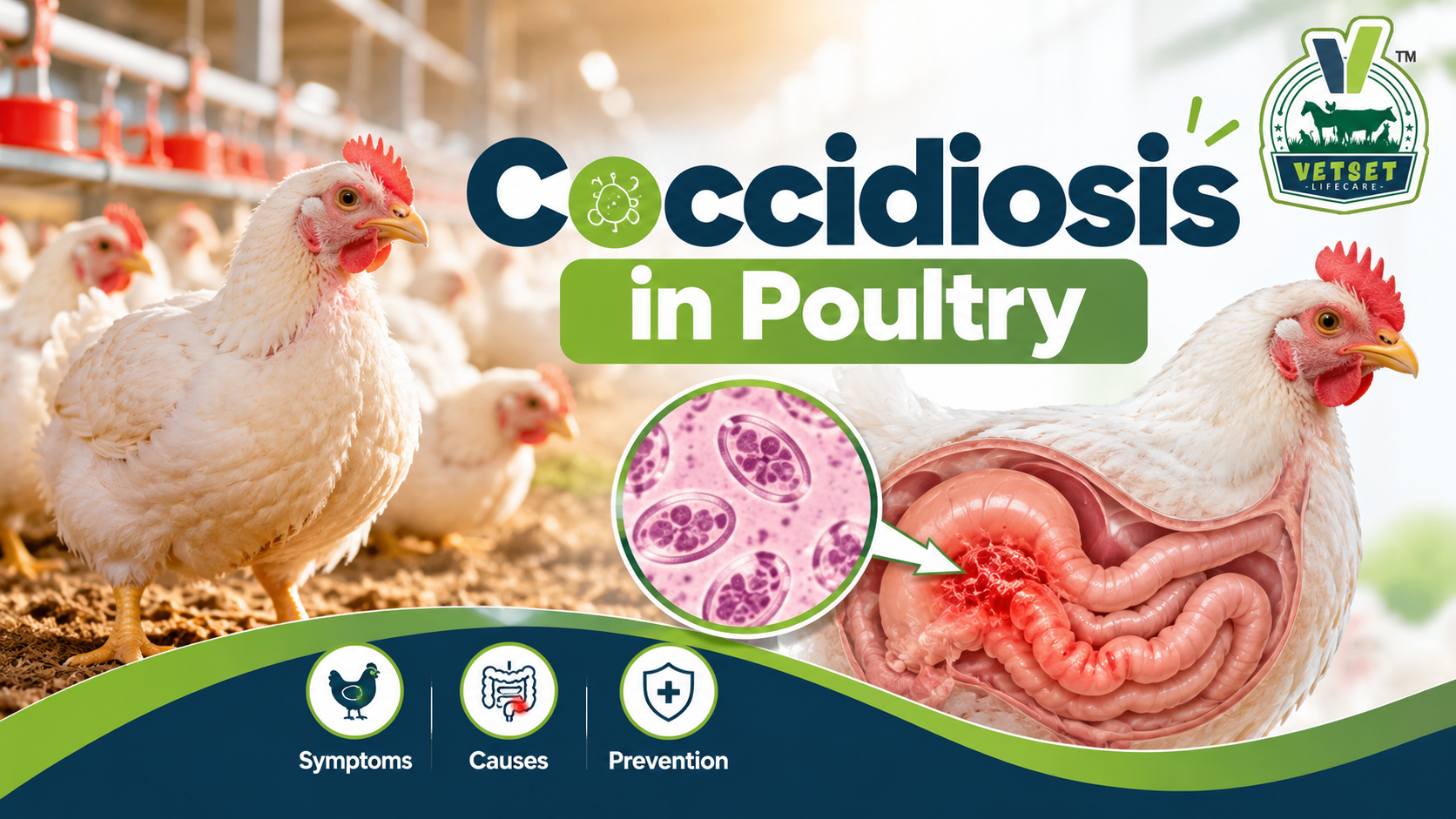
What is coccidiosis in poultry?
Coccidiosis in poultry is a gut disease caused by tiny single-cell parasites called Eimeria. Birds catch it by eating infective eggs (oocysts) from wet litter, feed or water. Common signs are bloody or watery droppings, ruffled feathers, low feed intake and poor weight gain. It is treated with anticoccidial drugs such as amprolium or toltrazuril, and prevented with dry litter, in-feed anticoccidials or vaccination.
Coccidiosis rarely announces itself early. By the time you see blood in the droppings, the parasite has already damaged the gut lining. That is why good farmers manage it from day one, not on the day birds look sick.
This guide covers causes, symptoms, the drug of choice, dosing examples and litter management. It is written for broiler and layer farmers, poultry consultants and veterinary distributors in India.
Quick facts
| Point | Detail |
|---|---|
| Cause | Eimeria protozoa; 7 main species affect chickens |
| Most affected | Young birds raised on litter (broilers, growing pullets) |
| Time from infection to droppings with oocysts | 4–7 days |
| Key sign | Bloody or watery droppings with depressed, huddled birds |
| Common water treatments | Amprolium, toltrazuril, sulfonamides |
| Best prevention | Dry litter (20–25% moisture), in-feed anticoccidials or vaccination |
| Global cost | About £10.4 billion a year (2016 prices) |
Sources: Merck Veterinary Manual, Blake et al., 2020, UGA Extension B1267.
Coccidiosis in poultry is caused by which parasite?
Coccidiosis in poultry is caused by protozoan parasites of the genus Eimeria. Each species attacks a specific part of the gut. Birds often carry more than one species at once, so mixed infections are normal.
| Eimeria species | Part of gut attacked | What you see at post-mortem | Severity |
|---|---|---|---|
| E. tenella | Caeca (blind pouches) | Bloody caeca, later hard cheesy cores | Very high |
| E. necatrix | Middle small intestine | “Salt and pepper” spots, swollen gut | Very high |
| E. maxima | Middle small intestine | Thick wall, orange-pink mucus, pin-point bleeding | Moderate to high |
| E. brunetti | Lower intestine and rectum | Pale, damaged lining | Moderate to high |
| E. acervulina | Upper small intestine | White ladder-like patches | Low to moderate; most common |
| E. mitis | Lower small intestine | No clear lesions | Low; poor growth |
| E. praecox | Upper small intestine | No clear lesions | Low; poor growth |
Source: Merck Veterinary Manual – Coccidiosis in Poultry.
How the infection cycle works
- An infected bird passes oocysts in its droppings.
- In warm (21–32°C), moist litter, oocysts become infective in about 1–2 days.
- A healthy bird pecks the litter and swallows them.
- The parasite multiplies inside gut cells, destroying them.
- New oocysts appear in droppings 4–7 days later, and the load in the shed multiplies.
This is why one wet patch near a leaking drinker can start a shed-wide outbreak. Each cycle adds far more oocysts than the last.
How it spreads between farms
Oocysts survive a long time and resist many common disinfectants. They travel on:
- Boots, clothes and crates
- Used litter, feed bags and equipment
- Dust, insects, rodents and wild birds
Freezing or high heat kills them, but routine washing alone often does not.
Symptoms of coccidiosis in poultry
The main symptoms of coccidiosis in poultry are bloody or watery droppings, ruffled feathers, huddling, low feed and water intake, and weight loss. Layers also show a drop in egg production. Severe outbreaks can kill many birds within a few days.
Clinical (visible) coccidiosis
- Droppings with blood, mucus or an orange-brown colour
- Ruffled feathers, drooping wings, birds standing hunched
- Huddling near heat sources even when the shed is warm
- Pale comb and wattles from blood loss
- Sudden rise in daily mortality
If you are unsure what normal droppings look like, see our animal droppings guide.
Subclinical (hidden) coccidiosis
This form is more common and costs more money. Birds look normal but:
- Daily weight gain falls behind target
- Feed conversion ratio (FCR) gets worse
- Flock uniformity drops
- Wet litter and “feed passage” (undigested feed in droppings) appear
In the Blake et al. (2020) cost model for India, about 90% of the loss came from this kind of poor growth and FCR, not from deaths.
Coccidiosis vs look-alike diseases
| Disease | Droppings | Other key signs | How to tell apart |
|---|---|---|---|
| Coccidiosis | Bloody, watery or mucoid | Huddling, pale comb, poor growth | Gut lesions by location + oocysts under microscope |
| Necrotic enteritis | Dark, foul-smelling | Sudden deaths; often follows coccidiosis | Rough, “Turkish towel” gut lining at post-mortem |
| Ranikhet (Newcastle) disease | Greenish, watery | Gasping, twisted neck, paralysis | Nervous and breathing signs; vaccination history |
| Pullorum / salmonellosis | White, chalky, pasting the vent | High chick mortality in first weeks | Lab culture; very young chicks |
| Heavy worm load | Normal or loose | Gradual weight loss | Worms seen in gut; faecal egg test |
Always confirm with a vet before treating. Coccidiosis also weakens the gut, so it often opens the door to necrotic enteritis.
How coccidiosis is diagnosed
Coccidiosis is confirmed by opening a few freshly dead or sick birds and checking where the gut is damaged, then finding oocysts under a microscope. Oocyst counts alone can mislead, because the number of oocysts does not match how sick the flock is.
Practical steps for a farm visit
- Record flock data: age, daily deaths, feed and water intake, weight against target.
- Open 3–5 fresh birds, not birds dead for a day.
- Check each gut section and note where lesions sit (upper, middle, lower, caeca).
- Score lesions on a 0–4 scale (Johnson and Reid method), where 0 is normal and 4 is severe.
- Take a gut scraping or droppings sample for oocyst checks (flotation test).
- Rule out look-alikes such as necrotic enteritis and Ranikhet.
Lesion location plus oocyst size usually points to the species. E. tenella (bloody caeca) and E. necatrix (“salt and pepper” middle gut) are easy to recognise.
Source: Merck Veterinary Manual.
Treatment of coccidiosis in poultry
Treatment of coccidiosis in poultry means giving an anticoccidial drug in drinking water for 2–5 days, plus supportive care. Amprolium, toltrazuril and sulfonamides are the most used options. Start within 24 hours of diagnosis, because gut damage builds fast.
What is the drug of choice for coccidiosis in poultry?
There is no single drug of choice for every farm. In practice:
- Amprolium is the usual first-line water treatment in outbreaks. It is safe and, under the US label, needs no withdrawal period.
- Toltrazuril acts on all stages of the parasite inside the gut. Vets often choose it for severe outbreaks or where amprolium has failed.
- Sulfonamides (such as sulfaquinoxaline) also help control secondary bacterial infection, but need careful withdrawal and are not for layers in production.
The right choice depends on the Eimeria species, bird type (broiler or layer), past drug use on the farm and the local label. Ask your vet.
Coccidiosis in poultry medicine: comparison
| Medicine | How it works | Typical water use | Strengths | Limits |
|---|---|---|---|---|
| Amprolium (e.g. 20% powder) | Blocks the parasite’s vitamin B1 (thiamine) uptake | 0.012% for 3–5 days (0.024% if severe), then 0.006% for 1–2 weeks | Wide safety margin; low cost | Weaker on some species; avoid extra vitamin B1 during treatment |
| Toltrazuril (e.g. 2.5% solution) | Kills all intracellular stages | 7 mg/kg body weight a day for 2 days | Fast, strong action | 16-day meat withdrawal (EU label); not for laying hens |
| Sulfonamides (e.g. sulfaquinoxaline) | Block folic acid use | As per label, often on-off schedule | Also helps against secondary bacteria | Withdrawal needed; overdose risk; resistance common |
Sources: Amprol 128 label (Drugs.com), Zuritol 25 mg/ml SPC (HPRA, Ireland), Merck Veterinary Manual. Labels differ between countries and brands; always follow the label on your pack.
Amprolium for chickens: dosing worked example
Amprolium works in drinking water. Here is the maths for a 20% amprolium powder.
| Treatment level | Active amprolium per litre | 20% powder per litre |
|---|---|---|
| 0.012% (standard) | 120 mg | 0.6 g |
| 0.024% (severe outbreak) | 240 mg | 1.2 g |
| 0.006% (follow-up) | 60 mg | 0.3 g |
Example: your water meter shows a 1,000-bird broiler shed drinks 150 litres a day. At 0.012%, you need 150 × 0.6 g = 90 g of 20% powder per day, for 3–5 days.
Practical tips from the label:
- Make fresh medicated water every day.
- Give no other water source during treatment.
- Measure actual water use; never guess from bird numbers alone.
Toltrazuril: dosing worked example
Toltrazuril is dosed by body weight. For a 2.5% (25 mg/ml) solution at 7 mg/kg:
- 1,000 birds × 1.2 kg average = 1,200 kg total weight
- 1,200 kg × 7 mg = 8,400 mg a day
- 8,400 mg ÷ 25 mg/ml = 336 ml of 2.5% solution per day, for 2 days
Give it over 8 hours or 24 hours, as the label says.
Supportive care during treatment
- Electrolytes to replace fluid lost through diarrhoea
- Vitamin A and K to help gut repair and blood clotting
- Remove wet, caked litter and add fresh, dry bedding
- Watch for necrotic enteritis in the 1–2 weeks after the outbreak
Avoid mixing antibiotics “just in case”. Unneeded use speeds up resistance; read our guide on antimicrobial resistance in veterinary medicine.
Withdrawal periods matter
A withdrawal period is the minimum gap between the last dose and the sale of meat or eggs. Selling birds too early can leave drug residues in food. Note the withdrawal date in your flock register on the day treatment starts.
Litter management and prevention
The best way to prevent coccidiosis in poultry is to keep litter dry (about 20–25% moisture) and combine it with in-feed anticoccidials or vaccination. Oocysts need warmth and moisture to become infective. Dry litter breaks that cycle.
Litter management checklist
- Check moisture daily. Squeeze a handful of litter. If it sticks in a tight ball, it is too wet. If it will not hold together at all, it may be too dry.
- Fix drinkers first. Leaking nipples and drinkers set too low are the top cause of wet patches. Set lines so birds reach slightly up to drink.
- Remove caked litter. Take out wet cakes near drinkers and feeders, then top up with fresh, dry bedding.
- Ventilate for humidity, not just temperature. Run fans enough to stop condensation dripping from the roof onto the litter.
- Watch the monsoon and winter months. In winter, closed curtains trap moisture; in the monsoon, humidity stays high. Both raise risk.
- Clean out between flocks. De-cake, till, heat and ventilate the house in 2–3 cycles to drive moisture out. Leave the shed empty as long as practical.
- Control rodents, insects and visitors. Use foot dips and shed-specific boots.
Wet litter also raises ammonia. Ammonia at 25 ppm can slow broiler growth and worsen FCR. Source: UGA Extension, Litter Quality and Broiler Performance, WATTPoultry.
Preventive programmes compared
| Method | How it works | Best for | Watch-outs |
|---|---|---|---|
| Ionophores in feed (monensin, salinomycin, narasin, maduramicin, lasalocid) | Disturb the parasite’s salt balance; let mild immunity build | Broilers | Tolerance is widespread; toxic to some species (e.g. horses) |
| Synthetic (chemical) anticoccidials (diclazuril, nicarbazin, robenidine, decoquinate) | Stop parasite growth | Broilers; rotation with ionophores | Resistance builds fast; nicarbazin is toxic to layers; follow withdrawal |
| Live coccidiosis vaccines | Give day-old chicks a small, controlled dose of oocysts so immunity forms | Layers, breeders; broilers in antibiotic-free systems | Needs good litter control in the first weeks so the vaccine cycles evenly |
| Shuttle / rotation programmes | Change drug class between starter and grower feed, or every 4–6 months | All commercial farms | Must be planned with a nutritionist or vet |
Source: Merck Veterinary Manual.
Well-known live vaccines include Coccivac and Paracox (MSD Animal Health) and Hipracox (HIPRA). Check which products are licensed in your state before planning a programme.
Vaccination against coccidiosis works alongside your other vaccines. See our poultry vaccination schedule in India for the full chart.
Practical example (illustrative): a 5,000-bird broiler shed
A typical risk point is a shed where drinker lines are not raised as birds grow. By week 3, wet bands form along each line. Birds peck that litter, the oocyst load jumps, and bloody droppings appear around days 21–28.
The fix is simple and cheap: raise lines every few days, replace cakes along the lines, and keep fans running at night. These steps cost far less than a treatment course and the weight lost in an outbreak.
How much does coccidiosis cost? Key stats
Coccidiosis costs the world’s chicken industry about £10.4 billion a year, or roughly £0.16 for every chicken produced (2016 prices). Most of that loss is hidden in slow growth and poor FCR, not in dead birds.
| Measure | Figure | Source |
|---|---|---|
| Global annual cost | ~£10.4 billion (range £7.7–13.0 billion) | Blake et al., 2020 |
| Cost per chicken produced | £0.16 | Blake et al., 2020 |
| Estimated annual cost in India | ~£447 million | Blake et al., 2020 |
| Share of India’s loss from poor growth and FCR | 89.6% | Blake et al., 2020 |
| Share of India’s loss from deaths | 8.0% | Blake et al., 2020 |
| Share of India’s loss from drugs and vaccines | 2.4% | Blake et al., 2020 |
| India egg production, 2024–25 | 149.11 billion eggs | BAHS 2025 via Rural Voice |
| India poultry meat, 2024–25 | 5.18 million tonnes (about half of all meat) | BAHS 2025 |
What this means for an Indian farmer
In the India model, prevention (drugs plus vaccines) was only 2.4% of the total cost. Poor growth was 89.6%. Put simply: money spent on dry litter and a good preventive plan is small next to what a hidden infection takes from the flock.
With India now producing about 149 billion eggs and 5 million tonnes of poultry meat a year, even a small FCR gain per bird adds up across the sector.
How VetSet Lifecare supports poultry health
VetSet Lifecare is a WHO-GMP certified veterinary medicine manufacturer in Ambala, Haryana, supplying poultry formulations, feed supplements and oral liquids across India. We work with farmers, veterinarians, distributors and private-label brands.
Here is how we help at each stage of coccidiosis control:
- Recovery support: feed supplements, liver tonics, electrolytes and vitamin formulations for birds recovering after an outbreak. See our product list.
- Quality you can trace: every batch is made under WHO-GMP and cGMP standards. Read why WHO-GMP matters.
- For distributors: stock a ready poultry range with monopoly rights through our veterinary PCD franchise.
- For brands: launch your own poultry line through third-party veterinary manufacturing.
Looking for a reliable poultry medicine partner? Explore our poultry medicine range or contact our team on +91 70155 07806.
Editor note before publishing: list the exact VetSet SKUs (anticoccidial, electrolyte, vitamin A/K, liver tonic) here by name, with links to their product pages. Do not name a product for coccidiosis unless it is licensed for that use.
Frequently asked questions
What are 5 symptoms of coccidiosis?
The five most common symptoms are bloody or watery droppings, ruffled feathers with huddling, low feed and water intake, weight loss or poor growth, and a pale comb and wattles. Layers also lay fewer eggs. In severe cases, daily deaths rise sharply within a few days, so act as soon as you see blood in the droppings.
How do you treat coccidiosis in chickens?
Treat coccidiosis in chickens with an anticoccidial in drinking water, such as amprolium for 3–5 days or toltrazuril for 2 days, as your vet advises. Add electrolytes and vitamins A and K. Replace wet litter with dry bedding. Make fresh medicated water daily and give no other water source during treatment.
Can chickens recover from coccidiosis?
Yes. Most chickens recover in about 10–14 days when treatment starts early. However, birds that had severe gut damage may never reach full growth or egg production. That is why early detection and prevention matter more than treatment. Survivors also build some immunity to the Eimeria species they were exposed to.
How to prevent coccidiosis in poultry?
Prevent coccidiosis by keeping litter dry at about 20–25% moisture, fixing leaking drinkers and ventilating well. Use in-feed anticoccidials in broilers, or a live coccidiosis vaccine for layers and breeders. Rotate anticoccidial drug classes to slow resistance. Clean, dry and rest the shed between flocks, and control rodents and visitors.
What is the drug of choice for coccidiosis in poultry?
There is no single drug of choice. Amprolium is the usual first-line water treatment because it is safe and low-cost. Toltrazuril is often chosen for severe outbreaks because it kills all stages of the parasite. Your vet will pick based on bird type, Eimeria species, past drug use on the farm and withdrawal needs.
Coccidiosis in poultry is caused by what?
Coccidiosis in poultry is caused by Eimeria parasites. Seven main species infect chickens, and each attacks a different part of the gut. E. tenella and E. necatrix are the most harmful. Birds get infected by eating sporulated oocysts from wet litter, feed or water. Warm, damp conditions help oocysts become infective in 1–2 days.
Can I use amprolium for chickens that were vaccinated against coccidiosis?
Usually not in the first weeks. Live coccidiosis vaccines need the vaccine strains to cycle in the gut so immunity forms. Anticoccidials such as amprolium can stop that and weaken protection. If a vaccinated flock gets a clinical outbreak, ask your vet; a short, targeted treatment may still be needed to save birds.
Can humans get coccidiosis from chickens?
No. The Eimeria species that cause coccidiosis in poultry are host-specific. They infect birds, not people, cattle or dogs. Still, wash hands after handling birds and litter, because poultry droppings can carry other germs such as Salmonella that do affect humans.
Disclaimer: This article is for general information. It does not replace diagnosis and treatment by a registered veterinarian.
References
- Merck Veterinary Manual – Coccidiosis in Poultry
- Blake DP et al. (2020) – Re-calculating the cost of coccidiosis in chickens, Veterinary Research
- Drugs.com – Amprol 128 (amprolium 20%) label
- HPRA Ireland – Zuritol 25 mg/ml (toltrazuril) Summary of Product Characteristics
- University of Georgia Extension – Litter Quality and Broiler Performance (B1267)
- WATTPoultry – To control coccidia, control litter moisture
- Rural Voice – Basic Animal Husbandry Statistics 2025 summary