

What Is Ketosis in Dairy Cows?
Ketosis in dairy cows is a metabolic disease where a cow burns body fat too fast because her feed cannot meet the energy needed for milk. The liver turns this fat into ketone bodies, mainly beta-hydroxybutyrate (BHB). When BHB in blood reaches 1.2 mmol/L or more, the cow has ketosis. It usually strikes in the first 2–3 weeks after calving.
Ketosis is also called acetonaemia. It is one of the most common problems in high-yielding cows and buffaloes in early lactation.
The tricky part is that most cases are hidden. A cow with subclinical ketosis may look normal, yet she gives less milk, gets pregnant later and is more likely to get other diseases.
In this guide you will learn:
- Why ketosis happens after calving
- The early signs and how to test for it on the farm
- Treatment steps a vet commonly follows
- A simple prevention plan for the transition period
If your cows also face problems around calving, read our guides on milk fever in cows and how to increase milk yield in dairy cattle. These conditions are closely linked.
How Common and Costly Is Ketosis? Key Numbers
More than one in three cows in Indian dairy herds may develop ketosis, and each case can cost a farmer far more than the treatment itself. These numbers come from peer-reviewed studies.
| Finding | Figure | Source |
|---|---|---|
| Ketosis in Odisha dairy cows (2,760 cows, 280 herds) | 36.7% overall (27.2% clinical, 9.6% subclinical) | Biswal et al., Veterinary World, 2016 |
| Ketosis in first stage of lactation (same study) | 56.7% | Biswal et al., 2016 |
| Subclinical ketosis in Europe (5,884 cows, 10 countries) | 21.8% (range 11.2–36.6%) | Suthar et al., J. Dairy Sci., 2013 |
| Higher risk of displaced abomasum in cows with subclinical ketosis | 5 times | Suthar et al., 2013 |
| Higher risk of clinical ketosis later | 9.5 times | Suthar et al., 2013 |
| Lower chance of pregnancy at first insemination | about 30% lower | Mann & McArt, Cornell, 2018 |
| Average total cost per case (incl. linked diseases) | US$289 (about ₹24,000) | McArt et al., J. Dairy Sci., 2015 |
The cost figure is from US herds, so treat the rupee value as a rough guide. Indian costs will differ, but the pattern is the same: most of the loss comes from lost milk, late pregnancy and linked diseases, not from the medicine.
What this means for your farm: if you have 20 fresh cows a year, numbers like these suggest around 7 of them could face ketosis. Most of those cases will not show clear signs.
Causes of Ketosis in Dairy Cows After Calving
The main cause of ketosis is negative energy balance: after calving, milk output rises faster than the cow’s appetite. She makes up the gap by breaking down body fat. When fat comes in faster than the liver can use it, ketones build up in the blood.
Why the risk peaks after calving
- Feed intake drops in the last weeks of pregnancy and recovers slowly after calving.
- Milk yield climbs quickly towards peak lactation.
- Glucose is needed to make lactose (milk sugar), so blood glucose falls.
- Body fat is mobilised, raising non-esterified fatty acids (NEFA) in the blood.
- Excess NEFA overloads the liver, leading to ketones and sometimes fatty liver.
Common risk factors
- Fat cows at calving. Over-conditioned cows eat less after calving and mobilise more fat.
- Poor dry-cow feeding. Too much or too little energy in the last 3 weeks before calving.
- Other diseases. Milk fever, metritis, retained placenta and lameness cut appetite. Low calcium also slows the rumen, so calcium deficiency and ketosis often go together.
- High-yielding and older cows. In the Odisha study, the rate was highest in cows aged 5.5–6.5 years.
- Sudden feed changes or poor-quality fodder after calving.
- Spoiled silage that contains butyric acid, which is itself ketogenic.
- Heat stress, which lowers dry matter intake.
Types of ketosis
| Type | When it occurs | Main cause | Typical cow |
|---|---|---|---|
| Subclinical ketosis | 3–16 days in milk | High BHB, no visible signs | Any fresh cow |
| Type I (spontaneous) | 3–6 weeks after calving, near peak yield | Feed cannot meet milk demand | Thin to normal, high-yielding cow |
| Type II (fatty liver) | First 1–2 weeks after calving | Heavy fat mobilisation, liver overload | Over-conditioned cow |
| Secondary ketosis | Any time in early lactation | Another disease reduces appetite | Cow with metritis, mastitis, DA or lameness |
| Butyric (silage) ketosis | Any time | Poorly fermented silage | Cows fed spoiled silage |
Knowing the type matters. Type II cows need careful treatment because of liver damage, and secondary cases will relapse unless the main disease is treated.
Symptoms of Ketosis in Dairy Cows
The first sign of ketosis is usually a drop in feed intake, especially of concentrate (dana), followed by a fall in milk yield. A sweet, fruity or nail-polish (acetone) smell on the breath or milk is a classic clue.
Clinical (visible) signs
- Eats fodder but refuses grain or concentrate
- Sudden or steady drop in milk yield
- Dull, slow and less active
- Weight loss and a sunken, “empty” belly
- Firm, dry dung
- Acetone smell on breath, milk or urine
- Weak or slow rumen movements
Nervous ketosis (less common)
Some cows show nervous signs. Watch for excess licking of the body or walls, chewing with drooling, staggering, aggression or bellowing. Call your vet at once if you see these.
Subclinical ketosis
There are no clear signs. The only clues are slightly lower milk, more cases of other fresh-cow diseases and poor conception. That is why testing is the only reliable way to find it.
How to Test a Cow for Ketosis on the Farm
The most accurate on-farm test is a blood BHB meter; a reading of 1.2 mmol/L or higher means ketosis. Test fresh cows between day 3 and day 16 after calving.
| Test | Sample | What it measures | Accuracy | Practical note |
|---|---|---|---|---|
| Handheld BHB meter | Blood (tail vein) | BHB | High | Gold standard on the farm; strips cost more |
| Milk ketone strip | Milk | BHB | Moderate | Easy, no needle; good for screening |
| Urine strip / Rothera’s test | Urine | Acetoacetate | Lower | Cheap; can give false positives |
| Lab test (vet) | Blood | BHB, glucose, NEFA | High | Useful for herd-level problems |
BHB result guide
| Blood BHB (mmol/L) | Meaning | Action |
|---|---|---|
| Below 1.2 | Normal | Keep monitoring fresh cows |
| 1.2 – 2.9 | Subclinical ketosis | Start oral energy treatment with vet advice |
| 3.0 and above | Clinical ketosis | Call the vet for full treatment |
Herd tip: if 15% or more of tested fresh cows are above 1.2 mmol/L, it points to a feeding or transition problem across the herd, not just one sick cow (McArt, 2015).
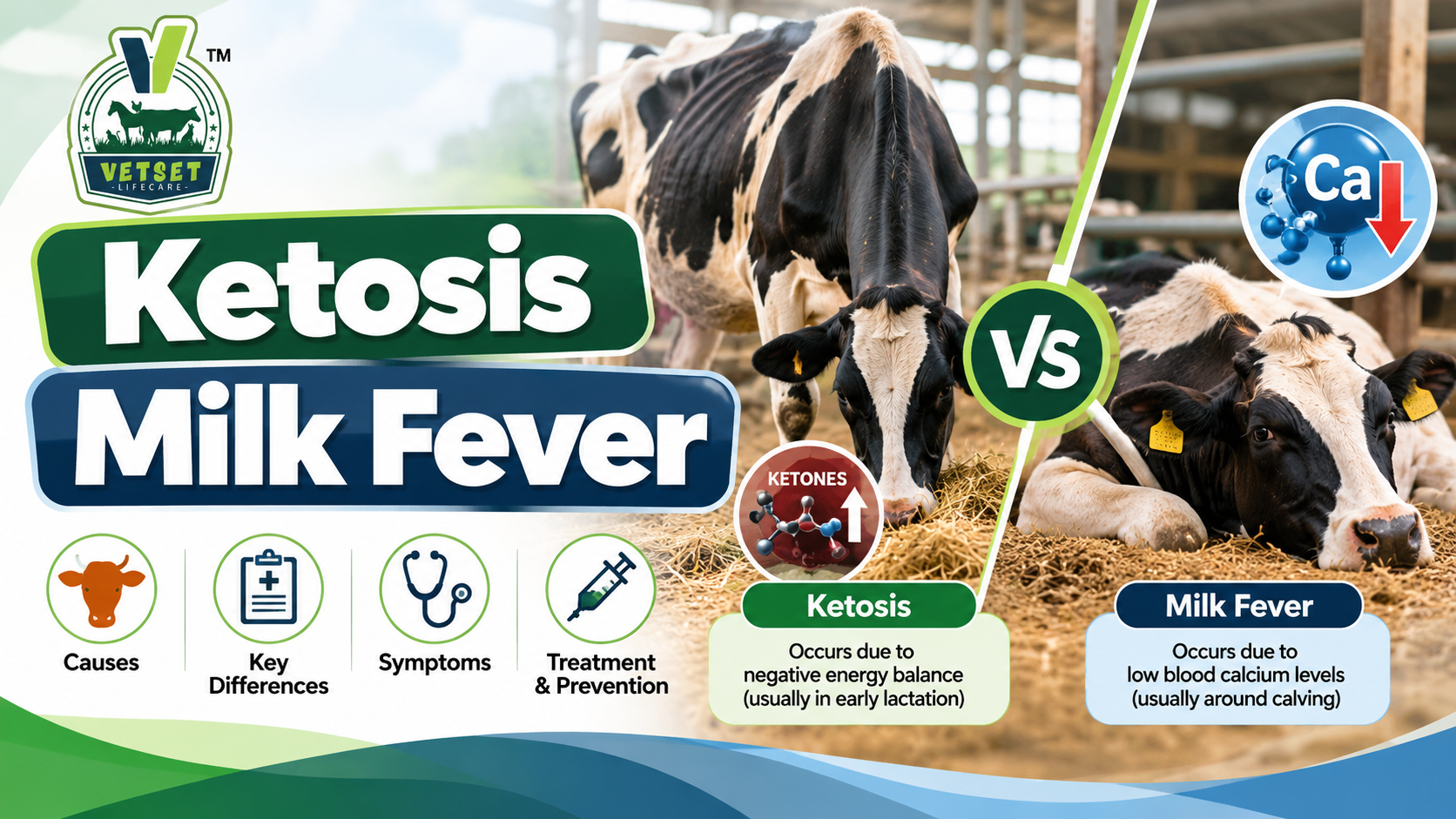
Ketosis vs milk fever: how to tell them apart
| Point | Ketosis | Milk fever |
|---|---|---|
| Timing | 1–6 weeks after calving | Within 72 hours of calving |
| Cause | Low energy (glucose) | Low blood calcium |
| Appetite | Refuses concentrate first | Stops eating fully |
| Standing | Usually standing | Often down, cannot rise |
| Smell | Acetone smell | No special smell |
| Quick test | BHB meter or ketone strip | Response to calcium |
Both conditions can occur in the same cow. Read more in our milk fever guide.
Treatment for Ketosis in Dairy Cows
Ketosis is treated by giving the cow a quick energy source that her body turns into glucose, usually oral propylene glycol, with IV dextrose from a vet for severe cases. Treating any linked disease, such as metritis, is just as important.
Safety note: Doses below are taken from published research and veterinary teaching material. They are for awareness only. Always confirm the diagnosis, dose and any withdrawal period with a registered veterinarian.
Step-by-step treatment plan
- Confirm the problem. Test BHB and check for milk fever, metritis, mastitis and displaced abomasum.
- Give oral propylene glycol. In Cornell research, cows received 300 mL by drench once a day for 3 days (Mann & McArt, 2018). Use a drench gun and give it slowly.
- IV dextrose for severe cases. A vet may give 500 mL of 50% dextrose into the vein. The effect lasts only a few hours, so it is combined with oral propylene glycol.
- Other vet-only options. A vet may add a corticosteroid such as dexamethasone, vitamin B12 with butaphosphan, or other glucose precursors, based on the case (Arunaman, COL, 2023).
- Treat the root disease. Secondary ketosis returns if metritis, lameness or low calcium is not fixed.
- Support feed intake. Offer fresh, tasty green fodder, good dry fodder and clean water. Increase concentrate slowly.
- Retest after 3–5 days. Check BHB again to confirm recovery and avoid relapse.
Comparison of common treatments
| Treatment | How it works | Speed | Duration of effect | Who gives it |
|---|---|---|---|---|
| Oral propylene glycol | Converted to glucose in the liver | Hours | Longer, while drenching continues | Farmer, with vet guidance |
| Oral glycerol | Glucose precursor | Hours | Moderate | Farmer, with vet guidance |
| IV 50% dextrose | Raises blood glucose at once | Minutes | Short (a few hours) | Vet only |
| Dextrose + propylene glycol | Fast plus lasting effect | Minutes to hours | Lowered BHB most in a Cornell trial | Vet + farmer |
| Corticosteroid (e.g. dexamethasone) | Helps the body make glucose | Hours | 1–2 days | Vet only; not for pregnant animals without vet advice |
| Vitamin B12 + butaphosphan, niacin, choline | Support energy and liver metabolism | Slow | Supportive | Vet guidance |
In the Cornell trial of 34 ketotic cows, the dextrose plus propylene glycol combination lowered BHB the most during treatment. The trial was small, so it did not measure milk or disease outcomes.
Common mistakes to avoid
- Treating only with IV glucose and stopping. The cow often relapses.
- Using steroids again and again without a vet.
- Ignoring a hidden disease like metritis or a displaced abomasum.
- Drenching too fast, which can cause liquid to enter the lungs.
- Overdosing propylene glycol. High doses can upset the rumen.
Prevention of Ketosis in Cattle
You prevent ketosis by managing the transition period well, from 3 weeks before calving to 3 weeks after, so the cow keeps eating and does not lose body fat too fast. Prevention costs far less than treatment and lost milk.
Transition-cow checklist
Dry period (60 to 21 days before calving)
- Keep cows in moderate body condition. Do not let them get fat. A score of about 3.0–3.5 on a 5-point scale is a common target.
- Feed good-quality dry fodder and limited concentrate.
- Give a balanced mineral mixture and vitamins.
Close-up period (last 21 days)
- Slowly start the concentrate the cow will get after calving, so the rumen adapts.
- Give enough space, shade and clean water so intake does not drop.
- Plan calcium support for high-risk cows to prevent milk fever.
Fresh period (first 21 days after calving)
- Offer fresh, tasty fodder right after calving.
- Raise concentrate step by step, not suddenly.
- Ask your vet about a preventive propylene glycol drench for high-yielding cows or cows with a past history of ketosis.
- Check every fresh cow daily: appetite, dung, rumen fill, milk yield, temperature.
- Test BHB in fresh cows between day 3 and day 16.
- Treat metritis, retained placenta and mastitis early.
Feed and housing
- Avoid spoiled or badly fermented silage.
- Reduce heat stress with fans, sprinklers or shade in summer.
- Keep a regular feeding time and avoid sudden ration changes.
Prevention methods compared
| Method | Main benefit | Cost level | Effort |
|---|---|---|---|
| Body condition control in dry period | Reduces fat mobilisation | Low | Medium |
| Gradual ration change before calving | Better intake after calving | Low | Low |
| Preventive propylene glycol drench | Extra glucose in high-risk cows | Medium | Medium |
| Mineral mixture and calcium support | Fewer milk fever cases, better appetite | Low to medium | Low |
| Routine BHB testing | Finds hidden cases early | Medium | Medium |
| Good housing and cooling | Keeps feed intake high | Varies | Medium |
These steps also support better fertility. For more help, see our guides on repeat breeding in cows and buffaloes and benefits of liquid calcium for cattle.
Practical Example: A Ketosis Plan for a 20-Cow Dairy
A simple fresh-cow routine of daily checks, BHB testing and early drenching can catch most ketosis cases before they turn severe. The example below is an illustration built from the study figures above, not data from a specific farm.
The situation
A farmer in Haryana keeps 20 crossbred HF cows. About 18 cows calve each year. Several fresh cows drop milk in week 2 and leave their dana, but they recover on their own after a few weeks.
What the numbers suggest
- At the Odisha rate of 36.7%, about 6–7 of 18 fresh cows could have ketosis each year.
- Most of them show no clear signs, so they are never treated.
- Each case raises the risk of displaced abomasum, metritis and late pregnancy.
What the farmer changes
- Buys a handheld BHB meter and tests every fresh cow on day 5 and day 10.
- Starts a propylene glycol drench, as advised by the vet, for any cow at 1.2 mmol/L or above.
- Stops feeding extra concentrate to dry cows that are already in good condition.
- Starts the fresh-cow concentrate slowly in the last 2 weeks before calving.
- Keeps a simple register: calving date, BHB result, treatment, milk yield on day 30.
What to track after 6 months
| Measure | Why it matters |
|---|---|
| % of fresh cows with BHB ≥ 1.2 mmol/L | Target below 15% |
| Milk yield at day 30 | Shows early lactation recovery |
| Cases of metritis and DA | Linked diseases should fall |
| Days to first heat and conception | Fertility improves when energy balance improves |
This record keeping turns guesswork into your farm’s own data. Share it with your vet to fine-tune the ration.
How VetSet Lifecare Supports Fresh-Cow Health
VetSet Lifecare is a WHO-GMP certified veterinary medicine manufacturer in Ambala, Haryana, making feed supplements, boluses and injections for dairy animals. Our range supports the nutrition and metabolic needs of cows around calving.
Products that fit a transition-cow plan
- Calcium supplements (liquid calcium, gels and boluses) to lower the risk of milk fever, which often triggers ketosis
- Liver tonics to support liver function during heavy fat mobilisation
- Mineral mixtures and multivitamins for balanced nutrition in the dry and fresh period
- Appetite and digestive boluses to help fresh cows return to full feed
- Energy supplements for high-yielding cows, used with vet advice
See the full range on our product list or read about our veterinary feed supplement manufacturing.
For distributors and veterinary brands
Ketosis, milk fever and low milk yield are among the most common problems dairy farmers bring to vets and medical stores. That makes fresh-cow products a steady category for distributors.
- Start a veterinary PCD franchise in India with VetSet Lifecare.
- Launch your own brand through our third-party veterinary manufacturing service.
Need help? Call +91 7015507806, email vetsetlifecare@gmail.com, or contact us for the product catalogue.
Frequently Asked Questions
How do you treat ketosis in cattle?
Ketosis in cattle is treated by restoring blood glucose. The usual first step is an oral propylene glycol drench, for example 300 mL once daily for about 3 days, as used in Cornell research. Severe cases may need IV 50% dextrose from a vet. Any linked disease, such as metritis or milk fever, must also be treated.
How do you know if a cow has ketosis?
A cow with ketosis usually eats less concentrate, gives less milk and looks dull a week or two after calving. Her breath or milk may smell of acetone. The surest check is a blood BHB test: 1.2 mmol/L or more confirms ketosis, and 3.0 mmol/L or more means clinical ketosis.
What is the treatment of ketosis?
The treatment of ketosis is energy replacement plus fixing the cause. Vets commonly use oral propylene glycol or glycerol, IV dextrose for fast effect, and sometimes a corticosteroid or vitamin B12 with butaphosphan. Good fodder and clean water help the cow eat again. Retest BHB after a few days to confirm recovery.
How can ketosis be prevented in cows?
Ketosis can be prevented by keeping dry cows in moderate body condition, changing the ration slowly before calving, and keeping fresh cows eating well. Control milk fever, reduce heat stress and avoid spoiled silage. For high-risk cows, a vet may advise a preventive propylene glycol drench and routine BHB testing in the first two weeks.
When does ketosis occur in dairy cows after calving?
Ketosis in dairy cows after calving most often occurs in the first 2–6 weeks of lactation. Subclinical cases are usually found between day 3 and day 16 in milk. Fat cows tend to get it early, within 1–2 weeks, while thin high-yielding cows often get it closer to peak milk yield.
Is milk from a cow with ketosis safe to drink?
Ketosis itself does not make milk unsafe, but milk from a sick cow may have an off smell and lower quality. The bigger concern is medicine. If the cow received drugs, follow the withdrawal period on the label or as advised by your vet before using or selling the milk.
Can ketosis in dairy animals like buffaloes happen too?
Yes. Ketosis in dairy animals is not limited to cows. High-yielding buffaloes, goats and sheep can also develop it when energy demand is higher than feed intake, especially in early lactation or late pregnancy. The signs, testing and treatment approach are similar, but doses must be set by a vet for each species.
What is the difference between clinical and subclinical ketosis?
Clinical ketosis shows clear signs such as poor appetite, a big milk drop and acetone smell, with blood BHB usually 3.0 mmol/L or higher. Subclinical ketosis has BHB between 1.2 and 2.9 mmol/L but no clear signs. It is more common and still lowers milk, fertility and disease resistance.
Final Word
Ketosis is common, mostly hidden and expensive, but it is also one of the easiest fresh-cow problems to prevent. Watch appetite, test BHB in the first two weeks and treat early with your vet. A healthy transition period means more milk, better fertility and fewer sick cows.
How We Prepared This Guide
We reviewed peer-reviewed studies on ketosis in Indian and international dairy herds, veterinary teaching material and university extension guidance. We selected studies with large sample sizes and clear BHB cut-off values. Indian data (Odisha, 2,760 cows) was used for local prevalence; European and US data for disease risk and cost. Treatment doses are quoted only as reported in the cited sources. The farm example is an illustration based on these figures. This article is for education and does not replace advice from a registered veterinarian.
References
- Biswal S., Nayak D.C., Sardar K.K. (2016). Prevalence of ketosis in dairy cows in milk shed areas of Odisha state, India. Veterinary World, 9(11): 1242–1247.
- Suthar V.S. et al. (2013). Prevalence of subclinical ketosis and relationships with postpartum diseases in European dairy cows. Journal of Dairy Science, 96(5): 2925–2938.
- McArt J. (2015 cost model, presentation). The cost of ketosis, citing McArt et al., Journal of Dairy Science, 2015.
- Mann S., McArt J. (2018). Postpartum ketosis treatments: propylene glycol, dextrose or both? Progressive Dairyman, Cornell University.
- Arunaman C.S. (2023). Treatment of bovine and ovine ketosis. In Management of Metabolic and Production Disorders in Cattle, Commonwealth of Learning.
- WikiVet. Ketosis of cattle.
- The Dairy Site. Acetonaemia (ketosis).
Related reading on VetSet Lifecare: Milk fever in cows · Mastitis in cows · Diarrhea (scours) in calves · Increase milk yield in dairy cattle