

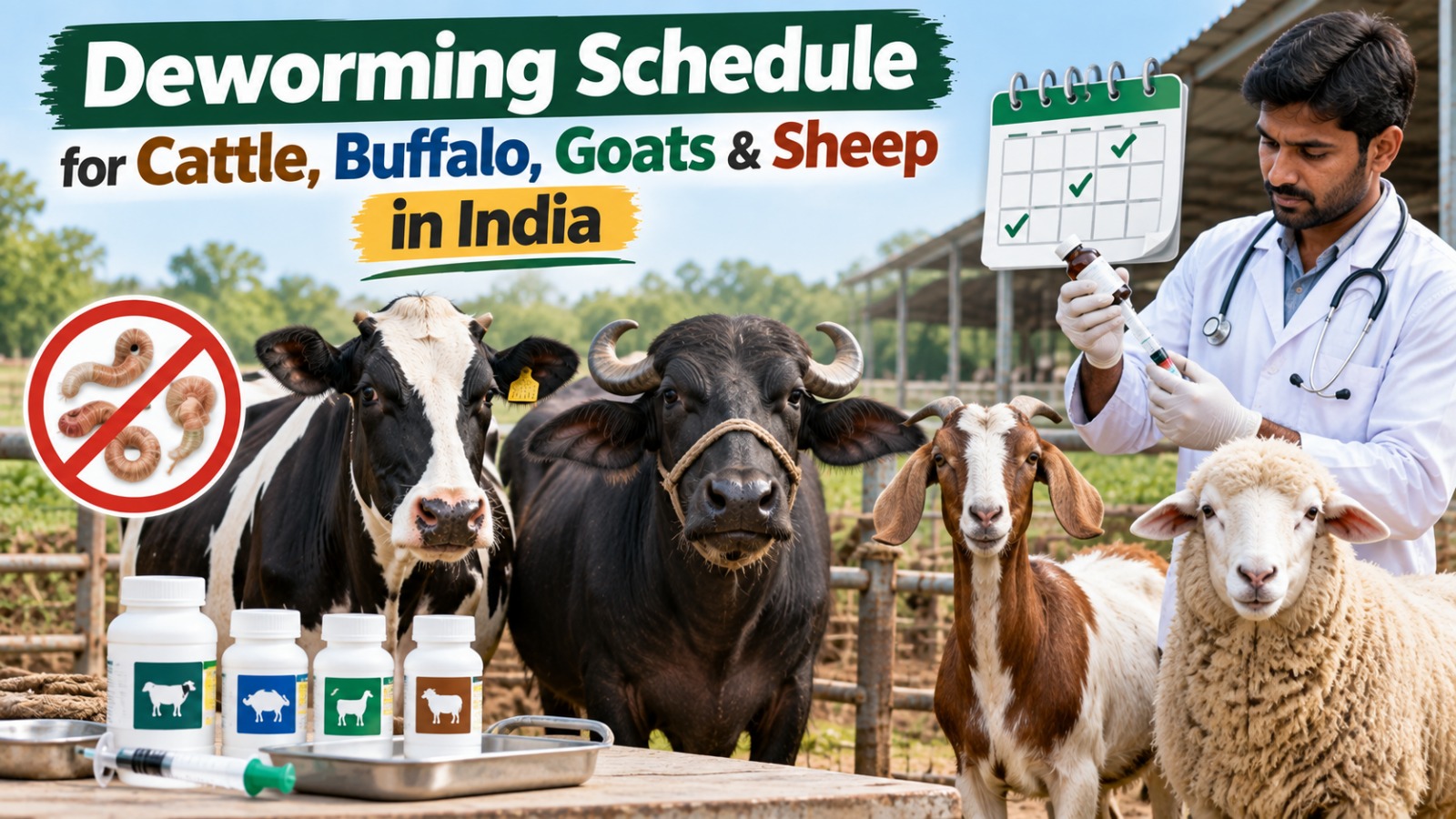
A reliable deworming schedule for cattle and buffalo in India starts with calves at 2-3 weeks of age, repeated every 6-8 weeks until 6 months, then every 3-4 months as they grow, and 2-3 times a year for adult animals — ideally timed around the monsoon and post-monsoon months when parasite risk peaks. Goats and sheep follow a similar structure but start slightly later, with lambs and kids first dewormed at 6-8 weeks. Exact timing should always be confirmed with a veterinarian based on regional climate and herd history.
Introduction
Ask most dairy farmers what’s cutting into their herd’s productivity, and internal parasites rarely come up first — yet they’re one of the most consistent, quietly damaging problems in Indian livestock farming. Unlike a disease outbreak, worm infestations build slowly: lower weight gain, reduced milk yield, poor coat condition, and reduced fertility, often long before anything looks visibly wrong.
This guide sets out a clear deworming schedule for cattle, buffalo, goats, and sheep in India, along with the seasonal timing and species-specific precautions that make the biggest practical difference.
Why Deworming Timing Matters More in India Than Elsewhere
India’s warm, humid climate — especially through the monsoon and the weeks immediately after — creates near-ideal survival conditions for parasite eggs and larvae on pasture. A multi-year study of gastrointestinal parasites in cattle, goats, and sheep across North Bengal, India, recorded an overall infection rate of 69.4%, with infections peaking sharply during the monsoon and summer months. Cattle showed the highest prevalence among the species studied.
This is the core reason a fixed, calendar-based deworming date doesn’t serve Indian herds well — the schedule needs to flex around the monsoon, not ignore it.
Deworming Schedule for Cattle
| Age / Stage | Deworming Guidance |
|---|---|
| Calves, 2-3 weeks | First deworming |
| Calves, up to 6 months | Repeat every 6-8 weeks |
| Growing stock, 6-24 months | Every 3-4 months, with extra attention during monsoon |
| Adult cattle | 2-3 times a year — commonly pre-monsoon, post-monsoon, and once more based on regional risk |
| Pregnant cows | Deworm 2-3 weeks before expected calving |
| New/purchased cattle | Deworm on arrival and isolate before introducing to the herd |
Deworming Schedule for Buffalo
Buffalo follow broadly the same schedule as cattle, with a few practical notes worth calling out separately since buffalo management often differs from cattle in Indian dairy systems:
| Age / Stage | Deworming Guidance |
|---|---|
| Buffalo calves, 2-3 weeks | First deworming |
| Up to 6 months | Every 6-8 weeks |
| Growing buffalo, 6-24 months | Every 3-4 months |
| Adult buffalo | 2-3 times a year, aligned with monsoon risk periods |
| Lactating buffalo | Use only dewormers approved for lactating animals and observe milk withdrawal periods |
| Pregnant buffalo | Deworm 2-3 weeks before expected calving |
Buffalo are often kept in wetter, more waterlogged grazing conditions than cattle in many parts of India, which can increase exposure to certain parasites — this is worth factoring into how aggressively you schedule monsoon-period deworming for buffalo specifically.
Deworming Schedule for Goats
| Age / Stage | Deworming Guidance |
|---|---|
| Kids, 6-8 weeks | First deworming |
| Young goats, up to 1 year | Every 4-8 weeks |
| Pregnant does | Deworm 2-4 weeks before expected kidding |
| Early pregnancy (up to ~2 months) | Avoid deworming during this window unless a veterinarian specifically advises it, due to potential abortion risk with certain drug classes |
| Adult goats | Periodic seasonal deworming, plus at least one annual treatment specifically targeting tapeworm |
Goats graze closer to the ground than cattle and buffalo, which increases their exposure to parasite larvae on pasture. Goats are also generally more susceptible to parasite-related disease than sheep, often showing clinical signs at lower worm loads.
Deworming Schedule for Sheep
| Age / Stage | Deworming Guidance |
|---|---|
| Lambs, 6-8 weeks | First deworming |
| Young sheep, up to 1 year | Every 4-8 weeks |
| Pregnant ewes | Deworm 2-4 weeks before expected lambing |
| Adult sheep | Regular seasonal deworming, plus annual tapeworm-specific treatment |
Species Comparison at a Glance
| Factor | Cattle & Buffalo | Goats & Sheep |
|---|---|---|
| First deworming age | 2-3 weeks | 6-8 weeks |
| Adult frequency | 2-3 times/year | Seasonal + annual tapeworm treatment |
| Grazing-related exposure | Moderate | Higher (close grazing) |
| Pregnancy caution | Deworm 2-3 weeks pre-calving | Avoid early pregnancy; deworm 2-4 weeks pre-birth |
| Most parasite-susceptible | Buffalo in wetter grazing zones | Goats more than sheep |
Common Mistakes in Livestock Deworming
- Sticking to a fixed date regardless of season — Indian parasite risk spikes sharply around monsoon, so a rigid annual calendar leaves animals under-protected exactly when risk is highest.
- Repeating the same dewormer without rotation — one of the leading causes of anthelmintic resistance, which makes future treatments progressively less effective.
- Using cattle-dosed pour-on products on goats or sheep — small ruminants need different dosing; cattle products should not be applied orally to goats or sheep.
- Skipping fecal egg counts — without periodic testing, there’s no reliable way to know whether a deworming program is actually working or whether resistance has developed in the herd.
- Deworming does or ewes in early pregnancy — this carries abortion risk with certain drug classes and should be avoided unless specifically advised by a veterinarian.
- Ignoring milk withdrawal periods — using a dewormer not cleared for lactating animals, or ignoring the withdrawal window, can affect milk safety for sale or consumption.
Practical Best Practices
- Rotate anthelmintic classes periodically, under veterinary guidance, to slow the development of resistance.
- Time treatments around the monsoon — pre-monsoon and post-monsoon deworming is widely recommended given how sharply parasite survival rises during this window in Indian conditions.
- Keep deworming records — date, product, dosage, and animal or group treated — to avoid missed doses and spot recurring problems early.
- Quarantine new animals before introducing them to the herd, since purchased livestock is a common route for parasite introduction.
- Use fecal egg count testing periodically, especially if animals show reduced weight gain, poor coat condition, or lower milk yield despite a regular deworming routine.
Why This Should Be Treated as a Framework, Not a Fixed Rule
The schedule above reflects widely-used veterinary guidance, but actual programs should be adjusted for:
- Local monsoon timing and climate in your specific region
- Grazing system — open pasture, semi-confinement, or stall-fed
- Herd-specific parasite history and fecal egg count results
- The dewormer class in use and any known local resistance patterns
FAQs
Q1. What is the deworming schedule for cattle in India?
Calves are typically first dewormed at 2-3 weeks, then every 6-8 weeks until 6 months old. Growing stock (6-24 months) should be dewormed every 3-4 months, and adult cattle 2-3 times a year, ideally around the monsoon and post-monsoon period.
Q2. What is the deworming schedule for buffalo?
Buffalo follow a schedule very similar to cattle — first deworming at 2-3 weeks, every 6-8 weeks until 6 months, then every 3-4 months as growing stock, and 2-3 times a year as adults. Buffalo in wetter grazing conditions may need closer monsoon-period attention.
Q3. What is the deworming schedule for goats?
Kids are typically first dewormed at 6-8 weeks, then every 4-8 weeks until about a year old. Adult goats should receive periodic seasonal deworming plus at least one annual treatment specifically for tapeworm.
Q4. What is the deworming schedule for sheep?
Lambs are usually first dewormed at 6-8 weeks, followed by treatment every 4-8 weeks until roughly a year old. Adult sheep need regular seasonal deworming along with an annual tapeworm-specific treatment.
Q5. What is the deworming schedule for a cow specifically?
A dairy cow’s schedule depends on her life stage — calves start at 2-3 weeks, growing heifers every 3-4 months, and adult cows 2-3 times a year. Pregnant cows should be dewormed 2-3 weeks before calving, and lactating cows require a dewormer cleared for use during lactation.
Q6. Why is monsoon season so important for deworming in India?
Warm, humid monsoon conditions significantly extend the survival of parasite eggs and larvae on pasture. Indian livestock studies have recorded parasite infection rates peaking during monsoon and summer, which is why pre- and post-monsoon deworming is widely recommended over a fixed annual date.
Sources
- Study on Gastrointestinal Parasitic Infections in Domestic Ruminants, North Bengal, India (2020-2024)
- General veterinary anthelmintic guidance for cattle, buffalo, goat, and sheep deworming protocols
Related Reading
- GMP Certified Veterinary Manufacturer in India: Why WHO-GMP Matters
- Milk Fever in Cows: Causes, Symptoms, Treatment & Prevention
- How Profitable Is a Veterinary PCD Franchise?
Looking for Reliable Deworming and Livestock Health Products?
VetSet Lifecare manufactures a WHO-GMP certified range of veterinary formulations for cattle, buffalo, goats, and sheep. Get in touch at +91 70155 07806 or vetsetlifecare@gmail.com for product and franchise queries.
Disclaimer: This schedule is a general reference based on widely-used veterinary guidance. Always consult a qualified veterinarian to confirm the deworming program, dosage, and dewormer selection suited to your herd, region, and grazing conditions.