

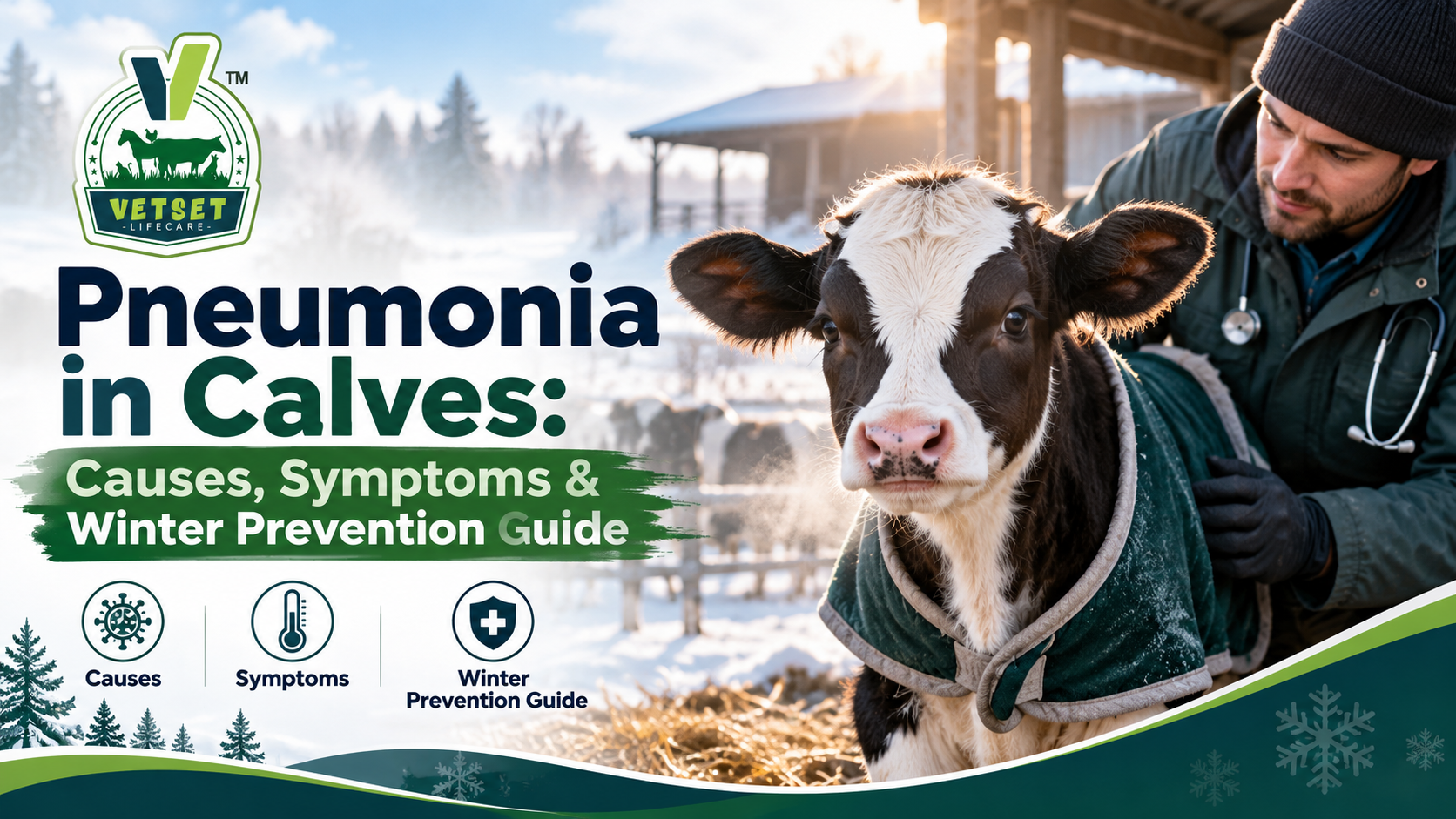
What is pneumonia in calves?
Pneumonia in calves is an infection and inflammation of the lungs, usually caused by viruses and bacteria together, and triggered by stress such as cold, damp air, poor ventilation or low colostrum intake. Early signs are fever above 39.2°C (102.5°F), cough, nasal discharge and drooping ears. Early vet treatment saves most calves; late treatment often leaves permanent lung damage.
It is one of the two biggest killers of young calves, next to diarrhoea (scours). The Merck Veterinary Manual calls enzootic pneumonia “the most common respiratory disease” in young dairy and beef calves.
Winter is the high-risk season in North India. Cold nights, closed sheds, wet bedding and ammonia build-up all weaken a calf’s lungs at the same time.
This guide covers:
- The main causes and risk factors
- Symptoms to check daily, with a simple scoring chart
- How vets treat calf pneumonia, and what you can safely do at home
- A winter prevention checklist for Indian dairy farms
- Direct answers to the questions farmers ask most
- Important: This guide is for awareness and farm management. It does not replace a veterinarian’s examination. Always ask your vet before giving any antibiotic or injection.
How serious is calf pneumonia? Key numbers
Calf pneumonia causes roughly 3 in 10 dairy calf deaths, and calves that survive it often grow and milk less later. The figures below come from published veterinary research and government surveys.
| What was measured | Figure | Source |
|---|---|---|
| Share of dairy calf deaths caused by enzootic pneumonia | About 30% | Merck Veterinary Manual |
| Calves in one affected group that can fall sick | Up to 100% | Merck Veterinary Manual |
| Sick calves that die (case fatality) | 5–20% | Merck Veterinary Manual |
| Pneumonia share of deaths: pre-weaned calves vs weaned heifers | 21.3% vs 50.4% | Dr Sheila McGuirk, University of Wisconsin |
| Murrah buffalo calves, CIRB Hisar (Haryana): share of deaths in winter | 37.6% (highest of all seasons) | Yadav et al., Buffalo Bulletin |
| Same herd: deaths from gut + pneumonia causes combined | 30.7% (largest cause group) | Yadav et al., Buffalo Bulletin |
| Milk lost in first lactation by heifers that had calf pneumonia | 121 kg on average (range 70–525 kg) | AHDB, via Farmers Weekly |
| Odds of surviving to 24 months: healthy vs pneumonia-treated heifers | 1.53 times higher for healthy heifers | Closs & Dechow, Livestock Science 2017 |
What this means for an Indian dairy farm
The Hisar data matters most here. It covers 24 years of buffalo calves in Haryana, and winter was the deadliest season. Calves under 3 months had the highest death rate (9.5%).
So the coming November–February period is when your calf shed needs the most attention. A calf lost or stunted now is a milking animal lost 2–3 years from now.
What causes pneumonia in calves?
Pneumonia in calves is caused by germs plus stress. A virus usually damages the airway first. Bacteria that already live in the calf’s nose then move into the weakened lungs. Stress from cold, damp air, crowding or low colostrum is what lets this happen.
Germs alone rarely cause disease in a well-fed calf kept in a dry, airy shed. That is why prevention focuses on management, not only medicine.
The germs involved
| Type | Common examples | Role |
|---|---|---|
| Viruses | Bovine respiratory syncytial virus (BRSV), infectious bovine rhinotracheitis (IBR), parainfluenza-3 (PI-3), bovine viral diarrhoea (BVD) | Damage the airway lining and lower immunity, opening the door for bacteria |
| Bacteria | Pasteurella multocida, Mannheimia haemolytica, Histophilus somni | Cause the serious lung infection; Pasteurella was the most common bacterium in Wisconsin lung samples |
| Mycoplasma | Mycoplasma bovis | Causes long-lasting pneumonia and ear infections; does not respond to many common antibiotics |
Sources: Merck Veterinary Manual, University of Wisconsin.
Stress and management risk factors
The Merck Veterinary Manual lists these as the main triggers:
- Poor colostrum intake in the first hours of life
- Bad ventilation — stale air, ammonia smell, dust
- High humidity and wet bedding
- Sudden weather changes, such as warm days and cold nights
- Crowding and mixing calves of different ages
- Poor nutrition, especially too little milk in cold weather
- Waning maternal antibodies at around 2–4 months of age
Winter in Haryana, Punjab and western UP ticks most of these boxes. Farmers close sheds against the cold, so ammonia and moisture build up inside.
What is enzootic pneumonia in calves?
Enzootic pneumonia is the long-running, herd-level form of calf pneumonia. It keeps coming back in young housed calves on the same farm, usually in the first few months of life. It is caused by the same mix of viruses, bacteria and poor housing described above.
“Enzootic” means the disease is always present at a low level on that farm. If you treat calf after calf every winter, you likely have enzootic pneumonia, and the shed itself needs fixing.
Related reading: Diarrhea (Scours) in Calves: Causes, Symptoms & Treatment. Scours and pneumonia often hit the same weak calves.
Pneumonia in calves symptoms: what to look for
The earliest signs of calf pneumonia are fever, a dull attitude and a drop in milk intake. Cough, nasal discharge and fast breathing usually follow. Drooping ears or a tilted head point to a Mycoplasma ear infection that often comes with pneumonia.
Many calves look normal at a distance while their lungs are already damaged. That is why daily close checks matter more than waiting for a cough.
Early vs advanced signs
| Stage | Signs you can see | What to do |
|---|---|---|
| Early (day 1–2) | Fever above 39.2°C, slow to drink or leaves milk, dull eyes, stands apart, clear nasal discharge, occasional cough | Call your vet the same day; isolate the calf |
| Developing | Repeated cough, thick or cloudy nasal discharge, watery eyes, fast or shallow breathing, one or both ears drooping | Vet treatment urgently; keep the calf warm and drinking |
| Advanced | Open-mouth breathing, grunting, neck stretched out, refuses all feed, lying down most of the time | Emergency; the lungs may already be permanently damaged |
| Chronic | Poor growth, rough hair coat, recurring cough after treatment, repeated relapses | Ask your vet about lung scanning and whether the calf is worth rearing |
A simple calf scoring check
Researchers tested a simplified scoring system on 500 hutch-raised dairy calves. Add up the points for each sign you see:
| Sign | Points |
|---|---|
| Cough (one or more) | 2 |
| Eye discharge | 2 |
| Fever above 39.2°C (102.5°F) | 2 |
| Abnormal or fast breathing | 2 |
| Nasal discharge | 4 |
| Ear droop or head tilt | 5 |
A total of 5 or more = treat as a pneumonia case. If the other signs add up to exactly 4, take the rectal temperature, because fever would push the score to 5. Source: Simplified scoring system, Dairy Cattle Extension.
Scoring is not perfect. In that study, it missed about 28% of calves whose lungs showed disease on ultrasound. So a calf that scores low but keeps leaving its milk still needs a vet check.
How often to check
The University of Wisconsin recommends screening calves at least twice a week from about 3 weeks of age, and again at weaning (McGuirk). In winter, a daily look at feeding time is better.
A useful early clue: watch how long each calf takes to finish its milk. A calf that stays at the bucket longer than usual, or stands still after drinking, is often getting sick.
Pneumonia in calves treatment: what works
The best treatment for pneumonia in calves is an early, full course of a vet-prescribed antibiotic, together with an anti-inflammatory painkiller and good nursing care. Speed matters most. A calf treated on the first day of fever recovers far better than one treated after it starts breathing hard.
Step-by-step treatment plan
- Isolate the calf in a dry, draught-free pen with deep, clean bedding.
- Take the rectal temperature and note all signs, using the scoring table above.
- Call your veterinarian. They will choose the antibiotic based on the likely germ and your farm’s past response to treatment.
- Give the full antibiotic course exactly as prescribed. Stopping early is a major cause of relapse and antibiotic resistance.
- Use an anti-inflammatory (NSAID) if your vet prescribes one. NSAIDs such as meloxicam or flunixin bring down fever and lung inflammation, so the calf starts drinking again sooner.
- Keep the calf eating and drinking. Offer warm milk in small, frequent feeds. Give oral electrolytes if it is dull or dehydrated.
- Re-check temperature every day. If fever has not dropped within 2–3 days, call the vet back. The antibiotic may need changing, especially if Mycoplasma is involved.
- Record everything: calf ID, date, drug, dose and withdrawal period. Records show which drugs work on your farm.
Never start, stop or switch antibiotics without your vet. Wrong use breeds resistant bacteria. Read more in our guide to Antimicrobial Resistance (AMR) in Veterinary Medicine.
Treatment options compared
| Approach | What it does | Best used for | Limits |
|---|---|---|---|
| Vet-prescribed antibiotics | Kill the bacteria causing the lung infection | All confirmed or suspected cases | Do not kill viruses; wrong drug or short course leads to relapse and resistance |
| NSAIDs (anti-inflammatory) | Lower fever, pain and lung swelling | Alongside antibiotics, as advised by the vet | Not a cure on their own |
| Supportive care (warmth, fluids, electrolytes, extra milk) | Keeps energy and hydration up while the calf fights infection | Every sick calf | Cannot clear a bacterial infection alone |
| Vitamin and mineral support | Supports immunity and recovery appetite | During recovery and in high-risk seasons | Supports treatment; does not replace it |
| Home remedies alone (herbs, steam, kadha) | May make the calf more comfortable | Mild comfort only | No proven ability to cure bacterial pneumonia; delaying the vet can cost the calf |

How to treat pneumonia in calves naturally or at home
You cannot safely cure bacterial pneumonia with natural remedies alone. What you can do at home is give excellent nursing care, which strongly improves the result of vet treatment:
- Keep the calf warm. Use a calf jacket or jute sack cover and deep straw bedding.
- Keep air fresh. Open shed vents or upper windows during the day without creating a draught at calf level.
- Keep it drinking. Offer warm milk 3 times a day in smaller amounts, plus clean lukewarm water.
- Watch the temperature twice a day and write it down.
- Clean the nose gently with a soft, damp cloth so the calf can breathe and smell its milk.
If the calf is not better in 24 hours, or gets worse at any point, call the vet immediately.
Can a calf survive pneumonia?
Yes. Most calves survive when treatment starts early. The Merck Veterinary Manual puts the death rate among sick calves at 5–20%. Calves treated late may survive but grow slowly. In one Penn State herd study, healthy heifers had 1.53 times higher odds of reaching 24 months than heifers treated for calf pneumonia (Closs & Dechow, 2017).
Withdrawal period: an often-missed step
If a treated female calf is later milked, or a male calf is sold for meat, the drug withdrawal period on the label must be followed. Ask your vet and keep it in your records.
Where VetSet Lifecare fits in
VetSet Lifecare is a WHO-GMP certified veterinary medicine manufacturer in Ambala, Haryana. Our range includes veterinary injections, boluses, and feed supplements such as multivitamins, liver tonics, electrolytes and mineral mixtures that vets use during treatment and recovery.
Browse the VetSet product list, or contact our team for product details. Distributors can also explore our veterinary PCD franchise. Always use any medicine under your vet’s advice.
Winter prevention guide for calf pneumonia
Most calf pneumonia can be prevented with four basics: enough colostrum on day one, a dry and airy shed, extra feed in cold weather, and early detection. Medicines treat the problem; management stops it from starting.
1. Colostrum: the first and biggest protection
Utah State University Extension recommends (Swartz et al.):
| Factor | Target |
|---|---|
| Amount at first feed | 10–12% of the calf’s body weight |
| Example | 3–4 litres for a 35–40 kg calf; about 2.5–3 litres for a 25 kg calf |
| Timing | Within 1–2 hours of birth; no later than 4 hours |
| Quality | 50 g/L IgG or more (Brix reading of 22% or higher) |
Antibody absorption falls sharply after 12 hours and is minimal by 24 hours. A calf that misses good colostrum starts life with weak defences against pneumonia.
2. Housing: dry, airy, but not draughty
Calves need fresh air, but cold wind at calf height is harmful. Use this checklist:
- Shed smells clean at calf height (no sharp ammonia smell that stings your eyes)
- Upper vents or windows open during the day; no direct wind blowing on calves
- Deep, dry straw or paddy bedding that covers the calf’s legs when it lies down
- Bedding changed or topped up before it gets wet
- No water leaks or urine pooling in the pen
- Calves kept separate from adult cattle and buffaloes
- No crowding; calves of very different ages not mixed
- All-in, all-out pens where possible, cleaned between batches
3. Keep calves in their comfort zone
Newborn calves are comfortable between about 10°C and 26°C. Month-old calves cope down to about 0°C (University of Wisconsin).
North Indian winter nights often fall below 10°C. Below that range, a young calf burns feed energy just to stay warm, and immunity drops.
- Use calf jackets or jute covers for calves under 3 weeks old on cold nights.
- Feed more milk or milk replacer in cold weather, ideally in 3 smaller feeds a day.
- Offer lukewarm drinking water, as cold water lowers intake.
4. Catch it early
- Score calves twice a week, and daily in peak winter, using the table above.
- Watch feeding time closely; slow drinking is often the first sign.
- Keep a simple register: calf ID, temperature, score and any treatment.
- Do not move calves with untreated or unfinished pneumonia into group or weaning pens.
5. Herd health support
- Ask your vet about vaccinating pregnant cows and buffaloes against respiratory viruses, so their colostrum carries more antibodies.
- Follow a proper deworming schedule for cattle and buffalo; worm load lowers growth and immunity.
- Feed the dam well in late pregnancy for better colostrum.
Real farm example: why scoring matters
In a University of Wisconsin field case, a 1,700-cow dairy had pneumonia problems despite many ventilation changes. When vets scored the calves, 45% scored 5 or higher, but only 10% of those calves had been treated in the previous week (McGuirk).
The lesson for any farm: sick calves go unnoticed unless someone checks them on a schedule. Regular scoring finds them early, when treatment works best and costs least.
Frequently asked questions
How do you treat a calf with pneumonia?
Isolate the calf in a warm, dry, draught-free pen and call your vet the same day. The vet will usually give an antibiotic course and an anti-inflammatory to cut fever. At home, keep the calf drinking warm milk and electrolytes, and check its temperature daily. Call the vet back if the fever does not fall within 2–3 days.
Can a calf survive pneumonia?
Yes, most calves survive when treatment starts early. The Merck Veterinary Manual puts the death rate among sick calves at 5–20%. Calves treated late, or that relapse, may survive with lasting lung damage. These calves often grow slowly and, as heifers, are more likely to leave the herd early and give less milk.
What are the signs of pneumonia in a calf?
The main signs are fever above 39.2°C, drinking less milk, dullness, cough, nasal or eye discharge and fast breathing. Drooping ears or a tilted head suggest a linked Mycoplasma ear infection. In late cases, the calf breathes with its mouth open and stretches its neck. Check calves at every feed, as early signs are easy to miss.
What is the best treatment for pneumonia in calves?
The best treatment is an early, full course of an antibiotic chosen by your vet, combined with an NSAID such as meloxicam or flunixin and good nursing care. Starting on the first day of fever gives the best recovery. No single antibiotic suits every farm, because the germs involved, and their resistance, vary from farm to farm.
What causes pneumonia in calves?
Pneumonia in calves is caused by viruses and bacteria acting together, such as BRSV, Pasteurella and Mannheimia. These germs take hold when a calf is stressed. Common triggers are low colostrum intake, poor ventilation, damp bedding, ammonia, crowding, mixing ages and sudden cold weather. That is why cases rise sharply in winter.
What is enzootic pneumonia in calves?
Enzootic pneumonia is the form of calf pneumonia that keeps recurring in housed young calves on the same farm. It is caused by a mix of viruses, bacteria and Mycoplasma, made worse by poor housing and air quality. If many calves need treatment every winter, the shed and management usually need fixing, not just the medicine.
Can you treat pneumonia in calves at home without a vet?
No, not safely. Home care such as warmth, dry bedding, fresh air, warm milk and electrolytes helps a lot, but it cannot clear a bacterial lung infection. Wrong or incomplete antibiotic use can cause relapse and drug resistance. Use home care alongside vet treatment, and call the vet immediately if the calf gets worse.
Is pneumonia in calves contagious?
Yes. The viruses and bacteria behind calf pneumonia spread through breath, coughing, shared buckets and close contact. One sick calf can start an outbreak, and in a crowded group nearly every calf may fall sick. Isolate sick calves, clean feeding equipment after each use, and avoid mixing calves of different ages.
How we prepared this guide
- We reviewed the Merck Veterinary Manual, USDA NAHMS data, University of Wisconsin and Utah State University extension guidance, and peer-reviewed studies.
- We gave priority to Indian data, including the 24-year Murrah buffalo calf study from CIRB, Hisar.
- Every number in this article links to its original source. Where studies disagree, we say so rather than pick the more dramatic figure.
- Drug names are given as general classes only. Doses are not given, because they must be set by a vet for each calf.
Sources
- Enzootic Pneumonia of Calves — Merck Veterinary Manual
- Morbidity and Mortality in U.S. Preweaned Dairy Heifer Calves — USDA APHIS NAHMS Dairy 2014
- Calf Pneumonia — Dr Sheila McGuirk, University of Wisconsin
- A study of pattern in calf mortality at an organized Murrah buffalo herd in India: a 24-year review — Yadav, Boora, Singh & Singh, Buffalo Bulletin
- The effect of calf-hood pneumonia on heifer survival and subsequent performance — Closs & Dechow, Livestock Science, 2017
- How to stop calf pneumonia reducing heifer longevity — Farmers Weekly (AHDB data)
- Colostrum Management for Dairy Calves — Utah State University Extension
- Simplified Scoring System to Identify Respiratory Disease in Dairy Calves — Dairy Cattle Extension
- Wisconsin Calf Health Scoring Chart — AABP