

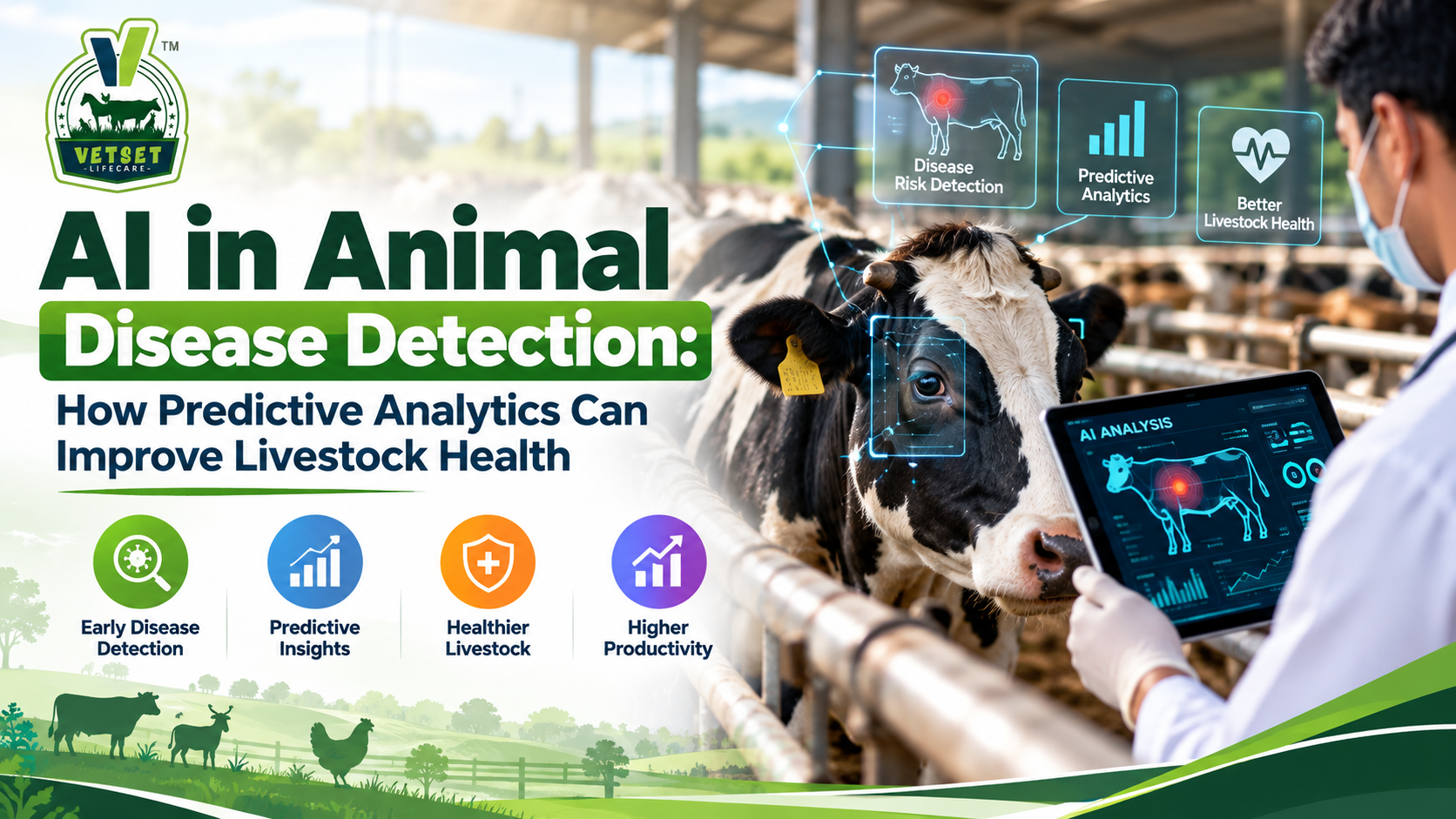
AI in animal disease means using computer programs to read animal data (milk records, body temperature, movement, photos and lab results) and flag sickness early. Predictive analytics goes one step further: it warns you that an animal is likely to fall sick before clear signs show. AI does not replace a veterinarian. It gives the vet and the farmer an early alert, so treatment starts sooner and losses stay smaller.
Key points at a glance
- Animal diseases destroy more than 20% of global animal production every year (WOAH, 2026).
- AI finds patterns in data that the human eye misses, such as a small drop in milk or a change in walking.
- Early alerts work best when paired with vaccination, deworming, clean housing and good feed.
- Always confirm an AI alert with a registered veterinarian before giving any medicine.
Why Livestock Disease Is Still a Big Problem
India has the largest livestock base in the world. The 20th Livestock Census (2019) counted 535.78 million animals in the country. That is a lot of animals to watch, and most farms have only a few vets to visit them.
The global picture is also worrying:
- The World Organisation for Animal Health (WOAH) says animal diseases destroy more than 20% of global animal production each year.
- The same report says animal health gets as little as 0.6% of global health spending.
By the time a farmer sees a dull, off-feed or limping animal, the disease has often been growing for days. Milk drops, treatment costs rise, and the sickness may spread to the rest of the herd. This is the gap that AI tries to close: catching the problem earlier.
What Is AI in Animal Health? (In Simple Words)
AI in animal health is a computer system that learns from past cases. You feed it thousands of examples, such as “this cow had mastitis” or “this hen had a respiratory infection”. It learns what the early signs look like. Then it checks new animals and tells you when something looks wrong.
Think of it like an experienced stockman who has seen 10,000 cows. He can walk through a shed and say, “That one is not right.” AI does the same, but it watches all animals, all day and night, and never gets tired.
How it works in 4 steps:
- Collect data: sensors, cameras, milking machines, farm records and lab reports.
- Clean and store it: the system lines up the data animal by animal.
- Find patterns: the model compares each animal with its own normal and with similar animals.
- Send an alert: the farmer or vet gets a message to check a particular animal.
The Role of AI in Veterinary Medicine
Artificial intelligence in veterinary medicine is no longer just a lab idea. Today the role of AI in veterinary work falls into four jobs.
| Job | What AI does | Example |
|---|---|---|
| Early detection | Spots small changes before symptoms are clear | A sensor notices lower rumination and body heat rise |
| Diagnosis support | Helps read images and lab data faster | A program flags a suspect X-ray or blood slide for the vet |
| Prediction (predictive analytics) | Estimates which animals are at high risk | A model warns that a fresh cow is likely to get mastitis |
| Herd and outbreak tracking | Watches trends across many animals or farms | Alerts when many sheds report the same signs |
This is why AI veterinary diagnostics and artificial intelligence in animal disease diagnosis are growing fast. The tool does not make the final decision. It helps the veterinarian decide sooner and with more facts.
Types of AI in Animal Disease Detection
When people search for “types of AI in animal disease”, they usually mean the methods below.
| Type of AI | Simple meaning | Used for |
|---|---|---|
| Machine learning | Learns patterns from past data | Predicting mastitis risk from milk data |
| Deep learning | A stronger version that learns from images and sound | Reading photos, X-rays and cough sounds |
| Computer vision | AI that “sees” through cameras | Spotting lameness, body condition and unusual behaviour |
| Sensor and IoT analytics | AI that reads wearable and barn sensors | Temperature, activity and rumination tracking |
| Natural language processing (NLP) | AI that reads text | Pulling patterns from vet notes and health records |
| Predictive analytics | Uses all of the above to forecast risk | “Which cows need a check this week?” |
How Predictive Analytics Improves Livestock Health
Predictive analytics looks at the past to guess what may happen next. On a dairy farm, it can answer questions like these:
- Which cows may get mastitis after calving?
- Which animals are slowing down and may be going lame?
- Which shed is heading for a respiratory problem?
Here is how this helps in real life:
- Earlier treatment. A sick animal is checked on day 1, not day 4.
- Less spread. You can separate a suspect animal before the herd is exposed.
- Smarter use of medicine. A right diagnosis helps the vet choose the right treatment. This supports responsible antibiotic use. Read more in our guide on antimicrobial resistance in veterinary medicine.
- Better planning. Records show which months and which sheds have the most problems, so you can plan vaccines and feed ahead of time.
What the Research Shows (and Its Limits)
Real studies back this up, but it is important to read them with care.
A 2025 study in Frontiers in Veterinary Science tested machine learning to detect clinical mastitis using milk electrical conductivity and somatic cell count. It used data from 93 cows on four dairy farms.
- A support vector machine model reached 95.6% accuracy and 100% sensitivity when using somatic cell count.
- A neural network model had the highest AUC score of 0.981.
The honest limits: this was a small study. The authors also note that current somatic cell count sensors can give imprecise readings and are costly to install. So these numbers show strong promise, not a guarantee for every farm.
Other research reviews cover AI for cattle lameness (using cameras and sensors) and for mastitis. They show the field is growing, but most tools are still tested on a limited number of farms. Results on your farm will depend on data quality, animal breed, housing and the system used.
Traditional Checking vs AI-Assisted Checking
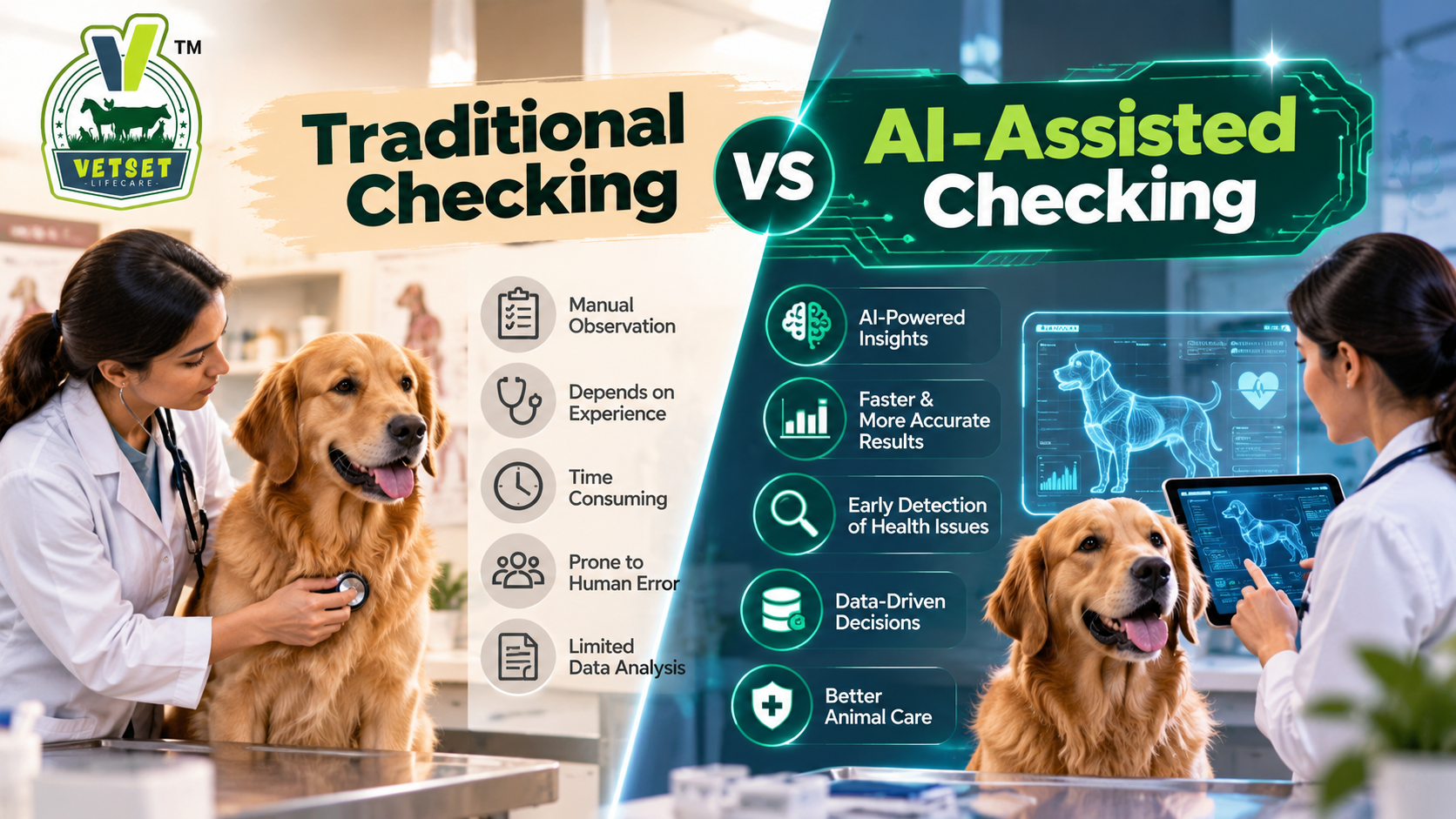
| Factor | Traditional method | AI-assisted method |
|---|---|---|
| When it spots trouble | After clear signs appear | Often before clear signs appear |
| Coverage | Depends on who is watching, and when | Can monitor every animal around the clock |
| Records | Notebook or memory | Stored, searchable data |
| Cost to start | Low | Higher (sensors, software, internet) |
| Skill needed | Experience and observation | Setup help plus vet support |
| Final decision by | Farmer and vet | Vet, using AI as a guide |
Takeaway: the best farms use both. AI gives the early warning. The vet’s skill and your daily observation give the final answer.
Challenges You Should Know About
AI is useful, but it is not magic.
- Data quality: poor or missing records give weak results.
- Cost: sensors and software can be expensive for small farms.
- Internet and power: rural areas may have weak connectivity.
- False alarms: some alerts will turn out to be nothing, and some real cases may be missed.
- Local fit: a model trained on foreign breeds may not work as well for Indian breeds and conditions.
- Not a replacement for a vet: a diagnosis and prescription must come from a registered veterinarian.
How Small and Medium Farms in India Can Start
You do not need a costly system on day one. Start with the basics that make any AI tool work better:
- Keep digital or written records of milk yield, heat dates, calving, illness and treatments for every animal.
- Check body temperature and milk quality regularly. Note any change.
- Take clear photos or short videos of an animal that looks unwell and share them with your vet.
- Follow a fixed vaccination and deworming plan. See our deworming schedule for cattle, buffalo, goats and sheep and poultry vaccination schedule.
- Ask your vet or dairy cooperative whether a low-cost monitoring tool suits your herd size.
Strong basics also reduce the number of diseases AI has to catch in the first place.
Technology Finds the Problem. Quality Medicine Solves It.
An AI alert is only the first step. After the vet confirms the problem, the animal needs the right treatment, nutrition and support. This is where trusted medicine matters.
At VetSet Lifecare, we are a WHO-GMP certified veterinary medicine manufacturer in Ambala, Haryana. We make injections, boluses, oral liquids, powders and feed supplements for livestock, poultry and pets, under strict quality control.
Here is how our knowledge can help you after an early alert:
- Learn the signs and care steps for mastitis in cows and milk fever in cows.
- Protect your herd with our guides on foot and mouth disease in cattle, bloat in cattle and diarrhea (scours) in calves.
- Support milk output with our feed and supplement guide for dairy cattle.
- Explore our full veterinary product list or browse the products gallery.
Are you a distributor or entrepreneur? VetSet Lifecare offers a veterinary PCD franchise in India and third-party veterinary medicine manufacturing. Want to talk? Contact our team or call +91 7015507806.
Always use veterinary medicines only on the advice of a registered veterinarian.
Frequently Asked Questions
How is AI used in disease detection?
AI reads data such as images, sensor readings, milk records and lab results, and compares them with patterns learned from thousands of past cases. When a reading looks unusual, it sends an alert. In animals, this can mean flagging mastitis from milk data or lameness from video, so a vet can check the animal early.
How is AI used in animals?
AI is used in animals to track health, behaviour, feeding, breeding and productivity. Cameras and wearable sensors monitor movement, temperature and rumination. Software predicts illness, spots heat in cows, helps read X-rays and identifies individual animals. Farmers and vets use these insights to act sooner and keep better records.
What are 7 types of AI?
The popular “7 types of AI” list combines two groups. By ability: narrow AI, general AI and super AI. By function: reactive machines, limited memory, theory of mind and self-aware AI. This is a teaching framework, not an official standard. Animal health tools today use only narrow AI, mainly machine learning and deep learning.
Can AI identify an animal?
Yes. Computer vision can recognise an animal’s species and, in research and some farm systems, even tell individual animals apart, such as by face, coat pattern or muzzle pattern in cattle. Accuracy depends on photo quality, lighting and how well the system was trained, so it is best used as a helper alongside tags and records.
Can AI replace a veterinarian?
No. AI can flag risk and speed up checks, but it cannot examine an animal, run every test, weigh the full history or prescribe treatment. A registered veterinarian must confirm the diagnosis and decide the treatment. The strongest results come when AI and a vet work together.
Is AI affordable for small farmers in India?
Full sensor systems can be costly, so they suit larger dairy and poultry farms first. Small farms can start with simple steps: written or digital records, regular temperature and milk checks, and sharing photos with their vet. As tools get cheaper and cooperatives adopt them, access should improve.
Which livestock diseases can AI help detect early?
Research shows AI can help detect mastitis, lameness, respiratory disease and changes in feeding or behaviour that point to illness. Results vary by tool and farm. AI works best for conditions that leave clear data trails, like milk changes, movement and temperature. A vet should confirm any alert.
Final Thoughts
AI in animal disease detection helps farmers see trouble earlier, plan better and lose less. It works best when it sits on top of good basics: records, clean housing, balanced feed, timely vaccines and a trusted veterinarian.
Start small, keep good records and ask your vet what suits your farm. When treatment is needed, choose medicines from a manufacturer you can trust. Visit VetSet Lifecare to explore our WHO-GMP certified range.
Sources
- WOAH: Animal health receives as little as 0.6% of global health spending (State of the World’s Animal Health report, May 2026)
- 20th Livestock Census 2019, Department of Animal Husbandry and Dairying, Government of India (summary)
- Machine learning-based clinical mastitis detection in dairy cows using milk electrical conductivity and somatic cell count, Frontiers in Veterinary Science, 2025
- Intelligent Perception-Based Cattle Lameness Detection and Behaviour Recognition: A Review (PMC)
- Current Trends in Artificial Intelligence and Bovine Mastitis Research: A Bibliometric Review (PMC)